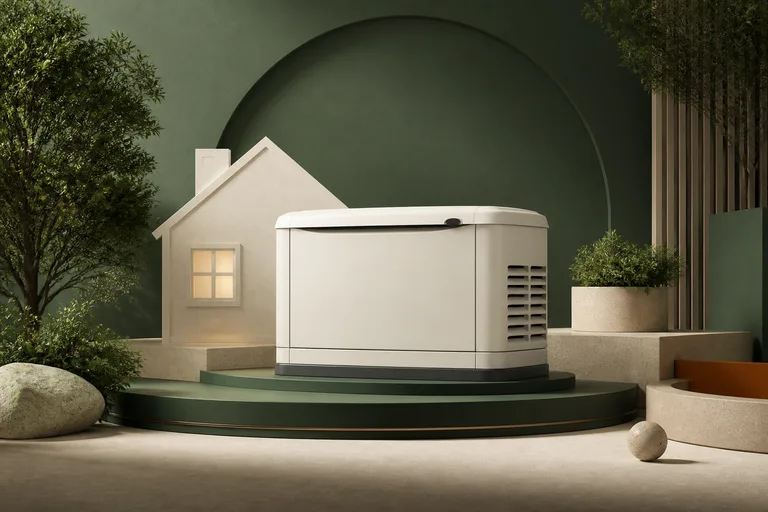
Unlike a portable generator, you don't need to wheel it outside, fill it with gasoline, run extension cords or manually start it during an outage. A standby system sits outside the home, connects to a permanent fuel source such as natural gas or propane, and works with an automatic transfer switch (ATS) to move your home's electrical load from the utility grid to generator power.
For homeowners who regularly experience hurricanes, severe storms, grid failures or extended outages, that convenience is the main reason to consider one.
But buying the biggest generator available is rarely the right answer.
The right system depends on:
- What you actually want to keep powered
- Your home's electrical load
- Whether you have natural gas or need propane
- Your electrical service and transfer-switch requirements
- Generator location
- Local permit and installation requirements
- Whether you need full-house or managed-load backup
- The quality of the local installer who will support it
This guide explains the entire decision before you start comparing individual generators or requesting installation quotes.
What Is a Whole House Generator?
A whole house generator is a stationary backup generator installed outside your home and connected to its electrical system.
Most residential systems use natural gas or liquid propane. When utility power fails, the automatic transfer switch detects the outage, isolates the home from the utility supply and signals the generator to start.
Once the generator is ready, the ATS transfers the selected electrical loads onto generator power.
When utility power returns, the process reverses automatically.
In practical terms, a properly designed standby system can keep equipment such as your:
- Refrigerator and freezer
- Lights
- HVAC system
- Well pump
- Sump pump
- Internet equipment
- Security system
- Garage door
- Medical equipment
- Cooking appliances
- Washer and dryer
running without you having to set up a portable generator every time the grid goes down.
Whole House Generator vs. Home Standby Generator
You'll see whole house generator, whole home generator, home standby generator and backup generator used interchangeably.
For most homeowners researching residential backup power, they describe the same basic category: a permanently installed generator that can automatically power some or all of a home during an outage.
There is, however, a useful distinction when you're actually specifying a system.
A generator can be installed as:
Whole-home backup
The system is sized and configured to supply essentially the entire house under the expected load.
This is the simplest user experience but may require a larger generator, more fuel capacity and a more expensive installation.
Managed whole-home backup
The generator is connected to the house, but load-management controls prevent several high-demand appliances from operating simultaneously.
For example, the system may temporarily prevent an electric water heater from running while a large air-conditioning compressor starts.
This can allow a smaller generator to support a surprisingly large home.
Essential-circuit backup
Only selected circuits are powered.
You might prioritise refrigeration, lighting, a well pump, one HVAC system, internet and a few outlets while leaving high-demand equipment off generator power.
This usually reduces the generator capacity required.
The important decision isn't whether a product is marketed as "whole house." It's whether the complete system can safely support the loads you expect to use during an outage.
How Does a Whole House Generator Work?
A residential standby system has several important components.
1. The generator
This contains the engine and alternator that produce electricity.
Residential units are commonly rated in kilowatts (kW).
2. The fuel supply
Most residential standby generators operate on:
- Natural gas
- Liquid propane
Larger or specialist systems may use diesel.
3. Automatic transfer switch
The ATS monitors utility power and controls the transfer between the grid and generator.
This is a critical part of the system, not an optional convenience.
It prevents generator power from being fed back into utility lines and allows the home to transition safely onto backup power.
4. Electrical connection
The generator must be integrated with the home's electrical service and distribution system.
The design varies depending on whether you're backing up the complete electrical service, selected circuits or using load management.
5. Generator pad and site preparation
Standby generators are normally installed on an appropriate base outside the home.
The final location needs to account for manufacturer requirements, exhaust, openings into the building, fuel supply, electrical routing and local code.
6. Load-management equipment
Some systems use control modules to manage large loads rather than simply installing a much larger generator.
This is one of the areas worth discussing with an installer because it can materially change both generator size and project cost.
What Size Whole House Generator Do I Need?
There isn't a reliable universal answer based purely on square footage.
Two 2,500-square-foot houses can have completely different electrical demands.
A home with gas heating, a gas water heater and one modest air conditioner may need substantially less backup capacity than a similar-sized all-electric home with multiple HVAC systems, electric water heating, a well pump, pool equipment and an EV charger.
Generator sizing should start with the loads you intend to power.
High-demand equipment commonly includes:
- Central air conditioning
- Heat pumps
- Electric furnaces
- Well pumps
- Electric water heaters
- Electric ovens and ranges
- Clothes dryers
- Pool and spa equipment
- Large refrigeration systems
- EV charging equipment
Motor-driven equipment also has to be considered differently from a simple resistive load because motors can require considerably more power while starting.
Typical residential standby-generator sizes
Residential standby units commonly fall into ranges such as:
| Generator size | Typical use |
|---|---|
| Around 10–14 kW | Essentials or relatively low-load homes |
| Around 18–20 kW | Broader household backup |
| Around 22–26 kW | Common whole-home / managed whole-home range |
| 30 kW+ | Larger homes and heavier electrical loads |
| 40–60+ kW | Very large homes or unusually demanding applications |
These are orientation ranges, not sizing recommendations.
A 26 kW generator isn't automatically right for a large house, and a smaller generator isn't automatically inadequate.
The better question is:
What is my expected simultaneous electrical load during an outage?
Use our Generator Size Calculator for an initial estimate, then have the final system verified against your actual electrical loads and installation requirements.
For a deeper explanation, see What Size Generator Do I Need?.
Full-Power vs. Load-Managed Systems
This is one of the most useful decisions to understand before shopping.
Imagine your house could theoretically demand 35 kW if every major electrical appliance operated at once.
That doesn't necessarily mean you need a 35 kW generator.
A load-management system may allow a smaller generator to serve the home by prioritising loads.
For example:
- The air conditioner starts.
- The system temporarily prevents another heavy load from starting.
- Once available generator capacity increases, the second load is restored.
For many homeowners, this creates a better economic trade-off than buying enough generator capacity to cover a rare worst-case scenario where every major load runs simultaneously.
However, if uninterrupted operation of all heavy loads is important, a larger system may make more sense.
This is why generator sizing and system design are related, but they are not the same thing.
Natural Gas vs. Propane Whole House Generators
Most home standby buyers will choose between natural gas and propane.
Natural gas
Natural gas is attractive because the generator can connect to an existing utility gas supply.
That means you don't have to store fuel on site or arrange tank refills during a long outage.
Advantages include:
- Continuous utility-supplied fuel
- No large propane tank
- No manual refuelling
- Convenient long-duration operation
But availability isn't the only consideration.
Your existing gas meter and piping must be capable of supplying the generator in addition to other gas appliances. Some installations therefore require gas-service upgrades.
Propane
Propane gives you a stored fuel supply on your property.
Advantages include:
- Available where natural gas isn't
- Fuel stored on site
- Commonly supported by residential standby generators
- Large tanks can support extended operation
The trade-off is that your outage duration is ultimately limited by the amount of fuel stored.
Fuel use also increases as electrical load increases, so tank sizing matters.
Which fuel is better?
If suitable natural gas service already exists, it is often the most convenient solution.
If natural gas isn't available — or you specifically prefer an independently stored fuel supply — propane can be an excellent option.
The right choice should consider both generator requirements and the reliability/capacity of your local fuel infrastructure.
Air-Cooled vs. Liquid-Cooled Generators
You'll also encounter air-cooled and liquid-cooled standby generators.
Air-cooled generators
These dominate mainstream residential standby installations.
They are generally:
- Smaller
- Simpler
- Less expensive
- Easier to install
- Available in capacities suitable for many homes
Modern residential air-cooled units are commonly available into the mid-20-kW range.
Liquid-cooled generators
Liquid-cooled systems are closer in design philosophy to automotive engines.
They become relevant where a property needs:
- Higher output
- Extended heavy-load operation
- A larger residence
- More demanding electrical systems
- Capacity beyond mainstream air-cooled units
They can also cost materially more to purchase, install and maintain.
For an ordinary residential property, don't assume liquid cooling is automatically "better."
It is normally a system requirement, not an upgrade checkbox.
How Much Does a Whole House Generator Cost?
A professionally installed whole house generator is a significant home project.
For many residential installations, a useful starting expectation is roughly:
$8,000–$16,000 installed
But that range can move substantially in either direction.
The generator itself is only part of the price.
Your final project may include:
- Generator
- Automatic transfer switch
- Load-management equipment
- Concrete or composite pad
- Electrical work
- Gas piping
- Propane equipment
- Gas-meter upgrades
- Trenching
- Permits
- Inspections
- Delivery
- Labour
- Site-specific electrical upgrades
Large liquid-cooled systems can push considerably beyond mainstream residential budgets.
One of the biggest mistakes buyers make is comparing generator equipment prices against another company's installed system quote.
They are not the same thing.
A smaller generator also doesn't necessarily produce proportionally lower installation costs because much of the electrical, fuel, permitting and site work may still be required.
See our full Whole House Generator Cost Guide for current equipment and installation cost breakdowns.
What Does Installation Involve?
Whole house generator installation is usually a multi-trade project.
The exact process varies, but commonly looks like this.
Site assessment
An installer evaluates:
- Electrical service
- Generator loads
- Fuel supply
- Generator location
- Utility connections
- Distances and clearances
- Access
- Local requirements
Generator sizing
The required loads are identified and a generator/load-management configuration is selected.
Permitting
Depending on the jurisdiction and scope of work, permits and inspections may be required for electrical, fuel-gas, plumbing or building work.
Site preparation
The generator location is prepared and an appropriate base installed.
Fuel connection
The generator is connected to natural gas or propane.
This can involve new piping, tank work or utility upgrades.
Electrical installation
A licensed electrical professional integrates the generator and transfer switch with the home's electrical system.
Commissioning and testing
Once installation is complete, the system should be tested under appropriate conditions to confirm that the generator, transfer switch and selected loads operate as intended.
Read the full Generator Installation Guide before comparing installer quotes.
Automatic Transfer Switches Explained
The automatic transfer switch is what makes a standby generator a genuinely automatic backup-power system.
During normal operation, your home receives electricity from the utility.
When an outage occurs, the ATS detects the loss of utility power and signals the generator to start.
Once generator power is ready, the switch disconnects the relevant electrical loads from the utility and transfers them to the generator.
When normal utility service returns, the ATS transfers the loads back and the generator shuts down.
Transfer switches are available in different configurations and amperages.
A whole-house installation may use a service-rated ATS matched to the home's electrical service, while another design may back up only selected circuits.
Learn more in our Generator Transfer Switch Guide.
Whole House Generator vs. Portable Generator
A large portable generator can provide substantial emergency power for far less money than a standby installation.
The trade-off is convenience and automation.
| Whole house standby generator | Portable generator |
|---|---|
| Permanently installed | Mobile |
| Automatic operation | Usually manually started |
| Natural gas or propane common | Gasoline, propane and multi-fuel common |
| Automatic transfer switch | Requires suitable connection method |
| Can provide broad home backup | Commonly prioritises selected loads |
| Higher installation cost | Lower upfront cost |
| No setup during outage | Requires outage-time setup |
| Designed as permanent infrastructure | Can be used elsewhere |
A portable generator can make more financial sense if outages are rare and you're comfortable manually managing backup power.
A standby generator makes more sense where automatic restoration, long outages or critical household loads justify the additional cost.
Whole House Generator vs. Home Battery
Generators are no longer the only serious option for automatic home backup.
Home batteries can provide silent backup without combustion or fuel storage.
The two technologies solve the same problem differently.
Standby generator strengths
- Can operate for extended periods while fuel is available
- Strong fit for long-duration outages
- High power output available
- Mature installer/service ecosystem
Home battery strengths
- Quiet
- No combustion engine
- Instant electronic switchover
- Can integrate with solar
- Minimal fuel logistics
For short outages and solar-equipped homes, battery storage can be compelling.
For multi-day outages with large household loads, a generator may still be the more practical solution — or a hybrid generator/battery system may make sense.
See Generator vs. Home Battery Backup for the full comparison.
Major Whole House Generator Brands
The US residential standby market includes several established manufacturers.
Generac
Generac has one of the broadest residential standby line-ups and an extensive dealer network.
See our Generac Generator Guide.
Kohler
Kohler home generators are widely considered alongside Generac in premium residential installations and are offered across multiple standby capacities.
See our Kohler Generator Guide.
Cummins
Cummins offers residential standby systems alongside its much broader commercial and industrial power-generation business.
See our Cummins Generator Guide.
Briggs & Stratton
Briggs & Stratton offers its PowerProtect residential standby range across several common residential capacities.
Other brands and alternative whole-home backup products also exist.
The best choice isn't necessarily the brand with the strongest advertising.
Local installation and service support matter.
A technically good generator with weak dealer coverage in your area may be a worse long-term purchase than a comparable system supported by an experienced local installer.
What Should You Compare Between Generators?
Once you've established the required system capacity, compare generators on more than kW output.
Useful factors include:
Fuel compatibility
Natural gas, propane or both.
Rated power
Make sure you're comparing capacity under the fuel you actually intend to use.
Cooling system
Air-cooled or liquid-cooled.
Transfer switch
What is included and what does your installation require?
Load management
Can the system intelligently control high-demand loads?
Noise
Particularly important where the generator will sit near living areas or neighbouring properties.
Warranty
Look at both duration and what is actually covered.
Monitoring
Many modern systems offer remote status and maintenance alerts.
Installer network
Who will install, maintain and repair it locally?
Parts availability
Backup equipment isn't much use if a failed component is difficult to obtain.
Maintenance requirements
Understand the service schedule before buying.
Are Whole House Generators Worth It?
They can be — but not for everyone.
A whole house generator tends to make the strongest financial and practical sense when:
- Your area experiences regular outages
- Outages commonly last many hours or days
- You have a well or other essential electrically powered systems
- You need heating or cooling during outages
- Someone in the home relies on powered medical equipment
- You work from home and downtime is expensive
- The property is frequently vacant and needs automatic protection
- Frozen pipes, flooding or food loss create significant outage risk
- You value automatic backup enough to justify the installation cost
It may make less sense where:
- Outages are extremely rare
- A few essential circuits are sufficient
- A portable generator already meets your needs
- Battery backup better matches your outage profile
- The installation would require unusually expensive site upgrades
The honest comparison is not:
"Is a $10,000 generator worth $10,000?"
It's:
"What does an extended outage cost or disrupt for this particular household, and how often is that likely to happen?"
Disadvantages of Whole House Generators
Standby generators are convenient, but they're not maintenance-free magic boxes.
The main disadvantages are:
High upfront cost
Professional installation can cost as much as — or more than — the generator equipment itself.
Maintenance
Combustion engines require periodic servicing.
Oil, filters, batteries and other components need attention according to the manufacturer's maintenance schedule.
Fuel requirements
Natural gas systems depend on adequate utility fuel service.
Propane systems depend on stored fuel.
Noise
Standby generators are quieter than many large portables but still produce noticeable engine and exhaust noise.
Space
The unit needs a suitable outdoor location.
Installation complexity
Electrical, fuel, site and permitting requirements can make seemingly similar installations very different projects.
Carbon monoxide
A stationary generator still produces combustion exhaust containing carbon monoxide.
Correct placement and professional installation matter.
Never treat a permanently installed generator as automatically free of CO risk.
Generator Safety and Placement
A standby generator must be installed outdoors in a location that satisfies the generator manufacturer's instructions and all applicable local requirements.
Placement needs to account for potential exhaust entry points such as:
- Windows
- Doors
- Vents
- Soffits
- Crawl-space openings
Homes using combustion equipment should also have appropriate carbon-monoxide detection.
Because generator-clearance and permitting requirements can vary by equipment and jurisdiction, use the applicable manufacturer's installation instructions and local authority requirements rather than relying on a generic distance found online.
How Long Can a Whole House Generator Run?
A properly maintained standby generator can support an extended outage, but there is no universal maximum runtime.
Actual endurance depends on:
- Generator model
- Electrical load
- Fuel source
- Fuel availability
- Ambient conditions
- Required maintenance intervals
Natural-gas systems benefit from a utility-supplied fuel source as long as gas service remains available.
Propane systems are limited by tank capacity and consumption.
For a multi-day outage, fuel planning and maintenance matter just as much as generator wattage.
Do Whole House Generators Require Maintenance?
Yes.
A standby generator spends most of its life waiting for an outage, which makes routine maintenance particularly important.
Depending on the system, maintenance can include:
- Engine oil changes
- Oil-filter replacement
- Air-filter inspection/replacement
- Spark-plug service
- Battery checks
- Fuel-system inspection
- Exercise-cycle checks
- Software/monitoring checks
- General inspection
Follow the schedule specified for your actual generator rather than a generic maintenance interval.
If you're buying through an installer, ask what annual servicing costs and what local emergency repair support is available.
How to Choose a Whole House Generator
Don't start with the logo on the enclosure.
Use this order instead.
1. Decide what needs backup power
Whole home, managed whole home or essentials?
2. Calculate your electrical load
Pay particular attention to motors, HVAC and other large 240-volt loads.
3. Decide how loads will be managed
This can materially reduce the generator capacity required.
4. Determine your fuel options
Natural gas, propane or another appropriate fuel source.
5. Identify a realistic generator capacity
Use a calculator as a starting point and have the final design properly verified.
6. Compare suitable brands and models
Only now does product comparison become useful.
7. Compare installers
The installer matters nearly as much as the equipment.
Compare:
- Experience
- Licensing where required
- Brand familiarity
- Warranty support
- Maintenance capability
- Quote detail
- Permit handling
- Fuel work
- Electrical work
- Response times
8. Compare total installed price
Don't compare bare equipment cost with turnkey quotes.
9. Understand ongoing ownership costs
Fuel, maintenance and eventual component replacement should be part of the decision.
Start With Sizing, Not Brand
If you're at the beginning of the buying process, don't start by asking whether Generac, Kohler or Cummins is best.
Start with:
What do I need to power?
Then determine:
How much capacity does that require?
Then:
What fuel and system configuration makes sense?
Only after those decisions should you compare individual generators.
Next steps
Calculate your generator size →
See whole house generator costs →
Whole House Generator FAQs
What size generator will run an entire house?
There isn't one generator size that fits every house. The correct size depends on the electrical loads you intend to operate simultaneously, particularly HVAC, pumps, water heating and other high-demand equipment. A load-managed system may also allow a smaller generator to support a larger home.
How much does a whole house generator cost?
A useful starting range for many professionally installed residential standby systems is roughly $8,000 to $16,000, but larger generators and complex installations can cost substantially more. Generator size, transfer-switch requirements, fuel work, trenching, electrical upgrades, permits and location all affect the total.
Is a whole house generator worth it?
It is most compelling for homes exposed to frequent or extended outages, properties with critical electrical loads, and homeowners who value fully automatic backup. For occasional short outages, a portable generator or battery system may be more economical.
What are the disadvantages of a whole house generator?
The main drawbacks are purchase and installation cost, ongoing maintenance, fuel requirements, outdoor-space requirements, noise and installation complexity.
Does a whole house generator turn on automatically?
A properly configured standby system with an automatic transfer switch can detect an outage, start the generator and transfer the home's selected loads to generator power automatically.
Can a whole house generator run central air conditioning?
Yes, if the generator and electrical system are properly sized for the HVAC equipment's running and starting requirements. Large air-conditioning compressors can be among the most demanding loads in a home.
Is natural gas or propane better for a standby generator?
Neither is universally better. Natural gas offers a convenient utility-supplied fuel source where service is adequate. Propane allows fuel to be stored on the property and is useful where natural gas isn't available.
What's the difference between a portable and standby generator?
A standby generator is permanently installed and designed to operate automatically through a transfer switch. A portable generator is movable, normally requires manual setup and generally costs much less upfront.
Which whole house generator brand is best?
Generac, Kohler, Cummins and Briggs & Stratton are all established names in residential standby power. The right choice depends on the required capacity, features, price and — importantly — installer and service support available in your area.