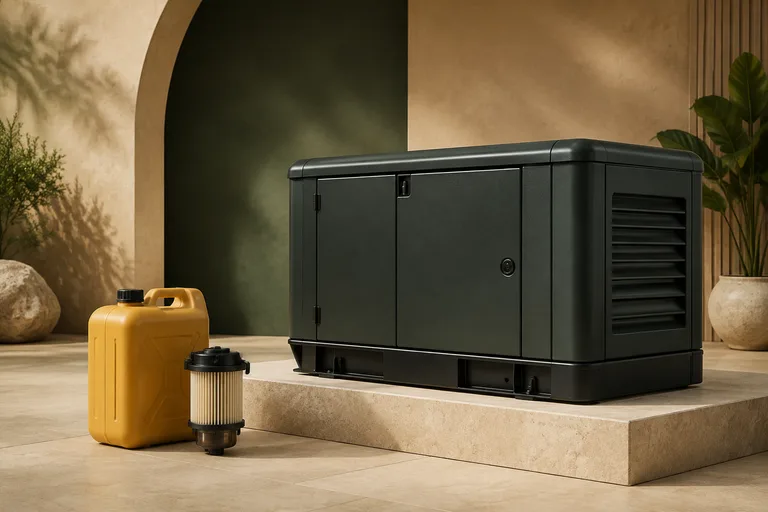
A diesel generator is usually not our default recommendation for a typical suburban home.
For most homeowners with practical access to natural gas or propane, a conventional gaseous-fuel standby generator is normally:
- easier to source
- simpler to integrate into the residential market
- available across more mainstream home-backup configurations
- less dependent on storing and managing liquid fuel
But diesel becomes much more interesting when the job changes.
We would seriously consider diesel when:
- the property needs larger sustained backup loads
- natural gas is unavailable
- propane is impractical or unattractive
- onsite liquid-fuel storage is desirable
- the generator may run for prolonged periods
- the application is a large home, farm, estate or mixed residential/light-commercial property
- 1,800-rpm liquid-cooled equipment is a better fit than a mainstream air-cooled standby generator
The useful question is therefore not:
"Are diesel generators better?"
It is:
"Is this property demanding the kind of backup system diesel is particularly good at?"
Diesel Generator: Quick Verdict
| Factor | Diesel Standby Generator |
|---|---|
| Best fit | Large homes, farms, estates, light commercial, long-run backup |
| Fuel storage | Onsite tank |
| Runtime | Limited by stored fuel, but can be very long with large tanks |
| Fuel availability | Independent of natural-gas utility |
| Main residential weakness | More specialised and usually more expensive than mainstream gaseous standby |
| Engine configuration | Commonly liquid-cooled on larger residential/light-commercial systems |
| Typical duty | Strong for sustained loads and long operating periods |
| Cold weather | Needs appropriate fuel and cold-weather design |
| Fuel ageing | Requires more management than propane |
| Refuelling | Delivery or onsite fuel logistics |
| Our default home recommendation | Only when the application justifies it |
For a normal 18-26 kW residential standby job with good NG or propane infrastructure, diesel is usually not the first system we would quote.
For a 30-50 kW estate, farm or large custom home where sustained backup and onsite fuel matter, it deserves a proper comparison.
What Is a Diesel Standby Generator?
A diesel standby generator uses a compression-ignition diesel engine connected to an alternator.
For permanent home backup, the system normally includes:
- diesel generator
- onsite fuel tank
- automatic transfer switch
- electrical integration
- fuel system
- starting battery
- exhaust and ventilation systems
When utility power fails, the generator starts automatically and the transfer system moves the selected electrical load onto generator power.
The important difference from natural gas is fuel storage.
A natural-gas generator normally depends on a utility pipeline.
A diesel generator carries its energy reserve onsite.
Does Generac Still Make Diesel Home Standby Generators?
Yes.
Generac currently lists diesel Protector standby generators for residential/light-commercial use, including current 15 kW, 20 kW, 30 kW and 50 kW models. Its current 20 kW RD02025 is marketed as a residential/light-commercial diesel standby generator, while the current 50 kW RD05033 is available as a single-phase 120/240 V unit suitable for larger residential applications.
Current starting MSRPs visible from Generac include approximately:
- 20 kW RD02025: $15,579
- 30 kW diesel: $17,329
- 50 kW RD05033: $20,779
Those are equipment MSRPs, not installed costs.
Current Generac Diesel Generator Sizes
Generac's current diesel category includes multiple configurations around:
- 15 kW
- 20 kW
- 30 kW
- 50 kW
Current Protector diesel systems use inline four-cylinder engines and, in the represented 15-50 kW family, operate at 1,800 rpm. Generac positions the line for applications including larger homes, guest houses, farms and small businesses.
That immediately tells you who diesel is aimed at.
This is not primarily the market for someone trying to back up:
- refrigerator
- a few lights
- one small AC
It's equipment designed to make sense when backup demand gets serious.
What Size Diesel Generator Do I Need?
Exactly the same sizing rule applies as with natural gas or propane:
calculate the actual electrical load.
Do not size a diesel generator from square footage.
The process is:
- identify required outage loads
- calculate running watts
- account for motor starting demand
- decide what can be load managed
- add sensible headroom
- compare the result with the generator's actual rated output
Use our generator size calculator for the first-pass estimate.
Diesel does not remove the need for proper sizing.
If anything, oversizing becomes more expensive because you are dealing with larger, heavier equipment and larger fuel infrastructure.
Why Diesel Is Interesting for Larger Loads
Current residential/light-commercial diesel units often use liquid-cooled industrial-style engines rather than the smaller air-cooled architecture common in mainstream home standby generators.
Generac's represented Protector diesel family uses:
- inline four-cylinder engines
- 1,800-rpm operation
- liquid-fuel storage
- larger physical platforms
That design is well suited to:
- sustained high loads
- long operating periods
- larger properties
- mixed residential/commercial applications
It does not mean every diesel generator is automatically more reliable.
It means the equipment class is different.
1,800 RPM vs 3,600 RPM
Many larger standby diesel generators operate at 1,800 rpm, including the represented Generac Protector diesel family.
Lower engine speed is commonly associated with larger liquid-cooled standby equipment intended for sustained operation.
But do not reduce that to:
"1,800 rpm always lasts twice as long."
We do not have a credible universal lifespan multiplier that supports that claim.
The useful conclusion is:
1,800-rpm liquid-cooled equipment is a different duty class from the smaller engines common in residential air-cooled standby systems.
How Much Diesel Does a Whole-House Generator Use?
Fuel consumption depends on:
- generator size
- electrical load
- engine
- operating conditions
Generac's Protector diesel data gives useful manufacturer examples:
| Diesel Generator | 50% Load | Full Load |
|---|---|---|
| 15 kW | 0.85 gal/hr | 1.46 gal/hr |
| 20 kW | 1.03 gal/hr | 1.97 gal/hr |
| 30 kW | 1.37 gal/hr | 2.77 gal/hr |
| 48/50 kW | 2.02 gal/hr | 4.02 gal/hr |
These are manufacturer-published figures for the represented Protector diesel family.
The relationship is obvious but important:
bigger generator + higher load = more fuel.
A 50 kW diesel running near full load can burn roughly twice as much fuel per hour as the represented 20 kW unit.
How Much Does a Diesel Generator Cost to Run?
As of August 24, 2026, EIA reported the US average retail on-highway diesel price at $5.652 per gallon including taxes. That is a current retail benchmark, not a generator-fuel quote; off-road, delivered or bulk diesel pricing may differ materially.
Using that retail benchmark purely for illustration:
Generac 20 kW Diesel
At 50% load:
1.03 gal/hr × $5.652 = about $5.82/hour
At full load:
1.97 gal/hr × $5.652 = about $11.13/hour
Generac 30 kW Diesel
At 50% load:
1.37 gal/hr × $5.652 = about $7.74/hour
At full load:
2.77 gal/hr × $5.652 = about $15.66/hour
Generac 50 kW Diesel
At 50% load:
2.02 gal/hr × $5.652 = about $11.42/hour
At full load:
4.02 gal/hr × $5.652 = about $22.72/hour
These are illustrative fuel-only calculations.
They do not include:
- delivery
- tank ownership
- taxes specific to your fuel source
- generator installation
- maintenance
- local price differences
- actual fluctuating electrical load
And using on-highway retail diesel can overstate or misrepresent what some standby-generator owners actually pay for delivered bulk fuel.
The point is not that diesel "costs exactly $11.13/hour."
The point is that fuel consumption needs to be modelled against your actual local diesel supply.
How Long Will a Diesel Generator Run?
Runtime is:
usable fuel ÷ fuel consumption
That makes diesel similar to propane in one important respect:
you have a finite onsite energy reserve.
But tank options can be substantial.
Generac's current 20 kW diesel page advertises an extended-tank option with more than two days of full-load runtime, and earlier Protector literature documented integrated base-tank options providing more than 90 hours at half load on represented configurations.
That is very different from carrying five-gallon cans to a portable generator.
Example Diesel Runtime
Take the represented 20 kW consumption:
- 1.03 gal/hr at half load
- 1.97 gal/hr at full load
If you had 100 usable gallons:
50% Load
100 ÷ 1.03 = approximately:
97 hours
or:
about 4 days
Full Load
100 ÷ 1.97 = approximately:
51 hours
or:
about 2.1 days
Now use 200 usable gallons and the theoretical runtime approximately doubles.
These are simple arithmetic examples.
Real operation depends on:
- tank usable capacity
- actual load
- maintenance
- fuel condition
- environmental conditions
What Size Diesel Tank Do I Need?
Tank size should be based on:
- generator consumption
- desired outage duration
- expected generator load
- refill access
- local code
- site constraints
For a serious resilience installation, decide the desired autonomy first.
Examples:
- 24 hours
- 48 hours
- 72 hours
- one week
Then calculate required usable fuel from the generator's published consumption.
Do not buy a tank first and ask what runtime it gives afterwards.
Diesel Base Tanks
Larger standby diesel generators can be configured with integrated base tanks, meaning the generator enclosure/platform sits above the fuel storage.
Current Generac Protector diesel systems offer code-ready fuel-tank configurations, including double-wall base-tank options. Generac specifically highlights external vent/fill provisions and UL/CUL 142-listed tank configurations on current Protector diesel products.
That can simplify certain installations.
It does not remove:
- local code
- spill-control requirements
- fuel delivery access
- inspection
- environmental considerations
Diesel Generator vs Natural Gas
Natural Gas Usually Wins When:
- adequate gas utility service exists
- lower current operating cost matters
- avoiding onsite liquid-fuel storage matters
- long utility-fed operation is desirable
Diesel Wins When:
- onsite fuel independence matters
- utility gas is unavailable
- large sustained loads favour heavier-duty equipment
- the property already manages diesel fuel
- commercial-style standby equipment is appropriate
For most normal suburban houses, I would still start with natural gas generators before diesel.
For an estate or farm, I would not dismiss diesel nearly as quickly.
Diesel Generator vs Propane
This is the more interesting off-grid-style fuel comparison.
Propane Advantages
- excellent long-term fuel storage
- strong residential standby ecosystem
- no liquid diesel ageing issue
- often simpler residential acceptance
- existing propane infrastructure is common in rural homes
Diesel Advantages
- strong larger-generator market
- high energy density
- substantial onsite storage possible
- well suited to large sustained loads
- familiar fuel on farms and commercial properties
For a typical rural home below the larger commercial-style capacity range, propane would still usually be our first quote.
For a large farm, estate or property already storing diesel, that can flip.
Diesel Generator vs Home Battery
A diesel generator and home battery sit at opposite ends of the backup-power spectrum.
A battery gives you:
- silent operation
- stored electricity
- low routine mechanical maintenance
- solar integration
Diesel gives you:
- substantial ongoing generation
- long-duration capability through refuelling
- much larger total energy throughput
For short outages, battery can be cleaner and easier.
For prolonged high-load outages, diesel can keep generating as long as fuel remains available.
See our generator vs home battery comparison.
Is Diesel Better for a Farm?
Often, yes.
Diesel becomes much more compelling on farms because:
- diesel may already be stored onsite
- large electrical loads may exist
- long outages can have substantial financial consequences
- pumps, refrigeration, milking and other equipment may need prolonged support
Generac specifically lists farms and milking parlours among the represented applications for its Protector diesel line.
This is exactly the type of use case where residential-style "which 22 kW generator?" advice stops being enough.
Is Diesel Better for a Large Home?
Potentially.
For a large estate requiring:
- 30 kW
- 40 kW
- 50 kW+
of real sustained backup capacity, diesel deserves consideration alongside:
- large propane systems
- large natural-gas systems
- liquid-cooled gaseous generators
Current Generac diesel equipment exists at 30 kW and 50 kW, including single-phase residential-compatible configurations.
At that point, the decision becomes:
which complete engineered system gives the best resilience, service and fuel logistics?
Not:
which fuel sounds nicest?
Is Diesel Good for Hurricanes?
Diesel can be very strong for hurricane resilience when:
- a substantial tank is filled before the storm
- the tank/system is appropriately installed
- fuel remains accessible
- the property has large sustained loads
Its advantage is stored energy.
Its weakness is resupply.
During a widespread event, diesel delivery can become difficult for exactly the same reasons propane delivery can:
- road closures
- supplier demand
- infrastructure disruption
The bigger your onsite reserve before the event, the less dependent you are on immediate resupply.
Does Diesel Go Bad?
Yes, diesel storage requires more management than propane.
Over long storage periods, diesel can be affected by issues such as:
- oxidation
- water contamination
- microbial growth
- sediment
- fuel-quality degradation
That makes fuel management part of standby-generator ownership.
This is one of propane's meaningful advantages for a residential system that may go long periods without consuming much fuel.
A diesel tank is not:
"fill it once and forget it for ten years."
How Long Can Diesel Be Stored?
There is no universal storage-life number we would publish without defining:
- fuel composition
- temperature
- tank condition
- contamination
- additives
- turnover
The safer operational rule is:
stored diesel needs an actual fuel-management plan.
That can include:
- regular inspection
- water control
- fuel rotation
- conditioning/treatment where appropriate
- tank maintenance
For a property already consuming diesel elsewhere, turnover can solve much of this.
For a home where the generator is the only diesel consumer, storage deserves more attention.
What Is Diesel Fuel Polishing?
Fuel polishing is a process used to remove contaminants such as:
- water
- sediment
- microbial contamination
from stored diesel.
It is more relevant to larger long-term storage systems than to mainstream residential propane installations.
Whether it is justified depends on:
- tank size
- fuel age
- contamination
- application criticality
Do not buy a recurring fuel-polishing contract merely because the phrase sounds technical.
Test and manage the actual fuel condition.
Diesel Generator Cold-Weather Operation
Diesel systems need appropriate cold-weather planning.
Issues can include:
- fuel behaviour at low temperatures
- battery performance
- engine starting
- oil viscosity
Generac has offered Protector diesel cold-weather kits including a block heater and thermostatically controlled battery warmer for installations where temperature regularly falls below 32°F / 0°C.
That tells you something important:
cold-weather capability is an engineered feature, not an assumption.
If the generator is being purchased for winter resilience, price the required cold-weather equipment in from day one.
Does Diesel Gel in Cold Weather?
Diesel can develop cold-flow problems at low temperatures depending on fuel formulation and conditions.
That is one reason winter diesel systems may require:
- seasonally appropriate fuel
- heating equipment
- fuel-management practices
The exact threshold varies too much with fuel formulation to publish one universal temperature as though every diesel behaves identically.
Are Diesel Generators Noisy?
Larger diesel generators are not silent.
Generac's represented 15-50 kW Protector data lists approximately:
- 65 dB(A) during exercise
- 70 dB(A) at normal operating load
for the represented family.
That is manufacturer specification data, not an independent head-to-head test against every gaseous standby unit.
Site placement still matters enormously.
If noise is a major buying criterion, a home battery is in another league entirely.
Diesel Generator Maintenance
Diesel generators require scheduled mechanical maintenance.
Depending on the equipment, this can include:
- engine oil
- oil filter
- fuel filters
- air filter
- coolant
- starter battery
- belts/hoses
- fuel-system inspection
- tank/fuel quality
This is generally a more involved maintenance proposition than a small residential air-cooled generator.
But larger diesel equipment is also built for a different duty class.
Do not compare service complexity without comparing the job being performed.
Diesel Fuel Filters Matter
Unlike a utility-fed gaseous generator, a diesel generator stores and handles liquid fuel.
That puts greater importance on:
- fuel filtration
- water control
- contamination
- tank condition
If stored diesel is contaminated, the engine does not care that the generator was expensive.
Fuel quality is part of generator reliability.
Diesel Generator Installation Cost
Diesel standby installation can involve:
- generator equipment
- tank
- fuel piping
- spill/containment requirements
- exhaust
- electrical work
- automatic transfer switch
- pad/foundation
- delivery/rigging
- permits
- commissioning
The equipment itself is also more expensive than many mainstream air-cooled residential generators.
Current Generac examples start around the mid-$10,000s for equipment before installation, including roughly $15,579 for the current 20 kW diesel and $20,779 for the current 50 kW single-phase unit.
That is why diesel needs a job.
Buying it because "diesels are tough" is not enough.
Automatic Transfer Switch
A permanent diesel standby generator still requires appropriate transfer equipment.
Generac's represented Protector diesel specification explicitly notes that an automatic transfer switch is not included in the generator specification.
So when comparing prices, confirm whether the quote includes:
- ATS
- service entrance equipment
- installation
- load management
- commissioning
Do not compare a bare diesel-generator MSRP against a packaged gaseous standby quote and call one cheaper.
Diesel Generator Warranty
Generac currently publishes a 5-year limited warranty for its Protector diesel standby systems.
Warranty terms should still be checked for the exact model because:
- labour
- travel
- maintenance
- consumables
- exclusions
can differ from the headline duration.
Warranty length is also not the same thing as expected generator life.
Are Diesel Generators More Reliable?
We would not publish that as a universal claim.
Diesel engines have an excellent reputation in many heavy-duty applications.
That is not the same thing as a credible residential standby failure-rate dataset proving diesel generators fail less often than natural-gas or propane generators.
Real-world reliability depends on:
- engine
- alternator
- fuel quality
- battery
- coolant
- controls
- installation
- maintenance
- service support
Diesel's heavy-duty use case is legitimate.
A fake universal reliability percentage is not.
Diesel Generator Lifespan
You will see very large hour-life claims repeated online for diesel generators.
We would not publish one universal number without manufacturer- or fleet-quality evidence tied to the actual equipment class.
Service life varies with:
- load
- operating hours
- maintenance
- duty cycle
- fuel quality
- environment
- repair economics
A 1,800-rpm liquid-cooled diesel has a different ownership proposition from a small portable generator.
That still does not give us permission to invent a 30,000-hour lifespan.
Who Should Buy a Diesel Generator?
Typical Suburban Home With Natural Gas
Probably not diesel.
Natural gas is normally the cleaner economic and logistical fit.
Rural Home Already Using Propane
Usually propane first.
Propane's storage characteristics and residential ecosystem make it difficult to beat for mainstream home backup.
Farm Already Storing Diesel
Diesel gets very interesting.
Existing fuel logistics remove one of diesel's biggest disadvantages.
Large Estate Needing 30-50+ kW
Diesel deserves a proper quote.
Especially where natural-gas infrastructure is limited.
Property With Mission-Critical Long-Run Loads
Potentially diesel.
But compare it against large liquid-cooled NG/LP systems rather than assuming diesel automatically wins.
Questions to Ask Before Buying a Diesel Generator
Ask:
- Why diesel instead of NG or propane for this property?
- What calculated electrical load requires this generator?
- What is fuel consumption at 50% and full load?
- What tank size are you proposing?
- What usable runtime does that provide?
- Is the tank integrated or separate?
- What fuel-management plan is required?
- What cold-weather equipment is required?
- Is the ATS included?
- What is the annual maintenance requirement?
- Who services this diesel engine locally?
- What does emergency service look like?
- What is the complete installed cost?
- How will the fuel be rotated or maintained?
If the installer cannot answer:
"Why diesel?"
with something more specific than:
"They're more reliable."
I would keep shopping.
Diesel Generator FAQ
Is diesel good for a whole-house generator?
Yes, especially for large homes, farms and prolonged high-load backup. For a typical suburban home with practical natural gas or propane, diesel is usually not our default.
How much diesel does a 20 kW generator use?
Generac's represented 20 kW Protector diesel data lists about 1.03 gal/hour at half load and 1.97 gal/hour at full load.
How much diesel does a 30 kW generator use?
The represented Generac 30 kW Protector consumes about 1.37 gal/hour at half load and 2.77 gal/hour at full load.
How much diesel does a 50 kW generator use?
The represented 48/50 kW Protector data lists about 2.02 gal/hour at half load and 4.02 gal/hour at full load.
How much does a diesel generator cost to run?
It depends on local diesel price, generator size and load. Using the August 24, 2026 EIA on-highway US average of $5.652/gallon purely as an illustration, the represented 20 kW unit works out around $5.82/hour at half load and $11.13/hour at full load.
Can a diesel generator run for several days?
Yes, if enough usable fuel is available and maintenance requirements are met. Current Generac Protector diesel configurations offer extended-tank options, including a current 20 kW option marketed with more than two days of full-load runtime.
Is diesel cheaper than propane?
Not universally. Local delivered fuel prices and generator efficiency matter. Compare actual manufacturer consumption against your local delivered fuel quotes.
Is diesel better than natural gas?
Usually not for a conventional suburban home with adequate NG infrastructure. Diesel becomes more attractive for large loads, onsite fuel independence and properties already managing diesel.
Is diesel better than propane?
For mainstream residential backup we would usually start with propane. Diesel becomes more compelling in larger, heavier-duty or farm/estate applications.
Does stored diesel go bad?
Diesel requires more storage management than propane and can suffer from water, contamination and degradation issues over time.
Do diesel generators work in cold weather?
Yes, when properly configured. Cold-weather accessories such as block heaters and battery warmers are used on diesel standby equipment in colder climates.
Does a diesel generator need an automatic transfer switch?
A permanent automatic standby installation normally does. The represented Generac Protector diesel specifications do not include the ATS with the base generator.
Final Verdict
For the average homeowner, diesel would not be my first whole-house generator fuel choice.
If natural gas is already available, start there.
If natural gas is unavailable but bulk propane is practical, propane is usually the cleaner residential solution.
Diesel starts winning when the property looks less like a normal suburban generator job and more like:
- large estate
- farm
- guest-house compound
- light-commercial property
- large sustained electrical demand
- long-running critical loads
- existing diesel storage/logistics
That is where diesel's heavier-duty equipment and onsite liquid-fuel reserve start earning their additional complexity.
The buying sequence should be:
calculate load → prove diesel has a real advantage → select generator capacity → calculate hourly fuel use → size storage for required autonomy → plan fuel quality/cold weather → verify local diesel service → price the complete installation.
If diesel cannot win that comparison on the actual property, do not buy it simply because diesel engines have a tough reputation.
If it can, then it may be exactly the right tool.
Evidence Basis
Current diesel product claims were checked against Generac's active US Protector diesel product pages and manufacturer specifications. Current products include diesel standby units from 15 kW through 50 kW, with current examples including a 20 kW RD02025 starting at $15,579 and a 50 kW RD05033 starting at $20,779.
Manufacturer fuel-consumption examples come from Generac Protector diesel data showing 0.85/1.46 gal/hr for the represented 15 kW system, 1.03/1.97 for 20 kW, 1.37/2.77 for 30 kW and 2.02/4.02 for 48/50 kW at half/full load respectively.
The illustrative operating-cost examples use EIA's August 24, 2026 US average on-highway diesel retail price of $5.652/gallon. That is a current public retail benchmark, not a quote for delivered standby-generator fuel.