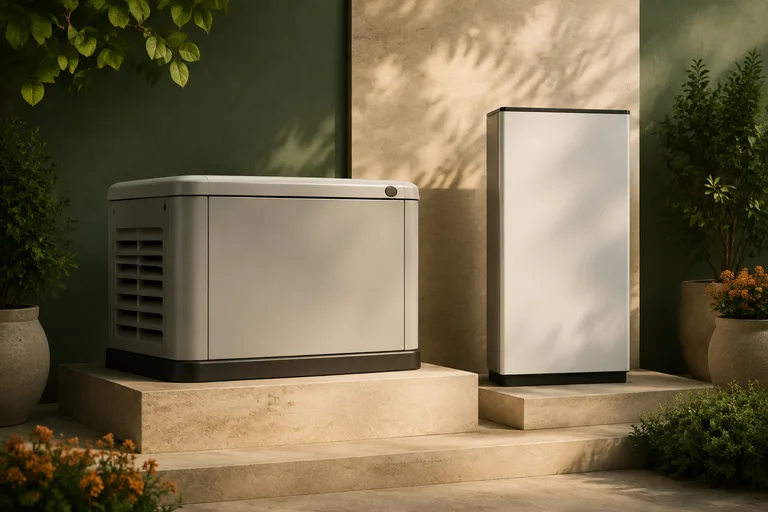
For most homeowners choosing backup power in 2026, a whole-house standby generator is the stronger choice for long outages and large electrical loads, while a home battery is better for short outages, silent operation and homes that can recharge from solar.
If your main concern is keeping a large house running through a multi-day outage, we would usually choose the generator.
If outages are normally short, you already have solar, or you value silent automatic backup more than essentially open-ended runtime, the battery becomes much more attractive.
And for a high-budget home where resilience actually matters, the strongest system can be both: batteries handle short outages and everyday energy use, while a generator handles extended outages after stored battery energy runs low.
The wrong way to compare them is generator kW versus battery kWh.
Those numbers describe different things.
A generator produces electricity while it has fuel.
A battery stores a finite amount of electricity and then has to be recharged.
That distinction drives almost everything else.
Generator vs Home Battery: Quick Verdict
| Factor | Whole-House Generator | Home Battery Backup |
|---|---|---|
| Best for | Long outages, large loads | Short outages, solar homes, silent backup |
| Energy source | Natural gas or propane | Stored electricity |
| Runtime | Continues while fuel is available | Limited by stored energy unless recharged |
| Output | Usually strong for large whole-home loads | Depends on inverter power and number of batteries |
| Solar recharge | No | Yes, when correctly configured with solar |
| Noise | Engine noise | Very quiet |
| Local emissions | Yes | None during battery discharge |
| Routine maintenance | Required | Generally lower |
| Fuel management | Required for propane; utility-dependent for NG | No combustion fuel |
| Everyday energy use | Normally backup only | Can support self-consumption/time-of-use use cases |
| 2026 federal §25D battery credit | No for new 2026 expenditures | No for new 2026 expenditures |
| Long multi-day outage | Strong | Highly dependent on storage, loads and solar production |
| Large HVAC / motor loads | Often easier | Possible, but system design matters |
| Initial system complexity | Generator + fuel + ATS | Battery + controls/inverter; solar optional |
| Our default for serious outage resilience | Winner | Better in specific use cases |
Compare the power your home needs, how long outages last and how each system will refuel or recharge before choosing generator or battery backup.
The Biggest Difference: Generators Make Energy, Batteries Store It
A whole-house generator converts fuel into electricity.
A home battery stores electrical energy that came from:
- the utility grid
- solar panels
- or another compatible charging source
That sounds obvious, but it completely changes the resilience maths.
Consider a current Tesla Powerwall 3.
Tesla specifies:
- 13.5 kWh nominal battery energy
- up to 11.5 kW continuous AC output
- seamless backup transition
- expansion capability
A current FranklinWH aPower 2 stores 15 kWh usable energy and provides 10 kW continuous real discharge power.
An Enphase IQ Battery 5P stores 5 kWh usable energy and provides 3.84 kVA continuous output per battery. Multiple units can be combined to increase capacity and power.
Now compare that with a standby generator.
A generator rated for 20, 22 or 26 kW does not contain 20, 22 or 26 kWh of stored energy. It can continue producing power at its rated capability as long as:
- sufficient fuel remains available,
- the fuel system can deliver it,
- and the generator remains mechanically operational.
This is why generator versus battery comparisons that simply put "22 kW generator" beside "13.5 kWh battery" are meaningless.
They are different units measuring different things.
kW vs kWh: The Part You Need to Understand
kW measures power.
It tells you how much electrical load the system can support at a given moment.
kWh measures energy.
It tells you how much electricity is stored or consumed over time.
A 13.5 kWh battery theoretically supplying a constant 1 kW load contains 13.5 hours of energy before accounting for system limits and losses.
At a constant 5 kW load:
13.5 kWh ÷ 5 kW = 2.7 hours
At a constant 2 kW load:
13.5 kWh ÷ 2 kW = 6.75 hours
Those are simple mathematical illustrations, not guaranteed Powerwall runtimes. Real systems maintain reserves, experience conversion losses, vary loads constantly and may recharge from solar.
But they show why battery runtime cannot be answered without knowing household load.
Exactly the same principle applies to generator sizing.
How Long Does a Home Battery Last During an Outage?
Battery runtime depends primarily on:
usable battery capacity ÷ average electrical load
Consider a simplified 13.5 kWh battery example:
| Average Household Load | Simple Theoretical Runtime |
|---|---|
| 0.5 kW | 27 hours |
| 1 kW | 13.5 hours |
| 2 kW | 6.75 hours |
| 3 kW | 4.5 hours |
| 5 kW | 2.7 hours |
| 10 kW | 1.35 hours |
Those figures deliberately ignore losses, reserves, temperature effects and solar charging.
They're here to demonstrate the relationship.
A battery could therefore keep:
- refrigeration
- internet
- lighting
- selected outlets
- a few small appliances
running much longer than it could support:
- central air conditioning
- electric water heating
- electric resistance heat
- EV charging
- ovens
- pool equipment
- multiple large appliances simultaneously
This is why someone saying:
"A Powerwall lasts X hours"
without giving the home's load is giving you half an answer.
How Long Does a Whole-House Generator Run?
A standby generator is not constrained by a fixed electrical storage capacity.
Its runtime depends on its fuel supply.
Natural Gas Generator
A utility-fed natural gas generator has no tank-style fixed runtime.
It can continue operating while:
- utility gas remains available
- pressure remains adequate
- the generator is maintained
- the generator does not experience a mechanical failure
That makes natural gas particularly attractive for extended outages.
It does not make the system invulnerable. Gas infrastructure and pressure can fail too.
Propane Generator
A propane generator is limited by the fuel physically stored onsite.
Runtime therefore depends on:
- tank capacity
- usable fill
- generator consumption
- electrical load
- other propane appliances
- temperature
- vaporization capacity
- access to refilling
See our natural gas vs propane generator comparison for the detailed fuel decision.
The important comparison here is simple:
a generator can turn additional fuel into additional electrical energy; a battery needs another electrical source to recharge it.
What Happens to a Battery During a Multi-Day Outage?
This is where the battery-versus-generator decision gets interesting.
A battery without solar is effectively a finite reservoir.
Once its stored electricity is depleted during a grid outage, it cannot keep powering the home until something recharges it.
A battery paired with properly configured solar is different.
During an outage, compatible solar can potentially:
- power household loads during daylight,
- recharge the battery with surplus production,
- allow the battery to cover loads later when solar production falls.
That can turn a finite storage system into a renewable outage system.
But "solar means unlimited backup" is just as sloppy as calling natural gas unlimited.
Solar production changes with:
- weather
- season
- latitude
- array orientation
- shading
- snow or debris
- available daylight
- system size
Meanwhile household consumption does not automatically cooperate.
Several dark or heavily overcast days combined with high HVAC loads can create an energy deficit that eventually empties the battery bank.
Generator vs Battery for a 1-Day Outage
Battery can be the better system, particularly where loads are controlled.
For a short outage, batteries have several advantages:
- automatic transition
- virtually no operating noise
- no fuel combustion
- no refueling
- no engine warm-up
- minimal homeowner involvement
If a battery system has enough capacity to cover the expected outage, a generator's long-duration advantage may never matter.
This is where batteries are genuinely strong.
Generator vs Battery for a 3-Day Outage
Generator usually starts winning unless the battery system is large or has strong solar recharge.
Three days is 72 hours.
A single 13.5 kWh battery contains nowhere near enough energy to run a typical American home's normal electrical consumption continuously for 72 hours without recharge or severe load reduction.
Multiple batteries change the equation.
Solar changes it again.
But so does cloudy weather.
For a homeowner buying specifically because hurricanes, ice storms or grid failures can knock electricity out for several days, we would not size the resilience plan from the battery's brochure capacity.
Model the bad scenario.
Generator vs Battery for a Week-Long Outage
For a seven-day outage with substantial whole-house loads, we would normally choose a standby generator.
The generator's advantage is energy throughput.
If natural gas remains available, or sufficient propane can be stored/refilled, the system keeps converting fuel into electricity.
Making a battery system survive seven days requires some combination of:
- substantial storage
- aggressive load management
- adequate solar
- favourable weather
- another charging source
That can absolutely work.
But the design must prove it.
For prolonged-outage resilience, hoping that the sun will refill an undersized battery is not a plan.
Which Handles Air Conditioning Better?
Both technologies can run air conditioning when correctly sized.
Generators usually make the problem easier.
Large air conditioners introduce two separate requirements:
- running power
- motor starting/inrush power
Modern batteries can have substantial power output.
For example, Tesla specifies up to 11.5 kW continuous output for Powerwall 3 and a 185 LRA motor-start capability. Tesla also documents an optional higher off-grid output configuration when installation requirements are met.
Enphase specifies 3.84 kVA continuous and 7.68 kVA peak for three seconds from one IQ Battery 5P, with output scaling as batteries are added.
So the old claim that "batteries can't run central AC" is too broad.
Many can.
The real questions are:
- Can the inverter start the compressor?
- Can it support the running load?
- How much battery energy does the AC consume once running?
- What else needs to operate simultaneously?
A battery may be powerful enough to start an AC and still run out of energy quickly if the AC consumes heavily for hours.
Again: power and capacity are different problems.
Example: Powering a 4 kW Load
Suppose a home is averaging 4 kW during an outage.
A single 13.5 kWh battery contains:
13.5 ÷ 4 = 3.375 hours
of simple theoretical stored energy.
Two would contain:
27 ÷ 4 = 6.75 hours
Three:
40.5 ÷ 4 = 10.125 hours
Solar production could extend that substantially.
Load reduction could extend it substantially.
But stacking batteries does not change the fundamental economics: long-duration high-energy backup needs a lot of stored energy or a way of generating more.
A fuel-burning generator is that generator.
Current Battery Systems Are More Capable Than Older Comparisons Suggest
A lot of generator-versus-battery content is stale.
Current residential batteries can provide considerably more power and modularity than early home-storage systems.
Examples include:
| Battery | Usable / Nominal Energy | Continuous Output |
|---|---|---|
| Tesla Powerwall 3 | 13.5 kWh nominal | Up to 11.5 kW |
| FranklinWH aPower 2 | 15 kWh usable | 10 kW |
| Generac PWRcell 2 | 9-18 kWh usable depending on modules | 5.2-10.5 kW depending on configuration |
| Enphase IQ Battery 5P | 5 kWh usable | 3.84 kVA |
Generac's current PWRcell 2 documentation also supports up to 18 kWh per cabinet and states that its Smart Disconnect Switch can support whole- or partial-home backup and work with select Generac standby generators.
So this is no longer:
tiny battery versus huge generator.
It's a system-design comparison.
What Costs More: A Generator or Home Battery?
A battery backup system generally costs more upfront than a conventional standby generator at comparable entry-level backup scope, but exact installed cost varies too much to use a single national number as a quote.
Current EnergySage data puts a typical 13.5 kWh home battery at roughly $15,650 before incentives, while its generator comparison uses approximately $7,000 for a generator installation example. Whole-home battery systems requiring additional storage can cost materially more.
Those figures should be treated as market illustrations rather than prices for your house.
Generator Cost Depends On:
- generator size
- automatic transfer switch
- electrical work
- natural-gas or propane infrastructure
- concrete/pad/site preparation
- permits
- distance from utilities
- load management
- local labour
We cover those variables separately in our whole-house generator cost guide.
Battery Cost Depends On:
- storage capacity
- inverter/output requirement
- number of batteries
- backup gateway/controller
- service-panel changes
- existing solar
- new solar
- load-management hardware
- installation labour
- local permitting
- utility requirements
Do not compare a generator quote that can run nearly the whole house with a one-battery quote backing up four circuits.
Compare equal outcomes.
Does a Home Battery Still Get a 30% Federal Tax Credit in 2026?
No, not for new expenditures made in 2026 under the federal Residential Clean Energy Credit.
This is important because a lot of battery comparison pages are now outdated.
The IRS states that Public Law 119-21 accelerated termination of the §25D Residential Clean Energy Credit, and the credit is not allowed for expenditures made after December 31, 2025. IRS Publication 530 likewise states that residential clean-energy credits cannot be claimed for expenditures made after December 31, 2025.
Earlier IRS guidance said qualifying battery storage of at least 3 kWh could receive a 30% credit. That guidance applied before the law changed.
So if you are making the buying decision in 2026, do not automatically subtract 30% from a battery quote.
State, utility and local battery or solar incentives may still exist and can materially change the economics.
Check what applies to the property at the time of purchase.
Which Costs Less to Operate?
A battery does not consume propane or natural gas during an outage.
But that does not mean its electricity is economically "free."
The battery's energy has to come from somewhere:
- grid electricity
- solar electricity
- another generation source
Batteries also incur conversion losses and eventually age.
A generator has obvious variable operating costs because it burns fuel whenever it operates.
This makes the economics depend heavily on how the equipment is used.
If the System Exists Almost Entirely for Emergencies
A standby generator can be difficult to beat economically because you buy comparatively cheap generating capacity and only consume fuel when you need it.
If the Battery Is Used Every Day
A battery may do more than backup.
Depending on utility tariffs and system configuration, it can support:
- time-of-use arbitrage
- solar self-consumption
- peak management
- utility programmes
- daily energy optimisation
Tesla, Enphase and FranklinWH all position current battery products for operating modes beyond emergency backup.
A fair lifetime comparison therefore cannot pretend a battery sits unused for 20 years while the generator delivers all the value.
But neither should it invent guaranteed electricity savings.
Those depend on the local tariff.
Which Needs More Maintenance?
Generator.
A standby generator contains an internal-combustion engine.
Routine requirements can include:
- oil and filters
- spark plugs
- battery checks
- engine exercise
- air filters
- inspections
- manufacturer-prescribed service intervals
A home battery has no combustion engine and generally has fewer routine mechanical service requirements.
That is a genuine battery advantage.
It does not mean batteries never need service or fail.
Battery systems still contain:
- cells
- power electronics
- inverters
- controllers
- switches
- communications
- software
- thermal management components depending on design
We would not turn "less routine maintenance" into "maintenance free."
Which Is Quieter?
Battery, easily.
A battery system does not need to run a combustion engine every time the grid goes down.
A standby generator does.
If the generator is close enough to:
- bedrooms
- patios
- neighbouring properties
- frequently occupied outdoor areas
noise can materially affect ownership experience.
Modern standby generators use acoustic enclosures and exercise modes designed to manage sound, but there is no realistic argument that an operating engine is quieter than an electronic battery system.
If near-silent backup is a priority, battery wins this category.
Which Produces Fewer Local Emissions?
Battery during discharge.
A battery does not burn fuel at the home while supplying stored electricity.
A natural-gas or propane generator does.
That matters for:
- local combustion emissions
- carbon monoxide safety
- noise
- homeowner preference
But "zero-emission battery" can also oversimplify the full lifecycle.
The electricity used to charge the battery has its own generation source unless it comes from onsite renewable energy.
For an outage-purchasing decision, however, the local distinction is straightforward:
battery discharge has no onsite combustion; generator operation does.
Does a Battery Work Without Solar?
Yes.
A home battery can be charged from the electrical grid and used for backup without solar if the system and local rules allow that configuration.
But there is a major outage limitation:
when the grid is down, a grid-only battery has no normal external source from which to recharge.
Solar changes that.
This means a homeowner considering battery-only backup should ask:
How much stored electricity do I need to survive the outage without assuming the grid comes back?
Not:
How big a battery does the salesperson normally sell?
Do Solar Panels Work During a Power Outage?
Not automatically.
A grid-connected solar system generally needs the appropriate equipment and configuration to safely operate when the utility grid is unavailable.
A battery-backed system designed for islanded operation can allow compatible solar to continue supplying the home and charging batteries during an outage.
Do not assume that owning rooftop solar automatically means it will recharge a battery while the grid is down.
Confirm the actual backup architecture.
Generator vs Battery With Solar
If you already own solar, the battery becomes substantially more compelling.
Without a battery or other suitable islanding equipment, you may have significant generating capacity sitting on the roof that cannot perform the backup role you expect during an outage.
Adding batteries can turn daytime solar into:
- immediate household power
- stored power for evening
- an opportunity to replenish energy throughout a longer outage
This is arguably the battery's strongest use case.
For a home with well-sized solar, modest outage loads and reasonable sunlight, batteries may provide highly effective multi-day resilience without ever burning fuel.
But design the system around winter, storms and bad production days - not a perfect April afternoon.
Can You Have a Generator and a Home Battery?
Yes, with compatible equipment and a properly engineered system.
And for some homes, generator + battery is better than either technology alone.
The architecture varies by manufacturer, so do not assume any generator can simply be connected to any battery.
Generac's current PWRcell 2 documentation, for example, specifically says its Smart Disconnect Switch works with select Generac standby generators.
Why Combine Them?
The battery can handle:
- momentary interruptions
- short outages
- overnight or quiet-hours loads
- solar storage
- daily energy optimisation
The generator can handle:
- depleted batteries
- extended cloudy weather
- multi-day outages
- sustained high loads
That lets each technology solve the problem it is naturally better at.
Generator + Battery Can Reduce Generator Runtime
This is the premium-resilience angle that gets missed.
Suppose a home's overnight essential load is comparatively small.
Instead of running a 20+ kW generator continuously to support a few kilowatts of load, a properly designed hybrid system could potentially use stored battery energy during low-load periods and run the generator when additional energy is actually required.
That can reduce:
- generator operating hours
- noise
- fuel consumption
- engine runtime
Exactly how the generator and battery interact depends on the equipment and controls.
Do not assume all systems support this operating strategy.
But conceptually, battery as buffer + generator as energy source is a stronger resilience architecture than forcing either asset to do everything.
When a Whole-House Generator Is Better
We would choose a whole-house generator when most of these are true:
- multi-day outages are a realistic concern
- hurricanes, winter storms or grid failures can last for days
- central air conditioning is essential
- the home has high electrical demand
- well pumps or other motors must operate
- you want broad whole-house coverage
- natural gas or substantial propane storage is available
- initial cost matters more than silent operation
- you do not already have solar
- you want the simplest route to long-duration backup
For this use case, a battery is competing against an energy source that can keep being replenished.
That is difficult to beat with storage alone.
When a Home Battery Is Better
We would choose battery backup when:
- outages tend to last hours rather than days
- silent operation matters
- you already have solar
- you want to use the system outside outages
- local utility tariffs make battery cycling valuable
- combustion equipment is undesirable
- fuel storage is impractical
- generator placement is difficult
- routine engine maintenance is undesirable
- your critical loads can be comfortably supported by the battery system
This is especially compelling for a solar home where the battery can recharge during an extended outage.
When We'd Install Both
We would seriously consider both when:
- outage resilience is mission-critical
- the budget allows it
- outages can be long
- solar already exists or is planned
- the home has both high peak loads and long-duration needs
- fuel use and generator runtime should be minimised
- automatic transition without lifestyle compromise matters
Think:
- medically important loads
- remote properties
- frequent outage regions
- large homes
- severe weather exposure
- homeowners spending heavily specifically for resilience
At that point, the question becomes less:
"Which technology wins?"
and more:
"What combination eliminates the largest failure modes?"
Generator vs Battery by Home Type
Typical Suburban Home With Natural Gas
Our choice: standby generator for serious backup.
If outages can last multiple days and natural gas infrastructure already exists, the generator's combination of output, runtime and cost is hard to beat.
A battery becomes more interesting if outages are short or solar is already installed.
Solar Home
Our choice: battery first, provided the storage is sized properly.
Solar gives the battery an outage recharge path and gives the system everyday value.
If the area also suffers prolonged weather-related outages, consider a generator as the second layer.
Rural Home Without Natural Gas
Our choice: case dependent, but generator remains strong where significant propane storage is practical.
A battery-plus-solar system can work exceptionally well in a rural environment, especially with a large array.
But if the property must survive days of poor solar production while running well pumps, HVAC and other large loads, stored propane can provide a much larger energy reserve.
Home With Frequent Short Outages
Our choice: battery.
Running a combustion engine for repeated 15-minute, one-hour or three-hour outages wastes many of the generator's biggest advantages.
This is battery territory.
Hurricane-Prone Home
Our choice: generator unless the battery/solar system has been designed specifically for several days of constrained production.
Hurricanes create exactly the scenario where battery marketing needs stress-testing:
- extended utility outage
- cloud cover
- potentially damaged solar arrays
- high cooling demand
- uncertain repair times
A properly designed battery-plus-solar system can survive those conditions.
An undersized one cannot.
Cold-Climate Home With Electric Heat
Our choice: normally generator, unless the battery bank is very large or the backup strategy excludes electric resistance heat.
Electric resistance heating can consume enormous amounts of energy.
A battery that looks huge while powering lights and refrigeration can look tiny when asked to heat an entire home through a winter outage.
Load calculations matter more than technology preference.
Don't Size Either System From Square Footage
A 4,000-square-foot house does not automatically need a particular generator.
Nor does it automatically need three batteries.
Two houses of identical size can have radically different electrical loads because one has:
- gas heat
- gas water heating
- one small AC system
while the other has:
- heat pumps
- electric water heating
- pool equipment
- well pumps
- two EVs
- multiple HVAC systems
Start with the electrical loads you actually need during an outage.
Then decide how much power the backup system must provide.
For a battery, also calculate how much energy those loads consume over the outage duration you want to survive.
Our generator size calculator handles the generator side of that decision.
Home Battery Runtime Should Be Modelled in kWh per Day
If you're seriously comparing a battery to a generator, this is the calculation we'd actually use.
Step 1: Define Essential Loads
Example:
- refrigerator
- freezer
- internet
- lighting
- well pump
- selected outlets
- HVAC
- medical equipment
Step 2: Estimate Daily Energy
Do not only look at device wattage.
Estimate how many kWh each load consumes over 24 hours.
Step 3: Add Them Together
Suppose essential consumption is:
22 kWh/day
A single 13.5 kWh battery clearly does not contain one full day's nominal energy for that load before considering reserves and losses.
Step 4: Add Solar Conservatively
If solar is present, model realistic outage production - including bad weather - rather than annual-average sunshine.
Step 5: Choose the Survival Window
Do you need:
- 8 hours?
- 24 hours?
- 72 hours?
- seven days?
The answer radically changes the system.
This is the battery equivalent of generator load calculation.
Don't Buy "Whole-Home Backup" as a Marketing Label
"Whole-home backup" does not tell you how long the whole home can run.
A battery system can technically be connected to the whole electrical panel while still having nowhere near enough stored energy to operate every load normally for a full day.
Likewise, a generator can be described as whole-home equipment while still requiring load management because its output does not support every large appliance simultaneously.
Ask for numbers:
- continuous power
- surge/motor-start capability
- usable kWh
- expected outage load
- expected runtime
- recharge capability
Labels don't keep the lights on.
Is a Tesla Powerwall Better Than a Generator?
A Tesla Powerwall is better than a generator for certain outage profiles, not universally.
Current Powerwall 3 specifications include:
- 13.5 kWh nominal energy
- up to 11.5 kW continuous power
- strong motor-start capability
- seamless backup transition
- solar integration
- expansion capability
Those are serious residential-backup specifications.
But a Powerwall is still storing finite electrical energy.
A correctly fuelled standby generator can produce far more total kWh during a prolonged outage than one Powerwall stores.
So:
Short outage + solar + moderate loads: Powerwall has a strong case.
Five-day outage + large AC + high household consumption: standby generator usually has the stronger case.
Adding more Powerwalls changes the maths.
So does adding solar.
Price the complete systems required to achieve the same resilience target.
What About Enphase Batteries vs a Generator?
Enphase takes a modular approach.
One IQ Battery 5P provides:
- 5 kWh usable capacity
- 3.84 kVA continuous output
- 7.68 kVA peak output for three seconds
- LFP chemistry
- modular expansion
- a 15-year limited warranty subject to warranty terms
Multiple batteries increase both storage and available power.
That makes Enphase particularly useful when designing around:
- an existing Enphase solar system
- selected backup loads
- scalable storage
- a specific output requirement
But the same rule applies:
Calculate required kW and required kWh.
Don't compare the brand names.
Compare the engineered systems.
Generator vs Home Battery FAQ
Is a battery backup better than a generator?
A battery is better for short outages, silent operation and solar integration. A generator is generally better for long outages and sustained high household energy demand. Neither is universally superior.
Can a battery power an entire house?
Yes, if the battery system has sufficient power output and the electrical system is configured for whole-home backup. But whole-home connection does not mean unlimited runtime. Stored kWh determines how long the battery can support the home's loads.
Can one Powerwall run central air conditioning?
Powerwall 3 has up to 11.5 kW continuous output and Tesla specifies substantial motor-start capability, so some central AC systems can be supported. Whether yours can depends on compressor starting requirements, running load, other simultaneous loads and system configuration.
How many batteries do I need to replace a generator?
There is no fixed number. Calculate both peak kW demand and daily kWh consumption, then decide how long the home must operate without grid power and how much solar recharge can reasonably be expected.
Will a battery last overnight?
It can, but runtime depends on capacity and load. A 13.5 kWh battery running a theoretical constant 1 kW load contains about 13.5 hours of nominal energy. Higher average loads shorten runtime.
Can solar recharge batteries during a blackout?
Yes, when the solar, battery and system controls are designed to operate while isolated from the utility grid. Ordinary grid-tied solar should not automatically be assumed to operate during a blackout.
Does a home battery get the 30% federal tax credit in 2026?
Not for expenditures made after December 31, 2025 under §25D. Public Law 119-21 accelerated termination of the Residential Clean Energy Credit. State or local incentives may still apply.
Does a generator work with a home battery?
Some systems support generator and battery integration, but compatibility is equipment-specific. Generac, for example, documents compatibility between its PWRcell 2 system and select Generac standby generators.
Which is cheaper, battery backup or a generator?
Generators generally have the lower upfront entry cost for substantial backup capacity. Batteries can provide value outside outages and avoid fuel use, so total ownership economics depend on system size, utility rates, solar and how often the battery is used.
Which lasts longer during an outage?
A generator normally has the advantage in a prolonged outage because it can continue producing electricity while fuel is supplied. A battery is limited by stored energy unless it can recharge, commonly from solar.
Final Verdict
For Backup Generator Guide's core homeowner - someone buying protection against meaningful power outages - we'd still recommend a whole-house standby generator as the default resilience system.
Not because batteries are toys.
They aren't.
Current batteries can start serious motor loads, back up entire electrical panels and scale into substantial systems.
The generator wins the default decision because long outages are an energy problem, not merely a power problem.
A battery gives you a finite bank of kWh.
A generator gives you a machine capable of creating more kWh as long as you can continue supplying fuel.
That difference matters far more at hour 72 than it does at hour two.
We would switch the recommendation to battery backup when outages are predominantly short, the home already has solar, silence matters, or the owner can get meaningful everyday value from storing electricity.
And where the homeowner is spending serious money because outage resilience is genuinely important, we'd investigate battery + generator rather than forcing a false either/or decision.
The buying sequence should be:
Define the loads → calculate peak kW → calculate daily kWh → define the outage duration → model solar recharge if applicable → price generator, battery and hybrid systems against the same resilience target.
That gives you a real comparison.
Everything else is brochure maths.
Evidence Basis
Current product examples were checked against manufacturer documentation for Tesla Powerwall 3, Enphase IQ Battery 5P, FranklinWH aPower 2, Generac PWRcell 2 and Generac standby generators. Federal tax-credit treatment was checked against current IRS guidance reflecting Public Law 119-21.
Market pricing is used illustratively rather than as an installation quote. Battery runtime examples are arithmetic demonstrations and not manufacturer runtime guarantees. Actual performance depends on usable capacity, reserve settings, conversion losses, temperature, load profile, solar production and installation configuration.