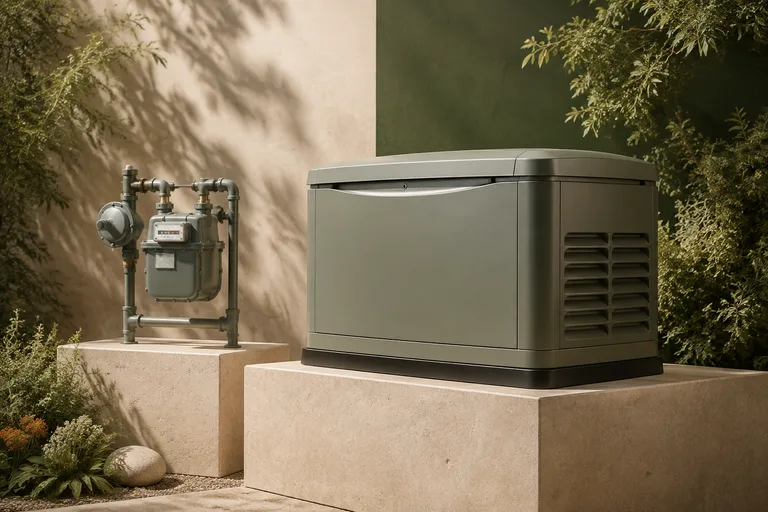
A natural gas generator is usually the most convenient whole-house backup option when the property already has adequate utility gas service.
There is:
- no onsite fuel tank to refill
- no fixed tank-style runtime
- automatic fuel supply while the gas utility remains available
- broad residential generator availability from major brands
But natural gas is not automatically the right choice simply because a gas meter exists on the house.
Before buying, you need to verify:
- the generator's actual natural-gas output
- calculated electrical load
- meter capacity
- regulator capacity
- gas pressure
- pipe sizing
- total demand from other gas appliances
That matters because many standby generators produce less power on natural gas than their headline propane rating.
And a property can have natural gas service while still lacking enough gas capacity to run a large generator correctly.
Natural Gas Generator: Quick Verdict
We would usually choose a natural gas whole-house generator when:
- the property already has natural gas
- the gas system can support the additional load
- extended outages are a concern
- automatic operation matters
- avoiding propane storage and refilling is valuable
- the chosen generator provides enough power on its NG rating
We would look harder at propane or another backup system when:
- there is no existing gas service
- extending gas infrastructure is expensive
- onsite stored-fuel independence is important
- the selected generator loses enough output on NG to affect sizing
- local natural-gas resilience is poor
For most suburban homes already connected to a suitable gas utility, natural gas is the default fuel we would investigate first.
What Is a Natural Gas Generator?
A natural gas generator converts natural gas into electricity using an internal-combustion engine connected to an alternator.
For residential backup, the most common setup is a permanently installed standby generator connected to:
- the home's natural-gas supply
- an automatic transfer switch
- the home's electrical system
When utility electricity fails, the standby system detects the outage, starts the generator and transfers selected or whole-home electrical loads onto generator power.
When utility electricity returns and stabilises, the system transfers the house back and shuts the generator down.
That is fundamentally different from a portable generator that must normally be:
- moved into position
- manually connected
- manually started
- manually refuelled
For serious automatic home backup, permanent standby is the main natural-gas use case.
Are Natural Gas Generators Good for Whole-House Backup?
Yes.
Natural gas is particularly well suited to standby generators because the home already has a continuously supplied fuel source when utility gas infrastructure is available.
The main advantages are:
- automatic operation
- no onsite bulk fuel storage
- no scheduled propane delivery
- no gasoline storage
- no tank-level monitoring
- potentially long-duration operation
- relatively low current residential fuel cost in our comparisons
The disadvantages are:
- dependence on the gas utility
- possible meter/regulator upgrades
- potentially substantial gas-pipe requirements
- lower output than propane on some generators
- no stored reserve if utility gas is interrupted
It is a strong fuel.
It is not magic.
Natural Gas Generator Sizes
Residential natural-gas standby generators cover a wide capacity range.
Current model examples in Backup Generator Guide's research include systems from roughly 9 kW NG into 50+ kW residential/light-commercial territory.
Some current examples:
| Generator | Natural Gas Output | Propane Output |
|---|---|---|
| Kohler 10RESV | 9 kW | 10 kW |
| Kohler 12RESV | 11 kW | 12 kW |
| Kohler 14RCA | 12 kW | 14 kW |
| Kohler 20RCA | 18 kW | 20 kW |
| Generac Next Generation 22 kW | 21 kW | 22 kW |
| Generac Next Generation 26 kW | 24 kW | 26 kW |
| Kohler 26RCA | 24 kW | 26 kW |
| Cummins RS25 | 25 kW | 25 kW |
| Cummins RS36 | 36 kW | 36 kW |
| Kohler 38RCLC | 38 kW | 38 kW |
| Kohler 48RCLC | 48 kW | 48 kW |
| Kohler 60RCLB | 58 kW | 60 kW |
The important column is Natural Gas Output.
Do not size from the number in the product name.
Does a Natural Gas Generator Produce Less Power?
Often.
But not always.
Several current residential generators are rated lower on natural gas than propane.
Examples include:
Generac Next Generation 22 kW
- 21 kW NG
- 22 kW LP
Generac Next Generation 26 kW
- 24 kW NG
- 26 kW LP
Generac Next Generation 28 kW
- approximately 25 kW NG
- 28 kW LP
Kohler 20RCA
- 18 kW NG
- 20 kW LP
Kohler 26RCA
- 24 kW NG
- 26 kW LP
But that behaviour is not universal.
Cummins examples in our current research include:
Cummins RS25
- 25 kW NG
- 25 kW LP
Cummins RS36
- 36 kW NG
- 36 kW LP
Kohler also has larger examples retaining the same output on both fuels.
So never write:
"Natural gas generators always lose power."
The correct statement is:
many residential standby generators are derated on natural gas, but the amount depends on the exact model.
What Size Natural Gas Generator Do I Need?
Size from electrical load.
Not square footage.
A 4,000-square-foot home with:
- gas heating
- gas water heating
- one efficient AC system
may require less generator than a 2,500-square-foot all-electric home with:
- heat pumps
- electric water heating
- well pump
- multiple HVAC units
- pool equipment
The correct process is:
- identify the loads that must operate during an outage
- calculate running demand
- account for motor starting loads
- decide what can be load managed
- add sensible headroom
- compare the result with the generator's NG rating
Use our generator size calculator for the first-pass calculation.
Then have the final system confirmed for the actual installation.
Example: Why the NG Rating Changes Sizing
Suppose the calculated requirement is:
24.5 kW
You look at a generator marketed as:
26 kW
Sounds large enough.
But if the manufacturer specifies:
- 24 kW on natural gas
- 26 kW on propane
the generator may not satisfy that 24.5 kW requirement on natural gas without additional load management.
Now compare a unit providing:
25 kW NG
That potentially changes the decision.
This is why Backup Generator Guide uses fuel-specific ratings across its model pages rather than headline capacity.
Best Natural Gas Generator Brands
There is no single best brand for every house.
Our main residential shortlist includes:
- Generac
- Kohler/Rehlko
- Cummins
- Briggs & Stratton
- Champion
For most homeowners, Generac remains our default starting point because of the breadth of its residential standby ecosystem and widespread dealer familiarity.
But natural gas makes Cummins particularly interesting because models such as the RS25 and RS36 retain equal NG and LP output.
Kohler/Rehlko also has strong residential options and larger liquid-cooled equipment.
The right decision comes down to:
- calculated load
- NG output
- installed price
- transfer equipment
- local dealer quality
- service availability
See our best whole-house generators guide for the broader shortlist.
Generac Natural Gas Generators
Generac has one of the broadest residential standby ranges in the US market.
Current project research includes Next Generation and Guardian products across mainstream whole-house capacities.
One important detail is that Generac model generations should not be mixed.
For example, current/recent 22 kW Generac evidence includes:
Next Generation 22 kW
- model 7260 / G0072600
- model 7325 / G0073250 with 200A ATS
- 21 kW NG
- 22 kW LP
Guardian 22 kW
- model 7042 / G0070420
- model 7043 / G0070430
- 19.5 kW NG
- 22 kW LP
Both can be described as "22 kW Generac generators."
They do not deliver the same natural-gas output.
See our Generac 22 kW generator guide before comparing quotes.
Generac 22 kW vs 26 kW on Natural Gas
The current Next Generation comparison is:
| Model | Natural Gas | Propane |
|---|---|---|
| Generac 22 kW | 21 kW | 22 kW |
| Generac 26 kW | 24 kW | 26 kW |
So moving from the current Next Generation 22 kW to 26 kW buys approximately:
3 kW more natural-gas capacity
not 4 kW.
That distinction matters when deciding whether the additional equipment cost has a real job to do.
See our Generac 22 kW vs 26 kW comparison.
Cummins Natural Gas Generators
Cummins is particularly interesting for natural-gas buyers.
Current verified residential examples include:
RS25
- 25 kW NG
- 25 kW LP
RS36
- 36 kW NG
- 36 kW LP
That equal-fuel output can be valuable where a competing generator loses several kilowatts on NG.
It does not make Cummins universally better.
Dealer quality, price, warranty and exact system design still matter.
But for a natural-gas home near a sizing threshold, Cummins deserves a proper comparison.
See our Cummins generator guide and Generac vs Cummins comparison.
Kohler/Rehlko Natural Gas Generators
Current residential Kohler/Rehlko examples include:
- 10RESV - 9 kW NG
- 12RESV - 11 kW NG
- 14RCA - 12 kW NG
- 20RCA - 18 kW NG
- 26RCA - 24 kW NG
- 24RCLA - 21 kW NG
- 38RCLC - 38 kW NG
- 48RCLC - 48 kW NG
- 60RCLB - 58 kW NG
This shows two useful things.
First, NG derating appears on several mainstream residential units.
Second, some larger liquid-cooled systems retain their full output on natural gas.
See our Kohler generator guide for the broader range.
How Much Natural Gas Does a Whole-House Generator Use?
Fuel consumption depends on:
- generator
- engine
- electrical load
- operating conditions
Do not use one cubic-feet-per-hour figure for every 20 kW generator.
Current manufacturer examples from our fuel research include:
Generac 18 kW Example
Approximate natural-gas consumption:
- 164 ft³/hour at 50% load
- 235 ft³/hour at full load
Champion 201222 Example
Approximate natural-gas consumption:
- 173.4 ft³/hour at 50% load
- 270.2 ft³/hour at full load
Consumption increases as generator load rises.
That sounds obvious, but it matters for both:
- operating cost
- fuel-system design
The gas line must be designed for the generator's required maximum demand, not its pleasant half-load consumption on an average afternoon.
How Much Does a Natural Gas Generator Cost to Run?
Using the January 2026 US residential natural-gas price input captured in our research:
$13.96 per thousand cubic feet
illustrative fuel-only costs include:
| Generator Example | 50% Load | Full Load |
|---|---|---|
| Generac 18 kW example | ~$2.29/hr | ~$3.28/hr |
| Champion 201222 | ~$2.42/hr | ~$3.77/hr |
| Kohler/Rehlko 20RESC | ~$2.27/hr | ~$3.94/hr |
| Cummins RS20A | ~$2.40/hr | ~$3.74/hr |
These are illustrative national fuel-only calculations, not your utility bill.
They exclude:
- local tariffs
- fixed charges
- taxes
- installation
- maintenance
- actual fluctuating load
The useful conclusion is that current residential NG operation can be economically attractive compared with propane in equivalent generator examples.
For the direct fuel comparison, see natural gas vs propane generators.
How Much Does a Natural Gas Generator Cost Per Day?
Take the hourly fuel cost and multiply it by actual runtime.
If a generator costs an illustrative:
$3.25/hour
in natural gas at its current operating load, then 24 hours would be:
$78/day
That does not mean every natural-gas generator costs $78 per day.
A lighter average load could cost less.
A larger generator or higher local gas price could cost more.
This is why a useful estimate needs:
generator consumption × actual load × local fuel price
not one national daily number.
How Long Can a Natural Gas Generator Run?
A utility-fed natural-gas generator has no fixed tank-style runtime.
It can continue operating while:
- utility gas remains available
- gas pressure remains adequate
- the fuel system can supply the generator
- required maintenance is performed
- the generator remains mechanically functional
That makes natural gas particularly useful for prolonged outages.
But do not call it "unlimited."
Natural-gas infrastructure can fail.
Generators can fail.
And prolonged operation can trigger hour-based maintenance.
Can a Natural Gas Generator Run for a Week?
Potentially, yes.
The fuel supply is not limited to an onsite tank.
But a seven-day generator run means:
168 operating hours
That can move the machine significantly through its maintenance schedule.
For example, some generator maintenance intervals appear around:
- 100 hours
- 200 hours
depending on model and operating conditions.
So the correct question is not simply:
"Can it run for seven days?"
It is:
"Can it run for seven days while receiving the fuel and maintenance it requires?"
Does Natural Gas Still Work During a Power Outage?
Often, yes.
Natural-gas distribution infrastructure is separate from the electric distribution network, which is why utility gas can remain available when electricity fails.
But it is not guaranteed.
Natural-gas service can be interrupted by:
- infrastructure damage
- pressure problems
- deliberate utility shutdown
- local emergency conditions
So we would never claim:
"Natural gas never goes out."
Natural gas provides utility-fed resilience, not independence from utilities.
If owning a fixed amount of fuel at the property matters more, propane deserves consideration.
Do Natural Gas Generators Work During Hurricanes?
Yes, provided:
- the generator survives the event
- natural-gas service remains available
- adequate pressure remains
- maintenance requirements are met
Natural gas has a major hurricane advantage:
you are not waiting for a propane delivery truck while roads and fuel logistics may be disrupted.
But propane has the opposite resilience advantage:
the fuel is physically stored on your property before the storm.
Which one is better depends on local infrastructure and likely disaster type.
For hurricane-prone homes, investigate the historical resilience of the actual local gas network.
Can Natural Gas Be Shut Off During a Disaster?
Yes.
Utility natural gas should not be treated as physically impossible to interrupt.
Emergency shutdowns, infrastructure damage or pressure problems can occur.
That means natural gas is best understood as:
continuously supplied fuel with utility dependency
rather than:
infinite fuel.
If complete fuel independence is the objective, stored propane or another backup architecture changes the trade-off.
Does a Natural Gas Generator Need a Larger Gas Meter?
Possibly.
Having an existing gas meter does not prove it can support a whole-house generator.
A standby generator can add a very large new gas demand.
For example, a large residential generator consuming roughly:
300+ ft³/hour
at full load represents approximately another:
300,000+ BTU/hour
using the common planning approximation of roughly 1,000 BTU per cubic foot of natural gas.
That demand sits on top of other gas equipment such as:
- furnace
- water heater
- dryer
- range
- pool heater
- fireplace
The installer needs to evaluate total connected load.
Natural Gas Generator Meter Sizing
Meter adequacy depends on:
- total BTU demand
- utility pressure
- meter rating
- regulator
- generator demand
- simultaneous appliance demand
A house might have a perfectly adequate meter for:
- furnace
- water heater
- stove
and still need an upgrade once a 20+ kW standby generator is added.
Do not accept:
"You've already got gas, so it'll be fine."
as an engineering calculation.
What Size Gas Line Does a Generator Need?
There is no universal gas-pipe size for a natural-gas generator.
Sizing depends on:
- generator maximum fuel consumption
- inlet pressure
- pipe length
- pipe material
- fittings
- pressure drop
- other connected appliances
- applicable fuel-gas code
A large generator 10 feet from the meter is a different fuel-delivery problem from the same generator 150 feet away.
Use the manufacturer's maximum fuel requirement and an actual fuel-system calculation.
Not an internet chart stripped of context.
Can a Gas Line Be Too Small for a Generator?
Yes.
An undersized fuel system can contribute to:
- poor starting
- unstable operation
- loss of output
- shutdown under heavy load
The generator can appear fine during a low-load weekly exercise and then struggle when a real outage places the house on it.
That is why full-demand fuel design matters.
The installation needs to work at:
worst credible generator load
not merely at idle.
Natural Gas Pressure Requirements
Standby generators require fuel delivered within the manufacturer's specified pressure range.
More pressure is not automatically better.
Too little can starve the engine.
Incorrectly regulated supply can create other operating and safety problems.
The correct pressure belongs in:
- manufacturer specification
- installation design
- commissioning test
Fuel-pressure adjustment is not a homeowner optimisation task.
Can You Share the Existing Gas Line?
Potentially.
But "share" does not mean "tee into whatever pipe happens to be nearby."
The entire system must still supply adequate demand when multiple appliances operate.
The calculation needs to consider a plausible high-load event such as:
- generator near full load
- furnace operating
- water heater operating
- other gas appliances demanding fuel
If the existing downstream piping cannot supply that demand, the generator may need:
- a dedicated larger line
- meter/regulator upgrade
- different routing
Natural Gas Generator Installation
A complete installation normally involves:
- electrical load assessment
- generator sizing
- site selection
- fuel-system design
- gas-line installation
- automatic transfer switch
- electrical integration
- permitting
- load management where required
- commissioning
The gas system is only one part of the job.
See our whole-house generator installation guide for the complete process.
How Much Does a Natural Gas Generator Cost to Install?
There is no useful single national installed price for all natural-gas generators.
Complete cost depends on:
- generator
- transfer switch
- generator size
- electrical work
- site preparation
- permits
- gas line
- meter/regulator upgrade
- trenching
- load management
- labour
Existing gas infrastructure can make natural gas economically attractive.
Needing major new gas infrastructure can do the opposite.
This is why equipment MSRP and installed cost should always be separated.
See our whole-house generator cost guide.
Is It Expensive to Add Natural Gas Just for a Generator?
It can be.
If the property does not currently have natural-gas service, the economics change materially.
Possible new costs can include:
- utility extension
- meter
- regulator
- trenching
- long piping
- permitting
At that point propane may make more sense even if its ongoing fuel price is higher.
We would not install expensive new natural-gas infrastructure solely because somebody said:
"Natural gas is cheaper."
Compare total installed ownership economics.
Natural Gas Generator vs Propane Generator
Our default fuel call is:
Choose Natural Gas When:
- adequate gas service already exists
- convenience matters
- long utility-fed runtime matters
- you want to avoid fuel storage
- NG-rated generator capacity satisfies the load
Choose Propane When:
- natural gas is unavailable
- new NG infrastructure would be expensive
- stored fuel independence matters
- propane's higher model-specific output is useful
- tank installation is practical
The complete comparison is covered in our natural gas vs propane generator guide.
Natural Gas Generator vs Home Battery
These solve different outage problems.
A natural-gas generator:
- creates electricity continuously from fuel
- can support substantial loads
- can operate for prolonged periods while gas remains available
A battery:
- stores finite kWh
- operates silently
- has no onsite combustion
- becomes much more compelling when solar can recharge it
For long high-energy outages, the natural-gas generator normally has the advantage.
For short outages, solar homes and quiet operation, batteries can be stronger.
See our generator vs home battery comparison.
Natural Gas Generator Maintenance
Natural gas does not remove engine maintenance.
A natural-gas standby generator still requires model-specific service involving items such as:
- engine oil
- oil filter
- air filter
- spark plugs
- starter battery
- valve clearance where applicable
- inspections
Long outages can bring service intervals forward quickly.
Do not assume:
"Natural gas burns clean, therefore the generator barely needs maintenance."
It is still an internal-combustion engine.
Are Natural Gas Generators More Reliable Than Propane?
We did not find credible population-level evidence proving residential standby generators are universally more reliable simply because they run on natural gas.
Fuel availability affects whether the generator can run.
Fuel-system design affects operation.
But generator reliability also depends on:
- engine
- electrical components
- installation
- battery
- maintenance
- environment
- service quality
Do not convert fuel preference into a fake reliability statistic.
Are Natural Gas Generators Quieter?
There is not enough equivalent model-matched testing to establish natural gas as universally quieter than propane.
Noise depends more usefully on:
- generator model
- enclosure
- load
- engine speed
- installation location
- measurement conditions
Compare exact manufacturer specifications where sound matters.
Do Natural Gas Generators Produce Carbon Monoxide?
Yes.
Natural gas combustion produces carbon monoxide and other exhaust gases.
A permanently installed standby generator must therefore be installed with required clearances and exhaust considerations.
Do not place one:
- inside a garage
- inside a house
- in another enclosed space
and do not treat natural gas as "clean enough" to remove combustion safety requirements.
Installation requirements matter.
Can You Convert a Generator to Natural Gas?
Some standby and multi-fuel generator models are designed to operate on either natural gas or propane.
But fuel conversion is model-specific.
Do not assume any propane generator can safely be converted to natural gas with a generic kit.
Changing fuel can affect:
- regulator configuration
- fuel delivery
- rated output
- controller setup
- warranty
- certification
Follow the manufacturer's approved configuration.
Portable Natural Gas Generators
Natural gas is not limited to permanent standby generators.
Some portable tri-fuel generators can operate on:
- gasoline
- propane
- natural gas
That can be useful for homeowners who want access to utility gas without paying for a permanent standby installation.
But portable equipment is still different from standby:
- manual setup
- connection requirements
- weather protection
- transfer equipment
- storage
- starting procedure
- output
A future tri-fuel generator guide should own that specific buying intent rather than forcing it into this standby-focused page.
Who Should Buy a Natural Gas Generator?
Suburban Home Already Connected to Gas
Strong fit.
This is the easiest natural-gas case.
Verify meter and piping capacity, then compare suitable NG-rated generators.
Large Home With High Electrical Demand
Potentially strong fit, but fuel infrastructure matters.
Large generators can create substantial gas demand.
Rural Home Without Natural Gas
Usually weak fit.
Propane normally makes more sense than extending expensive utility infrastructure solely for backup power.
Hurricane-Prone Home
Strong fit where the local gas network is resilient.
Utility-fed fuel avoids onsite refill logistics, but local gas resilience still needs consideration.
Homeowner Wanting Full Fuel Independence
Weak fit.
Natural gas remains a utility service.
Stored propane better matches that particular objective.
Questions to Ask Before Buying a Natural Gas Generator
Ask the installer:
- What is the generator's exact natural-gas output?
- What calculated electrical load are you sizing against?
- What is the generator's maximum natural-gas consumption?
- Can my current meter support it?
- Can my regulator support it?
- What pipe size are you proposing?
- What pressure will the generator receive under maximum demand?
- Are other gas appliances included in the calculation?
- Does the quote include meter/regulator work?
- What loads are being managed?
- Who commissions fuel pressure under load?
- Who services the generator afterwards?
If the salesperson cannot explain the difference between:
headline kW
and:
natural-gas kW
I would be cautious about letting them size the system.
Natural Gas Generator FAQ
Are natural gas generators worth it?
Usually yes when the home already has adequate gas service and prolonged automatic backup is the objective. They become less attractive if substantial new gas infrastructure is required.
How much natural gas does a whole-house generator use?
It varies by generator and load. Current residential examples in our research consume roughly 160-175 ft³/hour around half load and approximately 235-270 ft³/hour at full load for represented 18-22 kW-class equipment.
How much does a natural gas generator cost per hour?
Using January 2026 national residential natural-gas pricing, represented current generator examples in our research calculate to roughly $2.25-$2.45/hour at 50% load and approximately $3.25-$4/hour at full load. Local prices vary.
Can a natural gas generator run continuously?
It can run for prolonged periods while utility gas remains available and maintenance requirements are satisfied. There is no fixed tank-style runtime.
Will natural gas still work during a blackout?
It often does because gas and electricity use separate infrastructure, but natural-gas service can still be interrupted. Do not treat utility gas as guaranteed.
Does a natural gas generator need a gas tank?
No. A utility-fed natural-gas generator connects to the property's natural-gas supply rather than an onsite storage tank.
Does a natural gas generator produce less power than propane?
Many do, but not all. Current Generac and Kohler examples lose some output on NG, while Cummins RS25 and RS36 examples retain equal NG and LP output.
What size natural gas generator do I need?
Calculate the electrical loads you actually want backed up, starting demand, load management and sensible headroom, then compare the result with the exact generator's NG rating.
Can a 22 kW natural gas generator power a whole house?
Potentially, but the answer depends on actual load and exact model. A generator marketed as 22 kW may produce less than 22 kW on natural gas.
Can a natural gas generator run central air conditioning?
Yes, if the generator has sufficient running and motor-start capacity and the installation is correctly designed. Large HVAC systems may require load management or soft-start equipment.
Do I need a bigger gas meter for a whole-house generator?
Possibly. The generator can add hundreds of thousands of BTU per hour to the property's gas demand. Existing meter and regulator capacity must be checked.
Is natural gas cheaper than propane for a generator?
In the current manufacturer/EIA examples researched for Backup Generator Guide, natural gas produced materially lower illustrative fuel cost per hour. Local prices and infrastructure costs can change the total ownership decision.
Final Verdict
For a home that already has adequate natural-gas infrastructure, a natural-gas standby generator is usually the fuel setup we would investigate first.
The advantages are difficult to ignore:
- automatic utility-fed fuel
- no tank management
- no propane deliveries
- strong residential model selection
- attractive current fuel-only operating economics
- prolonged runtime without a fixed onsite fuel reserve
But there are two catches.
First: Use the NG Rating
A "26 kW generator" may only provide:
24 kW on natural gas.
Size against the fuel you will actually use.
Second: Prove the Gas Infrastructure
Having a gas stove does not prove the property can supply a large standby generator.
The system must support:
- generator demand
- existing gas appliances
- required pressure
- pipe losses
at the same time.
So our buying sequence is:
calculate electrical load → choose candidate generator → verify actual NG output → calculate maximum gas demand → verify meter/regulator/piping → compare complete installed quotes.
If that all works cleanly, natural gas is a very strong whole-house backup fuel.
If it doesn't, do not force the property into natural gas simply because the fuel itself looks cheap.
Evidence Basis
This guide uses the existing Backup Generator Guide research covering current residential standby models from Generac, Kohler/Rehlko and Cummins, including fuel-specific NG/LP output rather than headline capacity alone. Current verified examples include Generac Next Generation 22 kW at 21 kW NG, Generac 26 kW at 24 kW NG, Kohler 20RCA at 18 kW NG, Cummins RS25 at 25 kW on both fuels and Cummins RS36 at 36 kW on both fuels.
Fuel-consumption and illustrative operating-cost examples use manufacturer consumption data combined with the January 2026 US residential natural-gas price input captured in the project's fuel research. They are not local utility quotes.
Natural gas does not have a tank-style runtime, but this guide deliberately does not describe it as unlimited: continued operation still depends on utility gas supply, adequate pressure, generator condition and required maintenance.