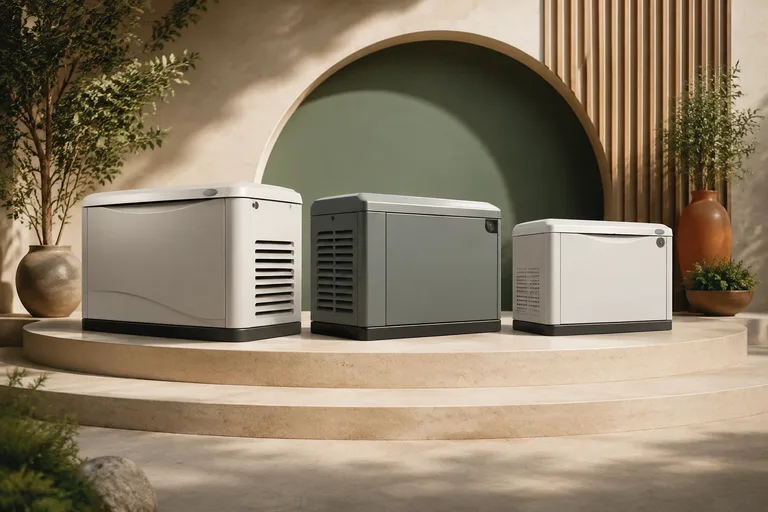
The best whole house generator is not necessarily the model with the highest kW rating or the brand with the biggest dealer network.
For most homeowners, the better choice is the generator that:
- Is correctly sized for the house
- Works with the fuel available at the property
- Has suitable transfer-switch and load-management options
- Has strong installer and service support locally
- Provides enough capacity without unnecessary oversizing
- Has warranty and parts support you can realistically use
Based on current 2026 manufacturer specifications, available independent testing, recurring installer and owner evidence, current US model availability and service considerations, Generac, Kohler, Cummins, Briggs & Stratton and Champion are the brands we'd put on a residential standby shortlist.
But we would not choose between them on brand name alone.
Best Whole House Generators: Our Shortlist
| Category | Our pick | Why it makes the shortlist |
|---|---|---|
| Best overall for most homeowners | Generac 22–26 kW class | Broad residential range, mature dealer ecosystem, strong monitoring/load-management options |
| Best Generac alternative | Kohler 20–26 kW class | Strong residential product range and compelling higher-capacity options |
| Best for service/reliability-led buyers | Cummins QuietConnect residential range | Established power-generation manufacturer with residential standby options and dealer support |
| Best high-output air-cooled alternative | Briggs & Stratton PowerProtect 26 kW class | High-capacity residential air-cooled option with competitive output |
| Best value-oriented contender | Champion home standby range | Worth comparing where local installation/service support and package pricing are strong |
These aren't universal winners.
The best generator for a 2,000-square-foot gas-heated home can be completely different from the best generator for a 4,500-square-foot all-electric property with two HVAC systems and a well pump.
Size the system first. Choose the generator second.
If you haven't done that yet, start with our Generator Size Calculator.
How We Chose These Generators
A lot of "best generator" pages have a credibility problem.
They present precise rankings without making clear whether anyone actually installed, operated or tested the generators.
We don't want to do that.
What we did
Our recommendations consider:
- Current manufacturer specifications
- Current US product availability
- Available independent testing
- Installer/trade evidence
- Recurring owner/community evidence
- Warranty terms
- Local serviceability
- Dealer network
- Parts/support considerations
- Fuel compatibility
- Transfer-switch options
- Load-management capability
- Monitoring features
- Equipment and installed cost
What we didn't do
We did not personally install and laboratory-test every generator on this page.
Where independent organisations have tested equipment, we treat that separately from manufacturer specifications.
Where installers or owners report experience, we treat that as experience rather than controlled testing.
And where we're making a judgement from several signals, we'll say so.
That's more useful than inventing a proprietary "9.7/10 reliability score" that has no underlying dataset.
The Most Important Buying Factor Isn't the Brand
One of the strongest signals in our research was something many product roundups barely discuss:
Who is going to install and service the generator where you live?
Whole house generators are not televisions.
You're buying a permanently installed engine, alternator, transfer system and fuel system that may sit outside for years and then be expected to start automatically during the exact moment local infrastructure is failing.
Owner and installer discussions repeatedly raise:
- Dealer quality
- Installation quality
- Parts availability
- Warranty service
- Whether local dealers service units they didn't install
- Maintenance availability
So if Brand A narrowly wins a specification comparison but has poor service coverage where you live, while Brand B has an excellent authorised installer five miles away, Brand B may be the better generator for your house.
Keep that in mind throughout this comparison.
1. Generac Home Standby Generators
Best Overall for Most Homeowners
Generac remains the obvious starting point for a US whole-house-generator shortlist.
That does not automatically make every Generac the best generator.
What makes the brand difficult to ignore is the combination of:
- Broad residential capacity range
- Strong US market presence
- Established dealer network
- Natural gas and propane configurations
- Automatic transfer-switch ecosystem
- Load-management options
- Remote monitoring
- Extensive installer familiarity
For a mainstream homeowner shopping in roughly the 20–26 kW residential range, we'd get a Generac quote.
Why we like Generac
The ecosystem matters.
A generator's usefulness depends on far more than its engine output.
You also need:
- Transfer equipment
- Controls
- Monitoring
- Parts
- Maintenance
- Installer expertise
- Warranty support
Generac's scale means many homeowners can find contractors already familiar with the equipment.
That can make ownership simpler.
Where we'd be cautious
Dealer experience is not universal.
Our community research surfaced both positive and negative Generac ownership/service experiences.
That's exactly why we'd evaluate the local dealer as part of the product.
Ask:
- Who installs it?
- Who performs warranty repairs?
- Who services it annually?
- Will they service a Generac installed by another contractor?
- How quickly can they obtain parts?
Best for
Homeowners who want a mainstream residential standby system with broad installer availability and a mature supporting ecosystem.
Our verdict
SHORTLIST
Generac should probably be quoted on most mainstream US standby-generator projects.
But don't sign because "everyone buys Generac".
Compare the actual installed system and local support against Kohler, Cummins, Briggs & Stratton and Champion where available.
Read our Generac Generator Guide →
2. Kohler Home Generators
Best Alternative to Generac
Kohler is the brand we'd most naturally put beside Generac in a serious residential comparison.
Its current residential range covers common home-standby capacities and extends into larger systems.
That makes Kohler particularly interesting where the homeowner wants:
- A mainstream residential standby system
- A larger-capacity option
- An alternative dealer ecosystem
- Strong local Kohler support
Why we like Kohler
Kohler offers current residential models across useful capacity bands rather than serving only one narrow segment.
Current manufacturer pricing observed during our research also gives buyers a relatively clear equipment-price ladder across several residential capacities.
That doesn't tell you installed cost, but it helps establish the equipment component.
Where we'd be cautious
The same rule applies as Generac:
local support beats internet reputation.
A Kohler system makes much more sense where you have a strong local dealer capable of installation, maintenance and warranty support.
If the nearest competent Kohler service provider is hours away while a strong alternative-brand installer is nearby, factor that into the decision.
Best for
Homeowners comparing premium mainstream standby systems who have good local Kohler installation and service coverage.
Our verdict
SHORTLIST
For a 20–26 kW residential project, we'd actively compare Kohler against Generac rather than assuming either brand wins automatically.
Read our Kohler Generator Guide →
3. Cummins QuietConnect Home Standby Generators
Best for Buyers Who Prioritise Power-Generation Pedigree and Local Support
Cummins is one of the biggest names in power generation generally, although its residential standby presence is less dominant than Generac's.
Its QuietConnect residential products belong on the shortlist where local Cummins support is available.
Why we like Cummins
Cummins brings an established power-generation and engine background to the category.
The residential offering includes automatic standby operation, sizing/dealer support and systems intended specifically for home backup.
The more important question is whether that product ecosystem is strong in your area.
Where we'd be cautious
A nationally recognised manufacturer doesn't automatically equal strong residential dealer coverage in every ZIP code.
Before choosing Cummins, check:
- Local residential installer availability
- Maintenance support
- Warranty handling
- Parts availability
- Response during major outage events
Best for
Homeowners with a strong local Cummins residential dealer who value the manufacturer's broader power-generation background.
Our verdict
SHORTLIST WHERE LOCAL SUPPORT IS STRONG
We would not rule Cummins out simply because Generac and Kohler appear more frequently in residential marketing.
But we'd want to know who is supporting the system locally before buying.
Read our Cummins Generator Guide →
4. Briggs & Stratton PowerProtect
Best High-Output Air-Cooled Alternative
Briggs & Stratton's current PowerProtect range gives homeowners another serious option in common residential standby capacities.
Its higher-output air-cooled products are particularly interesting where the calculated household load sits near the upper end of mainstream air-cooled systems.
Why we like Briggs & Stratton
The current residential range includes multiple capacities and variants, including systems in the mid-20-kW class.
That can create another option for homeowners trying to support substantial residential loads without automatically moving into a much larger liquid-cooled system.
Where we'd be cautious
Again, don't evaluate the equipment in isolation.
Check the local network.
The important questions are:
- Who installs PowerProtect locally?
- Who stocks common service parts?
- Who handles warranty work?
- How quickly can someone attend during an outage?
A strong specification sheet is only half the ownership experience.
Best for
Larger residential air-cooled applications where Briggs & Stratton has competent local installation/service support.
Our verdict
SHORTLIST
Particularly worth pricing where your calculated load is pushing toward the upper end of mainstream air-cooled standby capacity.
5. Champion Home Standby Generators
Best Value-Oriented Contender
Champion is worth considering for homeowners focused on value rather than simply choosing the most established residential standby brand.
The brand appears across both current standby offerings and wider generator categories, and its home standby systems can be competitive depending on package and installer pricing.
Why we like Champion
Value in a standby system isn't just:
lowest generator price
It's:
equipment + ATS + installation + warranty + service
Champion can become interesting when a local dealer offers a well-priced complete system.
Where we'd be cautious
We would not buy a standby generator purely because the equipment is cheaper online.
Verify:
- Local installer experience
- Service coverage
- Warranty support
- Parts availability
- Transfer-switch package
- Total installed price
If the local service proposition is weak, a cheaper generator can become false economy.
Best for
Price-conscious homeowners with strong local Champion installation and support.
Our verdict
VALUE SHORTLIST
Get a quote and compare the complete installed package rather than equipment price alone.
Generac vs. Kohler vs. Cummins vs. Briggs & Stratton vs. Champion
There isn't a defensible universal winner.
Here's how we'd narrow it down:
| Brand | Why we'd consider it | What we'd verify locally |
|---|---|---|
| Generac | Broad ecosystem and installer familiarity | Dealer/service quality |
| Kohler | Strong residential range and alternative to Generac | Dealer coverage and installed price |
| Cummins | Established power-generation manufacturer | Residential service network |
| Briggs & Stratton | Strong air-cooled residential capacities | Installer/parts support |
| Champion | Potential value | Serviceability and complete package |
The correct shortlist may therefore change by location.
That's not a weakness in the comparison.
It's how permanently installed equipment actually works.
What Size Whole House Generator Is Best?
The best generator size is the smallest properly designed system that reliably supports the backup loads you need, with appropriate capacity for starting loads and system requirements.
It is not automatically:
- 20 kW
- 22 kW
- 24 kW
- 26 kW
Those are product classes, not universal answers.
Smaller standby systems
Smaller systems can make sense for:
- Essential-load backup
- Gas-heated homes
- Smaller electrical loads
- Managed systems
18–22 kW systems
This is a useful mainstream range for many residential applications.
Whether it's enough depends on the house.
24–26 kW systems
These become attractive where:
- Household loads are higher
- Broader whole-home backup is required
- Multiple large loads exist
- The incremental installed cost is reasonable
30 kW+
Larger properties can move beyond mainstream air-cooled capacities.
At that point, the economics and system design can change significantly.
Don't buy a 26 kW generator because somebody on a forum says every modern house needs one.
Calculate your generator size →
Best Generator for a 2,000 Sq. Ft. House
There isn't one.
A 2,000-square-foot home with:
- Gas heating
- Gas water heating
- Gas cooking
- One AC system
can have radically different backup requirements from another 2,000-square-foot home with: - Electric heating
- Electric water heating
- Electric cooking
- Well pump
- Pool equipment
- Large HVAC
- EV charger
Choose the generator from the electrical loads, not floor area.
Best Generator for a 3,000 Sq. Ft. House
The same rule applies.
A larger home increases the probability of higher electrical demand, but square footage still doesn't determine generator capacity.
A 3,000-square-foot house might work well with a managed 22–26 kW system.
Another might require substantially more.
Get the load calculation first.
Natural Gas vs. Propane Whole House Generators
Most mainstream residential standby systems are designed around natural gas, propane or both.
But output can differ by fuel.
That matters.
When a manufacturer publishes different natural-gas and propane ratings, compare the generator using the fuel you will actually use.
Don't size your system from the larger marketing number if your selected fuel produces a lower rated output.
Natural gas
Advantages include:
- Utility-supplied fuel
- No on-site tank refilling
- Convenient extended operation
Potential drawbacks include: - Gas-meter capacity
- Pipe-sizing requirements
- Dependence on gas infrastructure
Propane
Advantages include:
- Stored on the property
- Available without natural-gas service
- Known fuel reserve
Potential drawbacks include: - Tank cost
- Refilling requirements
- Finite outage runtime
Compare natural gas generators →
Compare propane generators →
Air-Cooled vs. Liquid-Cooled Whole House Generators
Most mainstream residential standby buyers will be looking at air-cooled generators.
They are generally:
- Less expensive
- Simpler
- Smaller
- Available in capacities suitable for many homes
Liquid-cooled generators become more relevant as power requirements increase.
They can support: - Larger homes
- Higher simultaneous loads
- More demanding applications
- Capacities beyond typical residential air-cooled units
But they generally cost more to buy, install and maintain.
Don't upgrade to liquid cooling because it sounds more premium.
Choose it when the load and application justify it.
What Features Actually Matter?
Ignore feature-sheet clutter and focus on the things that affect the ownership experience.
Correct fuel-specific output
Check the rated output on natural gas or propane — whichever you'll use.
Automatic transfer switch
Understand:
- Whether one is included
- Its amperage
- Whether it's service rated
- How it integrates with the home
Load management
This can be more valuable than buying a larger generator.
Good load management allows heavy appliances to be prioritised rather than requiring enough capacity for everything to operate simultaneously.
Local monitoring
Remote monitoring can tell you:
- Generator status
- Exercise status
- Faults
- Maintenance requirements
Useful when you're away from the property.
Warranty
Don't compare only warranty length.
Ask:
- Who performs the repair?
- Is labour included?
- Who approves claims?
- Does installation affect coverage?
- Are extended warranties available?
Local service
Arguably the most underrated feature.
A generator with excellent specifications but no competent local support can be a terrible purchase.
How Reliable Are Whole House Generators?
There is not enough credible public evidence to declare one mainstream residential brand universally the "most reliable".
That's worth saying explicitly.
Manufacturer reliability claims are marketing claims.
Individual owner failures are real experiences but don't establish population-level failure rates.
Installer experience can be valuable but may reflect the brands that particular contractor sells or services.
Independent testing can evaluate performance, but short-term lab testing is not the same as ten-year field reliability.
So we don't manufacture a reliability ranking.
Instead, evaluate the things that reduce ownership risk:
- Proven product line
- Correct sizing
- Professional installation
- Local service support
- Parts availability
- Warranty
- Routine maintenance
Installation quality matters enormously.
What Independent Testing Tells Us
Consumer Reports is one of the more useful sources in this SERP because it actually describes testing rather than simply aggregating specifications.
Its generator testing considers areas including power delivery and how generators respond to demanding electrical loads.
That is materially different evidence from a page that simply reads manufacturer specifications and awards a "Best Overall" badge.
We use independent testing where it exists.
We don't pretend it answers every question.
A laboratory can test generator performance.
It cannot tell you whether the authorised dealer in your town will answer the phone five years from now.
Both matter.
What Generator Owners and Installers Tell Us
Community and installer evidence is messy — but useful.
Across the discussions we researched, recurring concerns included:
- Installation quality
- Dealer quality
- Maintenance support
- Warranty experience
- Whether another dealer will service the generator
- Parts/service availability
- Brand-specific experiences
The experiences conflict.
That's expected.
A forum where one owner has a failed Generac and another has years of trouble-free service doesn't establish a brand failure rate.
What it does tell us is that after-sales support belongs in the buying decision.
We weight that accordingly.
Should You Buy a Generator Online and Hire an Installer?
Potentially, but check first.
Buying equipment online may save money.
It can also create awkward questions:
- Will a local dealer install it?
- Will they service it later?
- Who handles shipping damage?
- Who handles warranty claims?
- Is the ATS correct?
- Are required accessories included?
- Does self-sourcing affect labour warranty?
A turnkey installer quote can cost more upfront but simplify accountability.
How Much Does a Good Whole House Generator Cost?
Mainstream residential standby-generator equipment commonly costs several thousand dollars before installation.
A useful planning range for many complete professionally installed systems is around:
$8,000–$16,000 installed
with larger and more complicated installations potentially exceeding $20,000.
The total can include:
- Generator
- Automatic transfer switch
- Load-management equipment
- Generator pad
- Electrical work
- Natural gas or propane work
- Trenching
- Permits
- Utility upgrades
- Labour
- Commissioning
This is why equipment price alone is a poor way to compare generators.
One manufacturer may appear cheaper until you discover the competing package includes a transfer switch or other equipment the first quote excludes.
Compare turnkey installed cost for equivalent systems.
See our Whole House Generator Cost Guide →
Is Generac or Kohler Better?
There isn't a universal winner.
Both deserve consideration for mainstream residential standby installations.
Generac's biggest practical advantage for many homeowners is its broad residential ecosystem and extensive installer familiarity.
Kohler provides a strong competing residential range and may be the better option where local Kohler installation and service support is stronger.
For an actual homeowner, I'd compare:
- Correctly sized Generac system
- Correctly sized Kohler system
- Exact fuel-specific output
- ATS/load-management configuration
- Warranty
- Installed price
- Local dealer reputation
- Ongoing maintenance/service support
If one system costs slightly more but comes from the substantially better local installer, I'd be comfortable paying more.
The installation and support relationship can matter for years after the equipment purchase.
Is Generac or Cummins Better?
Again, local support matters.
Generac has greater visibility in the mainstream residential standby market.
Cummins brings a substantial broader power-generation background and deserves consideration where its residential products are well supported locally.
Don't make this decision from logo recognition.
Compare the actual system being quoted and the company that will maintain it.
Is Kohler or Cummins Better?
Both are credible alternatives to simply defaulting to Generac.
I'd lean toward whichever has:
- The better correctly sized system
- Stronger local installer
- Better service coverage
- Competitive installed cost
- Appropriate warranty/support
If both are well supported locally, then product-level differences become much more important.
What Is the Best Whole House Generator Brand?
There isn't enough credible evidence to name one brand as universally best for every homeowner.
Our practical shortlist is:
Generac — strongest default starting point for many US homeowners because of its broad residential ecosystem.
Kohler — serious alternative with a strong residential range.
Cummins — compelling where residential dealer/service support is strong.
Briggs & Stratton — worth considering, particularly toward the higher-output end of mainstream air-cooled residential systems.
Champion — potentially attractive as a value-oriented option where local support is good.
The winner can change by ZIP code.
That's particularly important for standby generators because service is inherently local.
Which Whole House Generator Has the Best Warranty?
Don't choose a generator from the headline warranty duration alone.
Warranty terms can differ by:
- Product
- Promotional period
- Registration
- Residential vs commercial use
- Parts
- Labour
- Travel/service
- Installation
- Extended coverage
And a long warranty isn't much use if getting local warranty service is difficult.
When comparing quotes, ask the installer to provide the applicable warranty for the exact model being quoted.
Then ask:
If this generator fails under warranty, who comes to my house?
That's more useful than simply comparing "5 years" against "10 years" without reading the terms.
What Is the Quietest Whole House Generator?
Be careful with noise comparisons.
Manufacturers do not always publish sound levels under identical test conditions.
A dB number without context can therefore create false precision.
Noise depends on factors including:
- Generator model
- Load
- Engine speed
- Distance
- Measurement method
- Enclosure
- Installation location
- Nearby reflective surfaces
If noise is important because the generator will sit near a bedroom, patio or neighbouring property, compare published measurements only when their test conditions are reasonably equivalent.
Also discuss placement with the installer.
Moving a generator simply to reduce perceived noise may affect fuel/electrical runs and must still comply with placement requirements.
What Is the Most Reliable Whole House Generator?
We wouldn't make a universal reliability claim from the evidence currently available.
There is a difference between:
independent performance testing
and:
long-term population-level reliability data.
Publicly available evidence is much stronger for the former than the latter.
A few angry forum posts don't establish that a brand is unreliable.
Likewise, manufacturer claims don't establish that it is the most reliable.
For a homeowner trying to minimise failure risk, I'd focus on:
- Correct sizing
- Quality installation
- Established current product
- Good local dealer
- Parts availability
- Warranty support
- Regular maintenance
Those are variables you can actually control.
Should You Choose a Generator With Wi-Fi Monitoring?
Remote monitoring is useful, but it shouldn't decide the purchase by itself.
It can help you see:
- Generator status
- Exercise cycles
- Maintenance notifications
- Fault conditions
This is particularly valuable for: - Second homes
- Rental properties
- Frequently vacant homes
- Homeowners who travel
- Anyone responsible for a remote property
But I'd choose a better-supported generator without a flashy app over a poorly supported system with excellent software.
The generator still has to start.
Do You Need Load Management?
Often, it's worth considering.
Load management can prevent several high-demand appliances from operating simultaneously.
That may allow a smaller generator to provide broad household backup.
For example, rather than buying enough generator capacity to run:
- Two HVAC systems
- Electric water heater
- Dryer
- Pool equipment
at exactly the same moment, the system can prioritise those loads.
That can potentially: - Reduce required generator capacity
- Reduce equipment cost
- Reduce fuel consumption
- Keep the project within an air-cooled generator class
If unrestricted simultaneous operation matters to you, size accordingly.
But don't automatically buy a bigger generator before pricing a properly designed managed-load system.
Best Whole House Generator for Hurricanes
For hurricane-prone areas, I would prioritise the system rather than a special "hurricane generator".
Important factors include:
- Correct capacity
- Fuel availability
- Expected outage duration
- Generator placement
- Flood exposure
- Weather-resistant installation
- Local service coverage
- Parts availability
- Remote monitoring
- Maintenance readiness
Fuel deserves particular attention.
A generator can only run while its fuel supply remains available.
Natural gas can offer long-duration convenience where service remains operational.
Propane gives you a known amount of fuel stored on site.
The right choice depends on local infrastructure and your outage planning.
Best Whole House Generator for Cold Weather
Cold climates create different considerations.
Look at:
- Manufacturer operating-temperature guidance
- Cold-weather accessories
- Battery condition
- Fuel system
- Snow/ice exposure
- Installation location
- Maintenance
Some manufacturers offer cold-weather kits or accessories for specific models.
Don't assume every accessory fits every generator.
Use the requirements for the exact model being considered.
Best Whole House Generator for Large Homes
Large homes should not automatically buy the largest residential generator available.
Start with the load calculation.
If the property contains:
- Multiple HVAC systems
- Electric heat
- Electric water heating
- Well pumps
- Pool/spa equipment
- Large kitchens
- Multiple refrigeration systems
the load can become substantial.
At some point, the project may move beyond mainstream air-cooled standby generators into larger liquid-cooled equipment.
Before doing that, compare the economics of:
larger generator
versus:
smaller generator + intelligent load management.
The difference in installed cost can be meaningful.
Best Whole House Generator for Smaller Homes
Smaller homes can still have large electrical loads.
But if the property uses gas for heating, cooking and water heating and has modest HVAC requirements, a smaller standby system may be perfectly adequate.
Don't buy 26 kW simply because it is a popular residential size.
Oversizing adds cost without necessarily improving the backup experience.
Whole House Generator vs. Portable Generator
Before spending $10,000+ on a standby system, make sure you actually need one.
A portable generator can be a much better economic choice if:
- Outages are rare
- You only need essential circuits
- Manual setup is acceptable
- Someone is normally home
- Fuel storage/refuelling is manageable
A whole house standby generator becomes more compelling when you want: - Automatic operation
- Broad home backup
- Long-duration outage capability
- Power while you're away
- Permanent integration
- Minimal outage-time setup
Compare Portable Generators →
Whole House Generator vs. Home Battery
Home batteries are increasingly relevant to the same buyer.
A battery offers:
- Silent operation
- No combustion engine
- Fast automatic switchover
- Solar integration
- Low routine engine maintenance
A generator offers: - Extended operation while fuel is available
- High output options
- Established long-duration backup use
The better choice depends on: - Outage duration
- Electrical load
- Solar availability
- Fuel availability
- Budget
Some homes may ultimately benefit from both.
Compare Generator vs. Home Battery Backup →
How to Choose the Best Whole House Generator
If I were buying one tomorrow, I'd use this process.
1. Calculate the home's backup load
Do this before looking at models.
Use our Generator Size Calculator →
2. Decide what "whole house" means
Choose between:
- Essentials
- Managed whole-home
- Full simultaneous whole-home backup
3. Confirm the fuel source
Natural gas or propane will influence both installation and generator output.
4. Identify the appropriate capacity range
Now you can eliminate unsuitable models.
5. Find the strongest local installers
See which brands are genuinely supported in your area.
6. Get comparable system quotes
I'd aim for at least three where practical.
7. Compare the complete installation
Not just the generator.
Compare:
- Generator
- ATS
- Load management
- Electrical work
- Fuel work
- Permits
- Warranty
- Maintenance
- Total installed cost
8. Check who services it
Ask before signing.
9. Choose the best system
Not the best logo.
Our Final Whole House Generator Recommendations
If you want the shortest version:
Best starting point for most homeowners: Generac
Not because every Generac is objectively superior, but because its residential range and supporting ecosystem make it difficult to ignore.
Get a Generac quote.
Best alternative: Kohler
If Kohler has strong dealer support locally, compare it directly against the equivalent Generac installation.
Best power-generation alternative: Cummins
Particularly compelling where you have an experienced residential Cummins dealer.
Best high-output air-cooled alternative: Briggs & Stratton
Worth pricing when your load calculation sits toward the upper end of mainstream residential air-cooled capacity.
Best value contender: Champion
Worth considering when a competent local dealer can provide an attractive complete installed package.
But the final call is:
The best whole house generator is the correctly sized current model backed by the best installation and service proposition available where you live.
That's less exciting than declaring one universal winner.
It's also much more useful.
What to Do Next
If you don't know what capacity you need:
Calculate Your Generator Size →
If you want to understand the technology first:
Read the Whole House Generator Guide →
If you're budgeting:
See Whole House Generator Costs →
If you're preparing for installation:
Read the Generator Installation Guide →
If you know what you need and want actual quotes:
Find Generator Installers Near You →
Best Whole House Generator FAQs
What is the best whole house generator in 2026?
There isn't one generator that is best for every home. Our mainstream shortlist includes Generac, Kohler, Cummins, Briggs & Stratton and Champion. The best choice depends on required capacity, fuel, system design, local installer quality, warranty/service support and total installed cost.
What is the best whole house generator brand?
Generac is the strongest default starting point for many US homeowners because of its broad residential range and installer ecosystem. Kohler, Cummins, Briggs & Stratton and Champion can all be better choices under the right local conditions.
Is Kohler better than Generac?
Not universally. Compare equivalent correctly sized systems, fuel-specific output, transfer/load-management configuration, installed cost and local service support. A strong Kohler dealer can make Kohler the better local choice; the reverse can also be true.
Is Cummins better than Generac?
Cummins has a substantial power-generation background, while Generac has a particularly broad residential standby ecosystem. Local residential installation and service support should be part of the comparison.
What size whole house generator is best?
The correct size is determined by the electrical loads you want to operate, motor starting requirements and load-management strategy. Don't select capacity from square footage or popularity alone.
Is a 22 kW generator enough to run a house?
It can be enough for many homes, particularly where major loads use gas or are intelligently managed. Large all-electric homes can require more.
Is a 26 kW generator better than a 22 kW generator?
Only if you need the additional usable capacity. If your calculated load fits comfortably within a smaller system, buying extra kW may simply increase equipment and fuel costs.
What is the most reliable whole house generator?
We haven't found credible public population-level failure data sufficient to declare one mainstream brand universally most reliable. Correct sizing, installation quality, maintenance, parts availability and local service support all affect real-world reliability.
How long does a whole house generator last?
Service life depends on generator design, operating hours, environment, maintenance and installation quality. Use the manufacturer's maintenance requirements for the specific model rather than relying on a universal lifespan claim.
Is a whole house generator worth the money?
It can be where outages are frequent, long or expensive and automatic backup has meaningful value. For occasional short outages, a portable generator or battery may provide better economics.
Should I buy a Generac, Kohler or Cummins?
Get correctly sized quotes for the brands with strong service support in your area. Compare the complete installed system and the company that will maintain it rather than choosing from brand reputation alone.
Should I buy the generator before finding an installer?
Usually I'd reverse that process. Determine the required capacity, identify good local installers and then compare the systems they can install and support. Buying equipment first can limit installer options and complicate warranty/service arrangements.