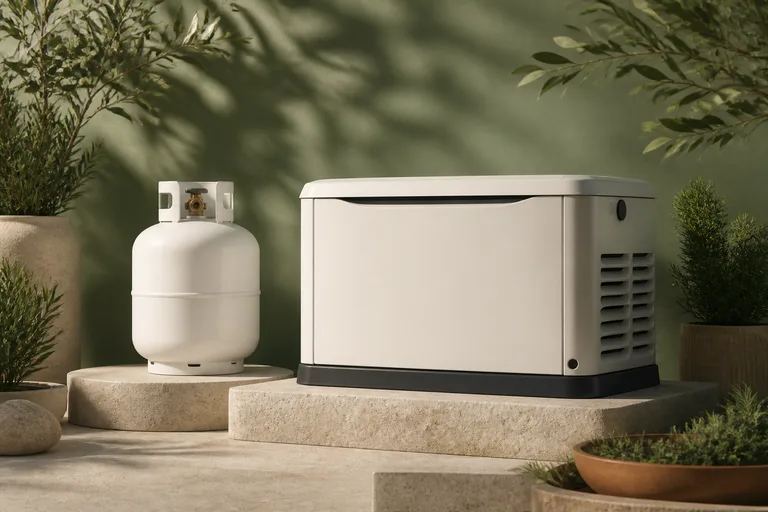
A propane generator is usually the better whole-house backup choice when natural gas is unavailable, expensive to establish, or you specifically want fuel stored onsite before an outage begins.
Propane has several real advantages:
- fuel can be stored at the property
- no dependence on a natural-gas utility
- some generators produce more output on propane than natural gas
- large tanks can support multi-day outages
- propane works well for rural properties
But propane also creates its own constraints:
- finite stored fuel
- refill logistics
- tank cost
- regulator and fuel-line requirements
- cold-weather vaporisation limits
- tank siting and installation requirements
The right question is not:
"Is propane better than natural gas?"
It is:
"Does stored propane give this property a better backup-power system than utility gas or another fuel?"
For many rural and off-gas homes, the answer is yes.
Propane Generator: Quick Verdict
We would usually choose a propane whole-house generator when:
- the property does not have natural-gas service
- extending natural gas would be expensive
- the home already uses propane
- stored fuel independence matters
- multi-day outages are possible
- an appropriate tank can be installed
- the generator's higher LP output is useful
We would look harder at natural gas when:
- adequate gas service already exists
- fuel cost per operating hour matters heavily
- avoiding deliveries/refills matters
- long utility-fed runtime is more useful than onsite stored fuel
The biggest mistake is treating propane as:
"a 500-gallon tank equals X days."
Runtime depends on load, generator consumption, usable fill, temperature, vaporisation and other propane appliances.
What Is a Propane Generator?
A propane generator uses liquefied petroleum gas - typically stored as liquid propane in a tank - as fuel for an internal-combustion engine connected to an alternator.
For residential whole-house backup, the typical system includes:
- permanent standby generator
- propane tank
- regulator system
- fuel piping
- automatic transfer switch
- electrical connection to the home
When the utility fails, the generator starts automatically and consumes propane vapor from the onsite storage system.
The tank stores propane as a liquid.
The generator normally consumes it as vapor.
That distinction matters in cold weather.
Are Propane Generators Good for Whole-House Backup?
Yes.
Propane is particularly strong for:
- rural homes
- properties without natural-gas service
- hurricane/winter-storm resilience
- owners who want fuel physically stored onsite
- areas where gas-utility dependence is undesirable
Its strongest benefit is straightforward:
you know the fuel is there before the outage starts.
That is fundamentally different from natural gas, where fuel supply depends on utility infrastructure continuing to operate.
But propane storage is finite.
That means resilience becomes a storage and logistics problem.
Propane Generator Sizes
Residential propane standby generators cover a broad range.
Current project research includes examples from smaller residential units through 50+ kW systems.
Current LP-rated examples include:
| Generator | Propane Output |
|---|---|
| Kohler 10RESV | 10 kW |
| Kohler 12RESV | 12 kW |
| Kohler 14RCA | 14 kW |
| Kohler 20RCA | 20 kW |
| Generac Next Generation 22 kW | 22 kW |
| Generac Next Generation 26 kW | 26 kW |
| Kohler 26RCA | 26 kW |
| Cummins RS25 | 25 kW |
| Cummins RS36 | 36 kW |
| Kohler 38RCLC | 38 kW |
| Kohler 48RCLC | 48 kW |
| Kohler 60RCLB | 60 kW |
For propane buyers, the full LP rating can sometimes be higher than the equivalent NG rating.
That can materially affect sizing.
Do Propane Generators Produce More Power Than Natural Gas?
Often.
But not always.
Current examples include:
Generac Next Generation 22 kW
- 21 kW NG
- 22 kW LP
Generac Next Generation 26 kW
- 24 kW NG
- 26 kW LP
Generac Next Generation 28 kW
- approximately 25 kW NG
- 28 kW LP
Kohler 20RCA
- 18 kW NG
- 20 kW LP
Kohler 26RCA
- 24 kW NG
- 26 kW LP
But Cummins provides an important counterexample:
Cummins RS25
- 25 kW NG
- 25 kW LP
Cummins RS36
- 36 kW NG
- 36 kW LP
So the correct statement is:
many residential standby generators produce more power on propane, but the advantage is model-specific.
Do not assume LP always gives you more output.
What Size Propane Generator Do I Need?
Start with electrical load.
Not house size.
The process is:
- identify the loads you actually want to run
- calculate total running demand
- account for starting loads
- decide what can be load managed
- add sensible headroom
- compare against the exact LP rating of candidate generators
Use our generator size calculator for the first-pass estimate.
Then size the propane storage and fuel system around the chosen generator.
Why Propane Output Can Change the Generator Size
Suppose your managed load is:
25 kW
A generator sold as 26 kW might provide:
- 24 kW on NG
- 26 kW on LP
On natural gas, it may be too small.
On propane, it may fit.
That means fuel choice can directly affect:
- generator model
- equipment price
- load-management strategy
This is why sizing and fuel selection should happen together.
How Much Propane Does a Whole-House Generator Use?
Fuel consumption depends on:
- generator size
- electrical load
- engine
- operating conditions
Current manufacturer examples in our research include propane consumption roughly in the range of:
1.5-2 gallons/hour around 50% load
and:
roughly 3-4 gallons/hour near full load
for represented mainstream residential standby systems.
For example, current research includes:
Generac 18 kW Example
- about 1.65 gal/hour at 50% load
- about 2.87 gal/hour at full load
Champion 201222
- about 2.0 gal/hour at 50% load
- about 3.6 gal/hour at full load
Generac 22 kW Example Used in Runtime Modelling
- about 2.45 gal/hour at 50% load
- about 3.71 gal/hour at full load
Do not apply those figures to every generator.
Use the manufacturer consumption table for the exact unit.
How Much Does a Propane Generator Cost to Run?
Using the January 2026 US residential propane price input captured in the project's research:
$2.566 per gallon, excluding taxes
illustrative current examples calculated to approximately:
| Generator | 50% Load | Full Load |
|---|---|---|
| Generac 18 kW example | ~$4.23/hr | ~$7.36/hr |
| Champion 201222 | ~$5.13/hr | ~$9.24/hr |
| Kohler/Rehlko 20RESC | ~$5.90/hr | ~$10.01/hr |
| Cummins RS20A | ~$4.63/hr | ~$7.86/hr |
These are illustrative fuel-only calculations.
They exclude:
- taxes
- delivery fees
- tank rental
- minimum-delivery charges
- installation
- maintenance
- regional pricing
- actual changing electrical load
Propane can therefore cost materially more per operating hour than natural gas in current examples.
But operating cost is only one part of the decision.
If natural gas would cost thousands to extend to the property, propane can still be the cheaper total system.
How Long Will a Propane Generator Run?
Runtime depends on:
usable propane ÷ generator consumption
But that simple formula needs assumptions.
The important inputs are:
- nominal tank size
- actual fill level
- usable fill
- generator load
- generator consumption
- ambient temperature
- tank vaporisation
- other propane appliances
Using a current 22 kW example consuming approximately:
- 2.45 gal/hour at 50% load
- 3.71 gal/hour at full load
and an illustrative assumption of 80% usable fill, the basic runtime model looks like this:
| Nominal Tank | Assumed Usable Fuel | 50% Load | Full Load |
|---|---|---|---|
| 250 gal | 200 gal | ~81.6 hours / 3.4 days | ~53.9 hours / 2.2 days |
| 500 gal | 400 gal | ~163.3 hours / 6.8 days | ~107.8 hours / 4.5 days |
| 1,000 gal | 800 gal | ~326.5 hours / 13.6 days | ~215.6 hours / 9.0 days |
These are illustrative calculations, not guaranteed runtimes.
Real runtime can be lower or higher.
How Long Will a 500-Gallon Propane Tank Run a Generator?
There is no single correct answer.
Using the same illustrative 22 kW consumption:
At 50% Load
Assume:
- 500-gallon nominal tank
- 400 usable gallons
- 2.45 gal/hour
Then:
400 ÷ 2.45 = about 163 hours
or:
about 6.8 days
At Full Load
Assume:
- 400 usable gallons
- 3.71 gal/hour
Then:
400 ÷ 3.71 = about 108 hours
or:
about 4.5 days
That is a huge difference from the same tank.
So any claim saying:
"A 500-gallon propane tank runs a whole-house generator for exactly X days"
without giving load and consumption is incomplete.
How Long Will a 250-Gallon Propane Tank Run a Generator?
Using the same illustrative 22 kW example and an assumed 200 usable gallons:
50% Load
200 ÷ 2.45 = about 81.6 hours
or:
3.4 days
Full Load
200 ÷ 3.71 = about 53.9 hours
or:
2.2 days
Again, actual runtime changes with load.
How Long Will a 1,000-Gallon Propane Tank Run a Generator?
Using 800 usable gallons:
50% Load
800 ÷ 2.45 = about 326.5 hours
or:
13.6 days
Full Load
800 ÷ 3.71 = about 215.6 hours
or:
9 days
That is why 1,000-gallon storage becomes attractive for properties where prolonged outages are a serious concern.
But there is another issue:
can the tank vaporise enough propane at the required temperature and withdrawal rate?
Gallons alone do not answer that.
What Size Propane Tank Do I Need for a Whole-House Generator?
There is no universal tank size.
Common residential tank capacities can include:
- 120 gallons
- 250 gallons
- 500 gallons
- 1,000 gallons
But the correct tank depends on:
- generator consumption
- desired outage duration
- climate
- generator load
- other propane appliances
- delivery access
- refill strategy
- vaporisation requirement
For serious whole-house backup, tank sizing should be treated as part of the generator design.
Not an afterthought.
Is a 120-Gallon Propane Tank Enough for a Whole-House Generator?
It can operate some standby generators.
But for prolonged whole-house backup, a small tank can disappear quickly.
If a generator consumes around:
2-3+ gallons/hour
under meaningful load, a relatively small usable fuel reserve may only support a limited outage window.
A 120-gallon tank may make sense for:
- shorter expected outages
- low average generator load
- other property constraints
It is not automatically the right resilience strategy for a homeowner preparing for a five-day hurricane outage.
Is a 500-Gallon Propane Tank Good for a Generator?
For many residential standby installations, 500 gallons is a much more substantial backup reserve.
Using the illustrative current 22 kW example, it can potentially support several days of operation depending on load.
It also provides more vaporisation surface than a smaller tank.
But even 500 gallons is not automatically enough.
A large house running:
- multiple AC units
- pool equipment
- heavy electrical loads
can consume fuel quickly.
Tank size should follow the outage target.
Is a 1,000-Gallon Tank Better?
It provides more stored energy and can improve long-outage resilience.
But larger tanks also create:
- higher equipment cost
- more site requirements
- more initial fuel cost
- greater space requirements
Buy storage for a reason.
A 1,000-gallon tank for a house that only experiences two-hour outages is probably unnecessary unless the property already uses propane heavily for other appliances.
Propane Tank Fill: Why "500 Gallons" Doesn't Mean 500 Usable Gallons
Propane tanks are not normally filled to 100% of their nominal water capacity.
Space must remain for thermal expansion.
That is why runtime modelling often uses a percentage of nominal tank capacity rather than assuming every named gallon is available.
Our illustrative tables use 80%.
Real fill state can differ.
If the tank is only half full when the outage starts, the nameplate capacity is irrelevant.
The useful number is:
how much propane is actually in the tank now?
Propane Vaporisation: The Part Most Generator Guides Ignore
A standby generator usually draws propane as vapor.
The tank stores propane as liquid.
The liquid therefore has to vaporise fast enough to meet generator demand.
Vaporisation ability changes with:
- outside temperature
- tank size
- tank fill level
- withdrawal rate
This creates an important scenario:
the tank can contain plenty of propane but still struggle to deliver vapor at the required rate.
That matters particularly in cold climates and with large generators.
Can a Propane Tank Be Too Small Even If It Has Enough Gallons?
Yes.
This is a critical distinction.
Tank sizing has two jobs:
- store enough fuel
- vaporise fuel fast enough
A small tank could mathematically contain enough gallons for the desired runtime while still being a poor engineering choice because its vaporisation capacity is insufficient under cold conditions.
That is why tank sizing should be verified by a propane professional against:
- maximum generator BTU demand
- expected minimum temperature
- tank fill level
- other propane loads
Do Propane Generators Work in Cold Weather?
Yes.
But cold weather can reduce propane vaporisation capability.
As temperature falls:
- tank pressure changes
- vaporisation can decline
- a heavily loaded generator demands substantial vapor
A tank that performs perfectly in summer can have less vaporisation capacity in severe cold.
This does not mean:
"Propane doesn't work in winter."
It means cold-climate design needs to account for the physics of the tank.
Does a Bigger Propane Tank Help in Cold Weather?
Generally, a larger tank can provide more surface area for vaporisation and more stored fuel.
But we would not publish one universal:
"At X°F you need exactly Y gallons"
table without sufficiently authoritative source data for the exact conditions.
The current project research specifically did not find a universal authoritative tank-size-by-temperature table suitable for a national rule.
So the correct process is:
take the generator's maximum propane demand to the propane supplier and have them size storage/regulation for the design temperature.
Propane Generator BTU Demand
Propane generator fuel requirements may be expressed in:
- gallons/hour
- cubic feet/hour of vapor
- BTU/hour
The fuel system needs to satisfy maximum generator demand.
As generator size rises, BTU demand rises.
That affects:
- tank size
- regulator
- line size
- vaporisation
Do not size propane piping from generator kW alone without using the manufacturer fuel data.
Propane Regulator Requirements
A standby generator relies on the correct regulated fuel pressure.
Propane systems may involve multiple regulation stages depending on:
- tank configuration
- line length
- appliance demands
- generator specification
Regulator design affects whether the generator receives the required pressure under load.
This is not a DIY optimisation exercise.
Fuel-pressure work should be handled by qualified installers.
Propane Generator Fuel-Line Size
There is no universal pipe diameter.
Sizing depends on:
- generator maximum BTU requirement
- line length
- pipe material
- regulator arrangement
- pressure
- fittings
- other loads
A generator 15 feet from the tank and the same generator 150 feet away can require different fuel-system designs.
Use the actual fuel calculation.
Can a Propane Generator Share a Tank With Other Appliances?
Yes, if the system is properly sized.
A propane tank may also supply:
- furnace
- water heater
- range
- fireplace
- pool heater
- dryer
But that means generator runtime modelling must account for those loads too.
A 500-gallon tank does not reserve every gallon for the generator.
During a winter outage, the propane furnace may be consuming fuel at the same time the generator is operating.
That can materially reduce backup duration.
Propane Generator Installation Cost
The propane side of the installation can include:
- tank
- tank delivery
- pad or excavation
- above-ground or underground placement
- regulators
- fuel lines
- trenching
- initial propane fill
- permits
- setback requirements
That sits alongside normal generator costs such as:
- generator
- automatic transfer switch
- electrical work
- site preparation
- commissioning
This is why propane is not automatically more expensive than natural gas.
If natural gas already exists, NG may have the infrastructure advantage.
If it does not, propane may avoid expensive utility extension.
Above-Ground vs Underground Propane Tank
Both can work for generator backup.
Above-Ground Tank
Potential advantages:
- easier access
- simpler inspection
- generally less excavation
Potential disadvantages:
- visible
- space/clearance considerations
- environmental exposure
Underground Tank
Potential advantages:
- less visually intrusive
- protects much of tank body from above-ground exposure
Potential disadvantages:
- excavation
- higher installation complexity
- different inspection/maintenance requirements
The decision is more site-planning than generator performance.
Can Propane Tanks Be Installed Anywhere?
No.
Tank installation is subject to:
- code
- setback requirements
- buildings
- ignition sources
- property lines
- accessibility
- delivery access
- local rules
Do not choose generator placement without considering where the propane tank and fuel line can legally and practically go.
The two systems need to be designed together.
Propane Refill During a Power Outage
Stored fuel gives propane independence from gas utility infrastructure.
But once storage drops, you depend on:
delivery infrastructure.
That can be difficult during:
- hurricanes
- floods
- wildfires
- ice storms
- blocked roads
- regional fuel shortages
The project research includes disaster evidence showing propane transport/refill constraints during wildfire conditions.
So the real resilience question is:
"How much fuel can I have onsite before the event, and how reliably can I refill it afterwards?"
Is Propane Better for Hurricanes?
It can be.
Propane's hurricane advantage is:
the fuel is already stored at the property.
You are not relying on utility gas pressure remaining available.
But the disadvantage is:
finite inventory and refill logistics.
For hurricane planning, a propane system becomes stronger when:
- storage is large
- the tank starts full
- the installation is protected appropriately
- expected outage load is managed
- refill logistics are realistic
Do not treat a small half-filled tank as "fuel independence."
Is Propane Better for Rural Homes?
Usually, yes, when natural gas is unavailable.
Propane avoids the need to extend gas-utility infrastructure and can provide substantial onsite energy storage.
That makes it a natural fit for:
- farms
- remote properties
- rural homes
- second homes
Especially where the property already uses propane.
Is Propane Better Than Diesel for Home Backup?
That depends on system size and application.
Propane has advantages such as:
- residential familiarity
- clean storage compared with gasoline
- easy integration with many home standby products
Diesel becomes more interesting in:
- larger systems
- heavy-duty applications
- commercial-style installations
See our diesel generator guide for more on larger systems and heavy-duty backup applications.
Propane Generator vs Natural Gas Generator
The clean decision is:
Propane Wins When:
- no NG service exists
- onsite fuel storage matters
- LP output advantage is useful
- rural location favours tank storage
- utility independence matters
Natural Gas Wins When:
- adequate NG service already exists
- lower current fuel cost matters
- refilling should be avoided
- utility-fed long-duration operation matters
See our full natural gas vs propane generator comparison.
Propane Generator vs Home Battery
Propane and batteries solve very different resilience problems.
Propane:
- stores chemical energy
- can provide a very large total energy reserve
- runs a combustion generator
- can support prolonged outages
Battery:
- stores electrical energy
- operates quietly
- has no onsite combustion
- can recharge from solar
For long high-energy outages, a large propane reserve can provide far more total kWh than a single residential battery.
For short outages or solar homes, battery backup can be more attractive.
See our generator vs home battery comparison.
Propane Generator Maintenance
Propane does not eliminate generator maintenance.
The generator still needs model-specific service involving:
- oil
- oil filter
- air filter
- spark plugs
- starter battery
- valve checks where applicable
The propane system itself should also remain in good condition.
Long outages can bring maintenance intervals forward quickly.
Is Propane More Reliable Than Natural Gas?
There is no credible population-level evidence proving propane-powered residential standby generators are universally more reliable.
Propane does give you:
onsite stored fuel
which removes one utility dependency.
But system reliability still depends on:
- generator
- tank
- regulator
- piping
- maintenance
- installation
- weather
- service support
Do not turn fuel storage into a fake engine reliability statistic.
Does Propane Store Well?
Propane is well suited to long-term storage in a proper tank.
Unlike gasoline, it does not create the same sort of short-term fuel-degradation problem that makes stored gasoline difficult.
That is one reason propane works well for backup systems that may sit unused for long periods.
The tank and regulators still need proper installation and inspection.
Do You Need to Treat Propane Fuel?
Normally, propane stored in a proper bulk tank does not require the same fuel-stabiliser routine associated with gasoline storage.
That makes standby readiness simpler.
You still need to know:
- tank level
- regulator condition
- leak-free fuel system
Can a Propane Generator Run Out of Fuel?
Yes.
And unlike utility-fed natural gas, when the tank is empty the generator stops.
That sounds obvious, but it creates an operational lesson:
monitor fuel before severe weather, not after the outage begins.
For a home dependent on propane backup:
- know current tank percentage
- know generator consumption
- define minimum reserve
- arrange refill before predictable storms
Should You Keep the Propane Tank Full?
For outage preparedness, a larger available reserve obviously increases runtime.
But actual fill management depends on:
- propane supplier
- tank ownership
- seasonal fuel use
- local pricing
- other appliances
The important point is not that the tank must always be at one exact percentage.
It is that the homeowner should know the actual available fuel before an outage-risk period.
Tank Ownership vs Tank Rental
Some homeowners own their propane tank.
Others lease/rent it through a propane supplier.
That can affect:
- supplier choice
- fuel pricing
- maintenance responsibility
- installation cost
- contract terms
If the generator will become a major propane consumer, understand the tank/supplier arrangement before buying the system.
Cheap tank installation tied to expensive long-term fuel is not automatically cheap.
Best Propane Generator Brands
Our main residential shortlist remains:
- Generac
- Kohler/Rehlko
- Cummins
- Briggs & Stratton
- Champion
For propane specifically, the useful difference is often:
how much LP output does the exact model provide?
Generac and Kohler mainstream models frequently reach their higher headline rating on LP.
Cummins examples such as RS25 and RS36 provide equal output on both fuels.
Brand should follow:
- load
- LP output
- installed cost
- dealer quality
- service support
not the other way around.
Generac Propane Generators
Generac has extensive residential propane capability.
Current examples include:
Next Generation 22 kW
- 21 kW NG
- 22 kW LP
Next Generation 26 kW
- 24 kW NG
- 26 kW LP
Next Generation 28 kW
- about 25 kW NG
- 28 kW LP
That LP advantage can matter for homeowners near a sizing threshold.
See our Generac standby generator guide.
Kohler/Rehlko Propane Generators
Current examples include:
- 10RESV - 10 kW LP
- 12RESV - 12 kW LP
- 14RCA - 14 kW LP
- 20RCA - 20 kW LP
- 26RCA - 26 kW LP
- 24RCLA - 24 kW LP
- 38RCLC - 38 kW LP
- 48RCLC - 48 kW LP
- 60RCLB - 60 kW LP
See our Kohler generator guide for the wider model range.
Cummins Propane Generators
Cummins offers propane-capable residential standby equipment across multiple capacities.
The interesting current examples are:
RS25
- 25 kW NG
- 25 kW LP
RS36
- 36 kW NG
- 36 kW LP
Propane does not buy additional rated output on those specific models because they already retain full natural-gas capacity.
That can still make Cummins a strong propane option.
See our Cummins generator guide.
Questions to Ask Before Buying a Propane Generator
Ask the installer/propane supplier:
- What is the generator's exact LP output?
- What is its maximum propane consumption?
- What tank size are you proposing?
- How much usable fuel should I model?
- What runtime does that give at realistic load?
- What minimum design temperature are you using?
- Can the tank vaporise enough propane at that temperature?
- What regulator configuration is required?
- What fuel-line size is required?
- Are other propane appliances included?
- Is the tank owned or leased?
- What are local refill lead times during major storms?
- Is the initial propane fill included in the quote?
If nobody can explain vaporisation and they are selling you a large standby generator in a cold climate, keep asking questions.
Propane Generator FAQ
How long will a 500-gallon propane tank run a whole-house generator?
Using an illustrative 400 usable gallons and a current 22 kW example consuming 2.45 gal/hour at 50% load, runtime is about 163 hours or 6.8 days. At 3.71 gal/hour full load, it is about 108 hours or 4.5 days.
How much propane does a whole-house generator use?
Current residential examples in our research range roughly from around 1.5-2 gal/hour at partial load to around 3-4 gal/hour near full load, depending on model.
What size propane tank do I need for a whole-house generator?
It depends on generator consumption, desired runtime, climate, other propane appliances and vaporisation requirements. Common residential tank sizes include 250, 500 and 1,000 gallons.
Is a 500-gallon propane tank enough?
It can provide several days of runtime for many residential systems depending on load, but it is not universally enough. Model actual consumption.
Is a 250-gallon propane tank enough?
Potentially for shorter outages or lighter loads. For prolonged whole-house backup, larger storage may be more appropriate.
Can propane generators run in freezing weather?
Yes, but tank vaporisation capability decreases as conditions get colder. Tank size, fill level and generator demand must be considered.
Do propane generators produce more power than natural gas?
Many do, but not all. Current Generac and Kohler examples often have higher LP ratings, while Cummins RS25 and RS36 retain equal output on both fuels.
Is propane more expensive than natural gas?
In current fuel-only examples researched for Backup Generator Guide, propane cost more per operating hour than natural gas. Local pricing and infrastructure cost can change the total ownership decision.
Does propane go bad?
Bulk propane stored correctly does not create the same short-term degradation issues associated with stored gasoline.
Is propane better for rural homes?
Often, yes. Propane provides onsite fuel storage without requiring natural-gas utility service.
Can a propane generator run for a week?
Yes, if enough usable fuel is stored and the generator/tank system can support the required load and vaporisation. A 1,000-gallon tank can provide substantial multi-day runtime in appropriate conditions.
Can a propane generator share fuel with my furnace?
Yes, if the entire tank, regulator and piping system is sized for simultaneous demand. Other appliances also reduce the fuel available to the generator.
Final Verdict
For homes without practical natural-gas service, propane is usually the whole-house generator fuel we would investigate first.
Its biggest advantage is not that propane is magically superior fuel.
It is that:
the energy is already sitting on your property before the outage happens.
That makes propane particularly strong for:
- rural homes
- long outages
- utility-independent fuel planning
- properties already using propane
And some generators provide additional output on LP.
But propane only works as a resilience strategy if the storage system is designed properly.
That means:
enough gallons + enough vaporisation + correct regulators + correct piping + realistic refill planning
A 500-gallon tank is not automatically "six days of backup."
And a tank containing fuel is not automatically large enough to vaporise that fuel at full generator demand in severe cold.
So our buying sequence is:
calculate electrical load → choose generator → confirm LP rating → calculate maximum consumption → define outage-duration target → size tank for both storage and vaporisation → price installation and refill logistics.
Do that, and propane can be an excellent whole-house backup fuel.
Skip it, and "we've got a big tank" is not much of a resilience plan.
Evidence Basis
This guide uses the existing Backup Generator Guide fuel research covering manufacturer LP output and consumption data from Generac, Champion, Kohler/Rehlko and Cummins, along with current US residential propane price evidence and tank/runtime modelling.
Runtime examples use explicit assumptions around nominal tank capacity, 80% usable fill and manufacturer consumption. They are illustrative rather than guaranteed runtimes.
The research also identified propane vaporisation, ambient temperature, tank fill and simultaneous appliance demand as critical variables, so this guide deliberately avoids publishing a universal tank-size-by-temperature rule unsupported by sufficiently strong evidence.