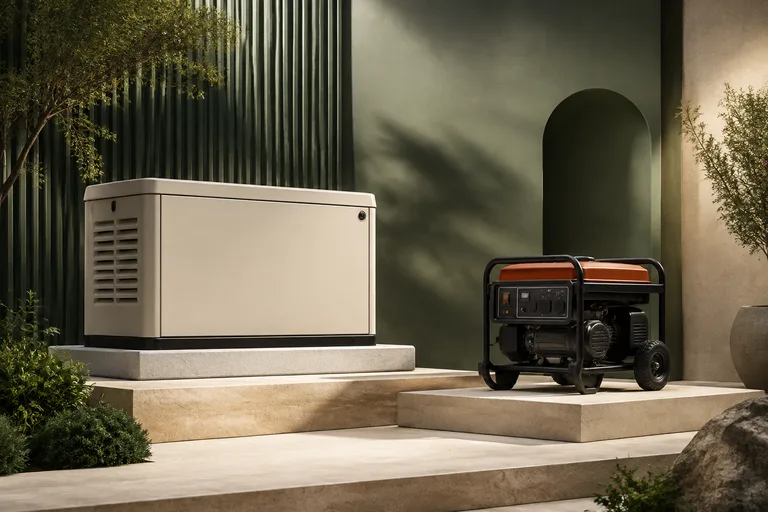
A whole-house standby generator and a portable generator can both keep your home running during an outage.
But they solve the problem in completely different ways.
A whole-house standby generator is permanently installed, starts automatically and normally runs on natural gas or propane.
A portable generator is manually deployed, manually connected and normally costs far less.
The commercial trade is simple:
Whole-house standby = automation, convenience and prolonged unattended backup.
Portable = far more watts per dollar.
For a homeowner who travels frequently, experiences long outages or wants the house to recover automatically at 2 AM, standby usually wins.
For a homeowner who can operate the system manually and wants the best backup capability for the budget, a large portable connected through a proper interlock or transfer switch can be bloody hard to beat.
Whole-House vs Portable Generator: Quick Verdict
| Factor | Whole-House Standby | Portable Generator |
|---|---|---|
| Automatic start | Yes | No |
| Automatic transfer | Yes | No |
| Permanent installation | Yes | No |
| Typical fuel | NG / propane | Gasoline / propane / NG |
| Purchase cost | Higher | Much lower |
| Installation cost | Higher | Much lower |
| Watts per dollar | Lower | Better |
| Unattended operation | Excellent | Poor |
| Multi-day outages | Excellent | Good with fuel/logistics |
| Fuel flexibility | Moderate | Excellent on dual/tri-fuel |
| Noise | Model-dependent | Often louder |
| Maintenance | Automatic system + engine | Engine + manual setup |
| Weather setup | Permanently weather-ready | Must be safely deployed |
| Best for | Convenience/resilience | Value/manual backup |
Our call: if automatic operation matters, buy standby.
If it doesn't, seriously consider portable before spending standby money.
What Is a Whole-House Standby Generator?
A whole-house standby generator is permanently installed outside the home and connected to:
- the electrical system
- an automatic transfer switch
- natural gas or propane
- sometimes diesel on larger systems
During a typical outage:
- utility power fails
- generator controller detects the outage
- generator starts
- automatic transfer switch moves the house onto generator power
- generator carries the supported loads
- utility returns
- system transfers back
- generator cools down and shuts off
Nobody needs to be home.
That is the main thing you're paying for.
What Is a Portable Generator?
A portable generator is a manually operated engine generator.
For home backup, a proper system typically uses:
- portable generator
- outdoor operating location
- generator inlet
- manual transfer switch or approved interlock
- household electrical panel
The homeowner normally has to:
- move/setup the generator
- connect fuel
- connect the generator to the inlet
- start it
- switch the panel onto generator power
- manually manage electrical load
- refuel or change fuel source
- shut everything down when utility returns
A portable generator can produce serious home-backup power.
It just doesn't remove the human from the process.
Which Is Better: Whole-House or Portable?
There is no universal winner.
Buy a Whole-House Standby Generator If:
- backup must be automatic
- you're often away from home
- outages can last days
- you want central HVAC supported automatically
- household members cannot deploy a portable generator
- you want permanent weather-ready equipment
- budget supports the installation
Buy a Portable Generator If:
- outages are occasional
- budget matters
- you're comfortable operating it manually
- you can safely position it outside
- you can manage household loads
- you want fuel flexibility
- automatic backup is not worth another several thousand dollars
That distinction matters more than brand.
Whole-House vs Portable Generator Cost
This is where the categories separate dramatically.
Current Generac standby equipment alone includes examples such as:
- 22 kW generator-only: around $6,309 MSRP
- 22 kW with transfer switch: around $7,369 MSRP
- 26 kW with transfer switch: around $8,219 MSRP
before complete installation.
A full standby installation can also require:
- generator pad
- ATS
- electrician
- gas piping
- meter/regulator work
- trenching
- permits
- load management
- commissioning
So installed cost can be materially higher than generator MSRP.
By comparison, a large portable generator can cost a fraction of that before adding:
- inlet
- interlock/manual transfer
- electrician
That is why portable usually wins the capital-efficiency comparison.
Watts Per Dollar: Portable Wins
This is the strongest portable argument.
A high-output tri-fuel portable such as the Westinghouse WGen11500TFc currently provides:
- 11,500 running watts gasoline
- 10,500 propane
- 9,500 natural gas
- 120/240V output.
That is serious household backup capacity.
Yet the portable architecture avoids the large permanent-installation cost of a whole-house standby system.
You are trading:
labour and convenience
for:
capital savings.
For many households, that's a very good trade.
Whole-House Generator Power
Residential standby generators commonly occupy roughly the:
10–26+ kW
range for mainstream air-cooled systems, with larger liquid-cooled equipment beyond that.
Examples already covered on this site include:
- 18 kW
- 22 kW
- 26 kW
- larger 30–50+ kW systems
But the relevant number is always:
actual fuel-specific output.
A 26 kW generator may only produce around 24 kW on natural gas.
Do not compare headline model names alone.
Portable Generator Power
Portable generators range from:
- 2–3 kW inverter units
- 5–7.5 kW essential-load machines
- 8–12+ kW serious home-backup units
For a whole-panel manual backup setup, I would generally investigate:
7–12+ kW running output
depending on the load.
Use our generator size calculator rather than buying from house square footage.
Can a Portable Generator Really Power a Whole House?
Potentially, yes.
But "whole house" needs defining.
A portable generator connected through an interlock can energise the home's main panel.
That does not mean every appliance can run simultaneously.
Suppose you have:
10 kW of generator capacity.
You could potentially run:
- refrigerator
- freezer
- well pump
- furnace blower
- lighting
- outlets
- microwave
- selected AC
while manually keeping high-demand loads off.
That is very different from recreating a full 200A utility service.
A 200A House Does Not Need a 48 kW Generator
A 200A electrical service at 240V theoretically represents:
48 kW.
That does not mean your backup generator needs to produce 48 kW.
Most households do not use every connected load simultaneously.
Backup sizing should focus on:
- what actually needs to run
- what starts at the same time
- which loads can be managed
This applies to both standby and portable generators.
Whole-House Generator Advantage: Automatic Operation
This is the strongest standby argument.
A whole-house generator can restore power while:
- you're asleep
- you're travelling
- nobody is home
- weather is severe
That can matter enormously if the house depends on electricity for:
- sump pump
- heating controls
- refrigeration
- medical/critical loads
- well pump
- security systems
A portable generator does nothing until someone operates it.
Portable Generator Disadvantage: You Have to Be There
This becomes more important than people expect.
Imagine:
- you're out of state
- outage starts
- freezer is warming
- sump pump has stopped
- nobody can deploy the generator
The $2,000 portable generator sitting in the garage has:
zero useful output.
For absentee homeowners, automation can justify the standby premium very quickly.
Whole-House Generator Advantage: Fuel Supply
Standby generators usually run on:
- natural gas
- bulk propane
That removes much of the fuel handling involved with gasoline portable generators.
Natural Gas Standby
Can potentially run for prolonged periods while utility gas remains available.
Propane Standby
Can run from large onsite storage.
That is far more convenient than filling a portable generator every few hours.
Portable Generator Advantage: Fuel Flexibility
This is where portable equipment can actually beat standby.
Current dual-fuel and tri-fuel generators may run on:
- gasoline
- propane
- natural gas
For example, the current Westinghouse WGen11500TFc supports all three fuels at 11.5/10.5/9.5 kW running output respectively.
That gives you genuine outage flexibility.
If one fuel becomes hard to obtain, another may still work.
Whole-House vs Portable on Natural Gas
If the home already has adequate natural gas:
Standby
Best for:
- automatic operation
- long outages
- no manual setup
Tri-Fuel Portable
Best for:
- lower cost
- manual backup
- retaining propane/gasoline fallbacks
This can be a very compelling portable architecture.
Whole-House vs Portable on Propane
Bulk propane works extremely well with standby.
A permanent propane system can support multi-day operation from:
- 250-gallon
- 500-gallon
- 1,000-gallon
storage depending on the application.
Portable generators can also run propane, but a standard 20 lb cylinder is a much smaller energy reserve.
For long outages, bulk fuel changes the game.
Which Is Better for Long Outages?
Usually:
whole-house standby.
Not necessarily because the generator itself can run longer mechanically.
Because the complete system is designed around:
- permanent fuel
- automatic transfer
- weather exposure
- long-duration home use
A portable generator can absolutely run through long outages.
But the owner must manage:
- fuel
- maintenance
- placement
- weather
- loads
- refuelling
for the entire event.
Portable Can Still Win Multi-Day Outages
Do not overstate the standby advantage.
A large tri-fuel portable connected to natural gas can remove much of the refuelling issue.
That creates a very strong setup:
NG-fed tri-fuel portable + interlock + manual load management
You still lack automation.
But once it is running, the energy economics can be excellent.
Which Is Better for Hurricanes?
If budget permits:
standby usually wins.
Why?
Because hurricanes can create:
- heavy rain
- strong winds
- flooded roads
- fuel queues
- long outages
That is exactly when you least want to:
- wheel equipment outside
- connect cords
- handle gasoline
But a well-prepared portable system can still be an excellent lower-cost solution.
Which Is Better for Winter Storms?
Again, standby has the convenience advantage.
A permanently installed system avoids deploying a 200+ lb generator in:
- snow
- ice
- freezing temperatures
But portable still makes sense when:
- outage frequency is low
- budget is limited
- homeowner can safely operate it
The climate does not automatically justify a $10,000+ system.
The outage economics do.
Whole-House vs Portable for Central AC
Standby is generally easier.
A large standby generator can be sized and installed specifically around:
- central AC
- HVAC starting loads
- load management
Portable generators can run some central AC systems too.
But you need:
- 120/240V output
- sufficient continuous power
- adequate surge capacity
- potentially a soft start
- manual load management
Once multiple HVAC systems matter, standby starts becoming more attractive.
Whole-House vs Portable for a Well Pump
Either can work.
The key issue is:
- pump voltage
- running load
- motor-start requirement
A panel-connected portable generator is much more useful for a well pump than extension-cord backup.
This is one of the strongest reasons to install an interlock or manual transfer switch.
Whole-House vs Portable for Gas Furnace Backup
Portable can win this easily.
A gas furnace mainly needs electrical power for:
- controls
- ignition
- blower
If your outage priorities are:
- furnace
- refrigerator
- lights
- internet
you may not need a whole-house standby generator at all.
A modest portable or inverter generator may solve the job far more cheaply.
Whole-House vs Portable for an All-Electric Home
Standby becomes more interesting.
An all-electric home may have:
- heat pumps
- electric water heater
- electric range
- electric dryer
- well pump
- EV charger
That can create much larger backup demand.
A portable can still work if you aggressively manage loads.
But at some point, the inconvenience starts defeating the savings.
Manual Load Management vs Automatic Load Management
Portable Generator
Usually:
you are the load-management system.
You manually switch breakers on and off.
Standby Generator
Can integrate:
- HVAC management
- load shedding
- priority controls
This allows the system to manage loads without the homeowner constantly watching capacity.
That becomes valuable as the house gets more electrically complex.
Whole-House Generator Installation
Standby installation is a proper project.
It can require:
- generator pad
- clearances
- fuel line
- electrical service work
- automatic transfer switch
- permitting
- commissioning
See our whole-house generator installation guide.
Portable Generator Installation
A portable generator itself is not permanently installed.
But a good home-backup setup still benefits from permanent electrical infrastructure:
- inlet
- dedicated generator breaker
- approved interlock
- or manual transfer switch
That investment can turn a portable generator from:
emergency extension-cord machine
into:
proper household backup system.
Portable Generator + Interlock
This is our preferred value setup for many homeowners.
The architecture is:
portable generator → inlet → generator breaker → approved interlock → main electrical panel
Benefits:
- flexible circuit selection
- hard-wired appliance backup
- lower cost
- no essential-load subpanel required in many installations
See our generator interlock kit guide.
Portable Generator + Manual Transfer Switch
Also valid.
This can be better where:
- panel has no approved interlock
- fixed essential circuits are preferred
- local installation architecture favours transfer equipment
See our transfer switch guide.
Automatic Transfer Switch: Standby's Killer Feature
The ATS is what makes standby genuinely automatic.
It safely moves the home between:
- utility
- generator
without the homeowner manually operating the electrical panel.
That automation is a big chunk of what you're paying for.
Maintenance: Which Is Easier?
Neither is maintenance-free.
Standby
Needs model-specific:
- oil
- filters
- spark plugs
- battery
- exercise checks
- system testing
Portable
Needs:
- oil
- filters
- spark plug
- fuel/storage management
- battery on electric-start models
Portable may run less often.
But gasoline storage can create its own maintenance problem.
Which One Is More Reliable?
There is no useful universal answer.
A permanently installed standby can be extremely reliable when:
- correctly installed
- maintained
- fuel supply remains available
A portable can be extremely reliable when:
- stored correctly
- fuel is available
- owner can deploy it
The main reliability difference is actually system readiness.
Standby is always sitting there connected.
Portable depends on:
- owner
- fuel
- setup
- storage condition
Which Is Quieter?
Usually, residential standby systems are easier to tolerate than large open-frame portable generators.
But exact noise varies by model.
Large portable conventional generators can be loud.
Inverter generators are much quieter, but usually provide less home-backup capacity per dollar.
If silence matters heavily, battery backup belongs in the comparison too.
See generator vs home battery.
Portable Generator Carbon Monoxide Risk
This is a major difference in user behaviour.
Portable generators must be deliberately placed safely every time they are used.
Current 2026 CPSC guidance says portable generators should be operated:
- outdoors only
- at least 20 feet from homes/buildings
- with exhaust directed away from windows, doors and vents.
CPSC specifically warns not to operate portable generators in:
- homes
- garages
- basements
- crawlspaces
- sheds
even with doors or windows open.
A standby generator is permanently sited during professional installation, so the homeowner is not making that placement decision every outage.
Can You Run a Portable Generator in a Garage With the Door Open?
No.
CPSC explicitly says not to do this.
This is not a judgement call.
Carbon monoxide can kill before occupants realise there is a problem.
Which Is Safer?
A correctly installed standby system removes more homeowner operating steps.
That is inherently useful.
A correctly installed portable setup can also be safe, but the user needs to:
- position the generator correctly
- connect it properly
- avoid backfeeding
- manage fuel
- manage weather
The more manual steps, the more opportunity for mistakes.
Which Is Better When Nobody Is Home?
Standby. Easily.
A portable generator cannot:
- deploy itself
- connect itself
- start itself
- operate your interlock
If unattended backup matters, the decision is basically made.
Which Is Better for Vacation Homes?
Usually standby.
Second homes are exactly where automatic backup can protect:
- refrigeration
- sump pumps
- heating
- pipes
- alarm/security systems
without someone being physically present.
Which Is Better for Someone on a Budget?
Portable.
This is the clearest portable victory.
If a properly configured portable system handles your actual outage loads, there is no reason to spend another several thousand dollars merely because standby is nicer.
Spend for a reason.
Is a Whole-House Generator Worth the Extra Money?
It is when the things you're buying matter.
The standby premium buys:
- automatic starting
- automatic transfer
- permanent fuel
- permanent outdoor installation
- unattended operation
- less homeowner labour
If those benefits aren't important, the economics become harder to justify.
Portable Generator Example: Westinghouse WGen11500TFc
A useful current example of the portable value proposition is the WGen11500TFc.
Current manufacturer documentation lists:
| Fuel | Running Output |
|---|---|
| Gasoline | 11,500W |
| Propane | 10,500W |
| Natural Gas | 9,500W |
It also provides:
- 120/240V
- 9.5-gallon gasoline tank
- tri-fuel capability.
That is enough capacity to make a portable system a serious alternative to lower-end standby installations for homeowners who accept manual operation.
Standby Example: Current Generac 22 kW
The current Generac Next Generation 22 kW is listed from:
$6,309 generator only
and:
$7,369 with transfer switch
before installation.
It provides:
- 21 kW NG
- 22 kW LP
and operates automatically when properly installed.
That illustrates the core market trade:
roughly double the generating capacity vs automation is not the comparison.
The comparison is:
what level of system integration and convenience do you actually need?
10 kW Portable vs 22 kW Standby
A useful way to think about it:
10 kW Portable
Can provide enough power for a substantial managed household load.
But you manually:
- start
- transfer
- refuel/manage fuel
- control circuits
22 kW Standby
Provides roughly twice the continuous capacity.
And it does everything automatically.
If the household only needs 7 kW during an outage, however, the extra capacity isn't necessarily the thing that justifies standby.
Automation is.
Portable vs Standby Runtime
Do not compare runtime without fuel context.
Gasoline Portable
Limited by:
- onboard tank
- stored cans
- petrol availability
Propane Portable
Limited by:
- cylinders/tank
- consumption
- refill access
NG Tri-Fuel Portable
Can potentially run for prolonged periods while utility gas remains available.
NG Standby
Same fuel-supply advantage, but permanently connected and automatic.
Propane Standby
Can use large bulk storage designed around multi-day operation.
Whole-House vs Portable for Fuel Consumption
Bigger generators generally consume more fuel.
If your real outage load is only:
4 kW
running a large 22–26 kW standby may not always be the most fuel-efficient approach compared with a smaller appropriately loaded generator.
But don't optimise fuel consumption while ignoring:
- convenience
- starting capacity
- resilience
- load requirements
Fuel use is one input.
Whole-House Generator vs Inverter Generator
This is an even wider gap.
A small inverter generator is best for:
- refrigerator
- electronics
- lights
- home office
- camping/RV
A whole-house standby system is designed for:
- HVAC
- pumps
- multiple circuits
- automatic home operation
See our inverter generator guide.
Whole-House Generator vs Tri-Fuel Portable
This is the comparison I would make for many natural-gas homes.
Standby
Choose for:
- automatic operation
- higher capacity
- permanent installation
Tri-Fuel Portable
Choose for:
- lower cost
- three fuel options
- manual backup
- strong watts-per-dollar
This may be the best budget alternative to a standby generator on the site.
Can I Start With Portable and Upgrade to Standby Later?
Absolutely.
And for uncertain buyers, that can be smart.
A homeowner can first install:
- portable generator inlet
- interlock/manual transfer
and use a portable system.
If outage frequency or household needs later justify standby, upgrade then.
The portable generator can still retain value for:
- secondary property
- jobsite
- emergency redundancy
What Happens to the Interlock if I Later Install Standby?
The electrical architecture may need to be redesigned when an ATS is installed.
Do not assume every component remains part of the final standby system.
But starting with a portable system is not inherently wasted money.
You're buying backup now rather than waiting years for the perfect system.
Whole-House vs Portable Generator by Homeowner Type
Family in Hurricane-Prone Area
Standby if budget supports it.
Long outages and severe weather make automation valuable.
Rural Home With Occasional Outages
Portable dual-fuel/tri-fuel can be excellent.
Especially if the owner is comfortable operating equipment.
Vacation Home
Standby.
Unattended backup is the point.
Budget-Conscious Homeowner
Portable.
Put some of the savings into:
- good inlet
- correct interlock
- fuel storage
- maintenance
Home With Medical or Critical Electrical Loads
Do not treat a home standby generator as a complete medical backup plan. Generac's represented residential owner's manual explicitly says the product is not intended for a critical life-support application.[5] Discuss power continuity, transfer interruption and an independent fallback with the equipment supplier and the clinician responsible for your care. Automatic starting may remove some manual operating steps, but it is not a guarantee that a medical device will remain powered throughout an outage.
Sources
Home With Frequent Short Outages
Potentially battery rather than either.
Test the choice against an outage you can actually manage
Before buying, walk through the household's first outage without touching live electrical equipment. Who is home, which loads must remain available, where would a portable run, and who can safely operate and refuel it? If there is no dependable operator or acceptable outdoor operating location, a low equipment price has not solved the backup problem.
For portable generators, CPSC says to operate outside, at least 20 feet from homes, with exhaust facing away, and never inside a home or garage even with doors or windows open. It also calls for CO alarms on every level and outside sleeping areas.[2] This portable-generator guidance is not a substitute for the exact standby model's installation requirements.
Compare two written scopes, not a portable's retail price against a finished standby installation:
- Portable route: selected loads, safe operating location, appropriate connection design, operator availability, fuel storage and refuelling responsibilities. Use the portable hookup guide to prepare questions for the electrician, not as permission to improvise a connection.
- Standby route: selected loads, automatic transfer, acceptable permanent location, fuel supply, commissioning and recurring service. Check property feasibility before proceeding to the standby installation process.
Use the installed-cost guide to understand standby scope, then browse providers for a property-specific assessment. If the main concern is choosing the contractor rather than the backup type, move to the installer-selection guide.
Sources
[2] https://www.cpsc.gov/Safety-Education/Safety-Education-Centers/Carbon-Monoxide-Information-Center
Cost Comparison: Don't Compare Generator to Generator
Compare the complete systems.
Standby System Cost Includes
- generator
- ATS
- pad
- electrician
- fuel work
- permits
- commissioning
Portable System Cost Includes
- generator
- inlet
- breaker
- interlock/manual transfer
- electrician
- cords/hoses
- fuel storage/setup
The portable still usually wins.
But compare finished systems rather than a bare generator price.
Questions to Ask Before Choosing
- Which loads absolutely need backup?
- What is their calculated running load?
- What is the largest starting load?
- Does the generator need to start automatically?
- Is anyone always available to deploy a portable?
- How long do local outages typically last?
- What fuels are available?
- Do I have natural gas?
- Can I store propane/gasoline safely?
- Do I need central AC?
- Do I need a well pump?
- How much am I willing to spend for automation?
- Is a local standby dealer strong?
- Can an interlock be installed on my panel?
If #4 is:
yes, automatic is essential
you can stop most of the portable comparison there.
Whole-House vs Portable Generator FAQ
Is a Whole-House Generator Better Than a Portable Generator?
For automatic, unattended and long-duration home backup, usually yes. For purchase price and watts per dollar, portable usually wins.
Is a Portable Generator Enough for a House?
Often, yes, if the load is managed. Large 7–12+ kW portable generators can supply substantial household circuits through proper transfer equipment.
Can a Portable Generator Run Central AC?
Some large 120/240V models can. Compressor starting demand and other simultaneous loads determine whether it works.
Is a Whole-House Generator Worth the Cost?
It is when automatic operation, permanent installation and unattended backup are worth the premium to you.
What Is the Cheapest Way to Back Up a Whole House?
A large portable generator connected through a properly installed interlock or manual transfer switch is often the lowest-cost architecture capable of powering broad household circuits.
Can a Portable Generator Be Connected to the Main Panel?
Yes, using suitable transfer equipment such as an approved interlock or manual transfer switch.
Do I Need a Transfer Switch for a Portable Generator?
If you're feeding household wiring, use proper approved transfer/interlock equipment rather than improvised backfeeding.
Can a Portable Generator Run on Natural Gas?
Some tri-fuel models can. Current examples include the Westinghouse WGen11500TFc at 9,500W running output on NG.
Which Costs More to Run?
It depends on fuel, generator size and load. Larger generators generally consume more fuel, but the more important comparison is often total ownership cost rather than one hour of runtime.
Which Is Better for a Multi-Day Outage?
Usually standby because of automatic operation and permanent fuel integration. A properly connected NG tri-fuel portable can still be very effective.
Which Is Safer?
Both can be safe when properly installed and operated. Standby removes more manual operating steps. Portable generators require strict carbon-monoxide placement and safe transfer procedures.
How Far Should a Portable Generator Be From the House?
Current CPSC guidance says at least 20 feet, outdoors, with exhaust directed away from the home and openings.
Final Verdict
The decision comes down to one question:
How much are you willing to pay to remove yourself from the outage process?
A whole-house standby generator gives you:
- automatic starting
- automatic transfer
- permanent fuel
- permanent installation
- higher typical capacity
- unattended operation
A portable generator gives you:
- much lower upfront cost
- excellent watts per dollar
- fuel flexibility
- mobility
- a perfectly viable way to power major household loads
if you're willing to operate it manually.
My call is:
Choose Whole-House Standby If:
You want the house to look after itself.
This is particularly compelling for:
- frequent outages
- long outages
- second homes
- critical loads
- homeowners who travel
Choose Portable If:
You want the most backup power for the least money and don't mind doing the work.
The value setup is:
large 120/240V portable → proper inlet → approved interlock/manual transfer → sensible load management.
And if your home has natural gas, a tri-fuel portable makes that equation even stronger.
Don't spend $10,000+ because somebody told you every house “needs” a standby generator.
And don't save money with a portable if nobody can safely deploy it when the outage actually happens.
Buy the system that fits the real outage behaviour of the household, not the one that looks best in a brochure.