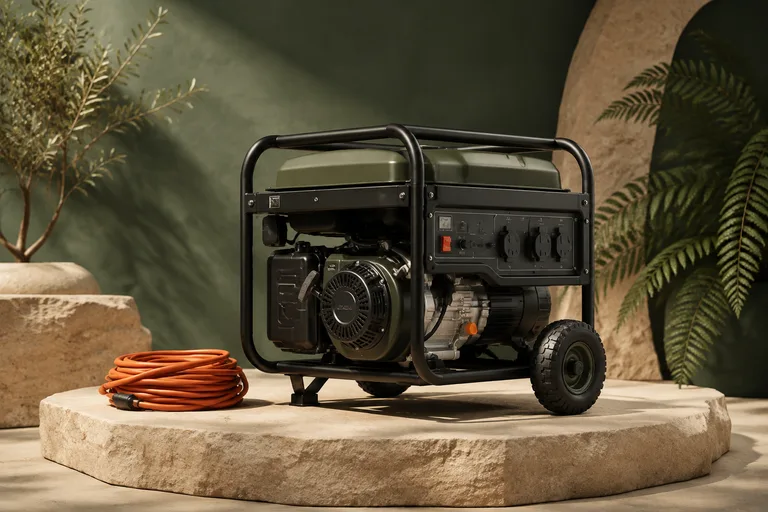
A portable generator is usually the best-value way to get serious home backup power without paying for a permanently installed standby generator.
For occasional outages, a properly sized 120/240V portable generator connected through an approved transfer switch or generator interlock can keep a surprising amount of a house running.
That can include:
- refrigerator and freezer
- lights
- furnace blower
- well pump
- sump pump
- internet
- selected outlets
- microwave
- some central air-conditioning systems
- other priority circuits
But a portable generator is not a cheaper version of a whole-house standby generator.
You give up:
- automatic starting
- automatic transfer
- permanent weather-ready installation
- hands-off refuelling
- seamless operation when nobody is home
The trade is simple:
portable generator = more watts per dollar
standby generator = more automation and resilience per dollar
For a homeowner willing to operate the backup system manually, portable can be an excellent buy.
Portable Generator: Quick Verdict
| Question | Answer |
|---|---|
| Best use | Occasional outages and budget-conscious home backup |
| Best value setup | Large portable + approved interlock/manual transfer |
| Typical serious home-backup size | Roughly 7-12+ kW running output |
| Best fuel flexibility | Tri-fuel |
| Best for quiet operation | Inverter generator |
| Best for whole-panel connection | 120/240V model with suitable inlet/transfer equipment |
| Automatic backup? | No |
| Can it run central AC? | Some can, depending on starting/running load |
| Can it run a whole house? | It can run many household loads, but capacity still limits simultaneous use |
| Must it run outside? | Yes |
Our default portable-generator recommendation for serious home backup is:
large 120/240V generator + 30A/50A inlet + approved panel interlock or manual transfer switch + sensible load management.
That architecture gives you far more useful household backup than buying a giant generator and then running extension cords through the kitchen.
How Does a Portable Generator Work?
A portable generator combines:
- internal-combustion engine
- alternator
- fuel system
- outlets
- circuit protection
The engine turns the alternator, which produces electricity for:
- extension-cord-connected equipment
- or a properly installed home transfer connection
Unlike an automatic standby generator, portable equipment normally requires the homeowner to:
- move or position the generator safely
- connect fuel
- connect the electrical load
- start it
- manually transfer or select circuits
- manage electrical demand
- refuel where necessary
That manual involvement is the main reason portable systems cost dramatically less than permanent standby systems.
Can a Portable Generator Power a House?
Yes.
But "power a house" can mean two very different things.
Meaning 1: Power Important Household Loads
Absolutely.
A 7-12 kW portable can support a meaningful set of loads when managed properly.
Meaning 2: Run Everything Exactly as Normal
Maybe not.
A typical home electrical service can theoretically support far more power than most portable generators produce.
For example:
200A × 240V = 48 kW
A portable generator producing 10 kW is nowhere close to recreating that full theoretical service capacity.
That does not mean 10 kW is useless.
It means you prioritise loads.
What Size Portable Generator Do I Need for a House?
Use actual loads, not square footage.
The process is:
- decide which appliances/circuits need backup
- total their realistic running demand
- identify the largest motor-starting load
- account for sensible headroom
- decide which large loads can be switched off while others operate
Use our generator size calculator for the first pass.
For portable home backup, the result should be compared with the generator's running watts on the fuel you intend to use.
Peak/starting watts are not continuous capacity.
Running Watts vs Starting Watts
Portable generators are normally sold with two power numbers.
Running Watts
The amount of power the generator can provide continuously.
Starting Watts
Short-duration additional output available to start loads such as:
- air conditioners
- pumps
- refrigerators
- compressors
For example, Champion's current model 201438 is rated at:
Gasoline
- 12,500 starting watts
- 10,000 running watts
Propane
- 11,250 starting watts
- 9,000 running watts
Natural gas
- 10,000 starting watts
- 8,000 running watts.
Do not size a home's continuous load against the 12,500W number.
The 10,000W gasoline rating is the continuous capacity.
Fuel-Specific Wattage Matters
Dual-fuel and tri-fuel generators often produce different power depending on fuel.
That means a generator advertised as:
10,000 watts
may only deliver that output on gasoline.
The Champion 201438 example drops from:
- 10,000 running watts gasoline
- to 9,000 propane
- to 8,000 natural gas.
The same pattern appears on other tri-fuel equipment.
So choose the generator based on the fuel you intend to use during the outage.
Not the biggest number printed on the box.
What Portable Generator Size Is Good for Home Backup?
A useful rough framework is:
| Running Output | Typical Home-Backup Role |
|---|---|
| 2-3 kW | Refrigerator, lights, electronics, selected small loads |
| 3-5 kW | Essentials plus furnace blower/small pumps depending on load |
| 5-7.5 kW | Strong essential-load backup |
| 7.5-10 kW | Serious household backup with manual load management |
| 10-12+ kW | Large portable whole-panel backup territory |
| 12+ kW | High-capacity portable use, but still not equivalent to large standby |
These are use-case bands.
They are not substitutes for a load calculation.
Is 5,000 Watts Enough for a House?
It can be enough for essential loads.
A 5 kW-class generator may support combinations such as:
- refrigerator
- freezer
- furnace blower
- lights
- TV/internet
- selected outlets
- sump pump
depending on actual load.
It is less likely to comfortably support:
- central AC
- electric water heater
- electric range
- dryer
- multiple large motors
simultaneously.
For a gas-heated home where the main outage priorities are heat, refrigeration and lights, 5 kW can be more useful than people assume.
Is 7,500 Watts Enough for a House?
For many homes, yes, with load management.
Generac's current GP7500E Dual Fuel provides:
- 7,500 running watts on gasoline
- 6,800 running watts on propane
- 9,400/8,500 starting watts respectively.
That is enough power to move beyond basic extension-cord backup into meaningful panel-connected home backup.
Whether it runs your AC or well pump depends on their actual starting requirements.
Is 10,000 Watts Enough for a House?
For a lot of homes, 10 kW is a very capable portable backup size.
Champion's current tri-fuel 201438 produces 10,000 running watts on gasoline and provides both:
- L14-30R 120/240V outlet
- 14-50R 120/240V outlet
making it suitable for properly engineered transfer/inlet configurations.
At that level, the bigger constraint often becomes:
which loads you choose to run simultaneously
rather than whether the generator can power anything useful.
Portable Generator vs Whole-House Standby Generator
Portable Generator Wins On:
- upfront cost
- watts per dollar
- mobility
- multiple fuel options
- easier replacement
- no permanent generator pad/system required
Whole-House Standby Wins On:
- automatic starting
- automatic transfer
- permanent fuel connection
- weather-ready installation
- higher convenience
- prolonged unattended operation
If your budget supports automatic backup and outages are frequent or serious, standby makes sense.
If outages are occasional and you can operate the equipment manually, portable is often the smarter economic play.
See our whole-house generator guide.
Portable Generator + Interlock: The Best-Value Home Setup
For many homeowners, this is the sweet spot:
portable generator → power inlet → dedicated generator breaker → approved panel interlock
During an outage, you manually choose which circuits receive power.
Advantages include:
- use existing household circuits
- run hard-wired furnace/well pump
- no extension cords through the house
- flexible circuit selection
- lower installation cost than standby
See our generator interlock kit guide for the detailed setup.
Portable Generator + Manual Transfer Switch
A manual transfer switch is another strong option.
Instead of using the existing main panel with an interlock, the system can transfer:
- selected circuits
- or a larger feeder
onto generator power.
This can be especially useful where:
- the existing panel does not support an approved interlock
- the homeowner wants a permanently defined essential-load group
See our generator transfer switch guide.
30 Amp vs 50 Amp Portable Generator
For serious household backup, one important difference is the generator's 120/240V output connection.
30A at 240V
Theoretical capacity:
7.2 kW
50A at 240V
Theoretical capacity:
12 kW
That makes a 50A outlet particularly useful on large portable generators.
But the outlet does not create power.
If the generator can only produce 8 kW continuously, a 50A receptacle does not magically provide 12 kW.
The generator rating remains the limit.
Best Fuel for a Portable Generator
There are four main fuel configurations worth understanding:
- gasoline
- propane
- dual-fuel
- tri-fuel
Natural gas appears mainly through tri-fuel equipment.
Gasoline Portable Generators
Gasoline commonly gives the highest rated output on multi-fuel generators.
Advantages:
- widely available
- high power output
- simple portable-generator ecosystem
Disadvantages:
- difficult long-term storage
- refuelling during regional outages
- fuel queues
- fuel degradation
- manual handling
Gasoline is excellent for generating power.
It is less elegant for keeping a generator ready for an outage that may not happen for 18 months.
Propane Portable Generators
Propane can simplify fuel storage.
Advantages include:
- long-term bulk storage
- no gasoline carburettor-fuel degradation problem
- easy cylinder swaps on smaller setups
- ability to share larger household propane supply in appropriate installations
Disadvantages:
- lower rated output on many multi-fuel generators
- cylinder runtime can be short on large equipment
- refill logistics
- cold-weather vaporisation issues on high-demand systems
Champion's current 201438 runs only about 3 hours at 50% load on a standard 20 lb propane cylinder, illustrating why a small barbecue cylinder is not much of a long-outage fuel reserve for a 9 kW generator.
Dual-Fuel Portable Generators
Dual-fuel usually means:
gasoline + propane
This gives you:
- gasoline's stronger output
- propane's storage convenience
Generac's current GP7500E Dual Fuel is a good example, rated at 7,500 running watts on gasoline and 6,800 on propane.
Dual-fuel makes sense when natural gas is not available at the property.
Tri-Fuel Portable Generators
Tri-fuel normally means:
- gasoline
- propane
- natural gas
For home backup, this may be the most useful portable-generator configuration.
Why?
You can run:
natural gas when utility gas remains available.
Switch to:
propane when stored fuel is more useful.
Or use:
gasoline when maximum output matters.
That creates meaningful fuel redundancy.
Is Tri-Fuel Worth It?
If your home has natural gas:
usually yes.
The additional fuel option can be extremely useful during extended outages.
If the home has no natural gas and never will, a dual-fuel generator may deliver nearly the same real-world benefit at lower cost/complexity.
Compare gasoline, propane and natural-gas operation in our tri-fuel generator guide.
Natural Gas Portable Generators
A tri-fuel generator can allow portable backup without storing large quantities of gasoline.
Champion's current 201438 includes a 25-foot natural-gas hose and is designed to operate directly on NG when correctly connected. It produces:
- 8,000 running watts
- 10,000 starting watts
on natural gas.
That is significantly less than its gasoline output.
So again:
size from the NG rating if NG is your backup fuel.
Conventional vs Inverter Portable Generator
These are different categories.
Conventional Portable Generator
Usually wins on:
- maximum watts per dollar
- large 120/240V output
- heavy home-backup loads
Inverter Generator
Usually wins on:
- noise
- portability
- light-load efficiency
- stable inverter output
- sensitive electronics
Generac's current GP3300i, for example, is a compact 3,300W inverter generator with TruePower output and COsense protection, currently starting around $939 MSRP.
That is a completely different job from a 10 kW open-frame tri-fuel machine.
See our inverter generator guide for a detailed comparison of inverter and conventional portable generators.
Can a Portable Generator Run Central Air Conditioning?
Yes, some can.
You need enough:
- 240V capability where required
- running watts
- compressor starting capacity
Central AC often creates a large short-duration startup demand.
A large portable generator may be able to handle it.
A soft-start device can potentially reduce that starting requirement when properly selected and installed.
Do not size from AC tonnage alone.
Use electrical data.
Can a Portable Generator Run a Furnace?
Often.
A gas furnace normally needs electricity for:
- blower
- controls
- ignition
The actual electrical load can be modest compared with electric resistance heating.
Because a furnace is hard-wired, a transfer switch or interlock is normally much cleaner than trying to use an extension cord.
Can a Portable Generator Run a Well Pump?
Yes, if it has:
- correct voltage
- enough running output
- sufficient motor-starting capacity
Well pumps can have high startup loads.
This is exactly why the generator's surge/starting rating matters.
Can a Portable Generator Run a Refrigerator?
Yes, assuming sufficient capacity.
Refrigerators consume relatively modest running power compared with major HVAC or heating loads, although compressor startup must still be considered.
A small inverter generator can often handle:
- refrigerator
- freezer
- lights
- communications
without requiring a huge open-frame unit.
Can a Portable Generator Run an Electric Water Heater?
Potentially, but electric resistance water heating can consume several kilowatts.
On a limited portable-generator system, it may make more sense to:
- temporarily shut off other large loads
- heat water
- turn water heater back off
- restore priority loads
Manual load management is the portable-generator game.
Can a Portable Generator Run an Electric Range?
Potentially, on sufficiently large equipment.
But ovens and electric cooktops can consume a large percentage of portable-generator capacity.
A smaller appliance such as:
- microwave
- countertop cooker
- propane grill used safely outdoors
may be more rational during an outage.
Backup planning does not require recreating normal grid behaviour perfectly.
Can a Portable Generator Run an EV Charger?
Technically possible with appropriate generator capacity and charging configuration.
Commercially?
Usually a poor priority.
EV charging can consume substantial continuous power that may be better reserved during an outage for:
- HVAC
- refrigeration
- water
- pumps
- household essentials
If emergency vehicle charging is genuinely required, include it in the load calculation rather than assuming.
How Long Can a Portable Generator Run?
Runtime depends on:
- fuel tank
- generator load
- generator efficiency
- fuel type
Manufacturer runtime numbers should always state the load condition.
For example, Champion's current 201438 runs:
- 8 hours on its 7.7-gallon gasoline tank at 50% load
- about 3 hours on a 20 lb propane cylinder at 50% load.
Generac's current GP5500E EFI model advertises up to 10.5 hours at 50% load.
A runtime figure without load percentage is largely useless.
How Much Gasoline Does a Portable Generator Use?
Fuel consumption depends on size and load.
You can estimate average hourly consumption from:
fuel tank capacity ÷ published runtime
Example:
Champion 201438:
- 7.7-gallon gasoline tank
- 8 hours at 50% load
Simple average:
7.7 ÷ 8 ≈ 0.96 gallons/hour
at that published operating condition.
That is an illustration, not a guarantee that consumption remains exactly linear at every load.
Can a Portable Generator Run All Night?
Yes, many can.
But you need to account for:
- fuel capacity
- operating load
- placement
- weather
- noise
- maintenance
Never move the generator closer to the home simply because you do not want to hear it overnight.
Safety beats convenience.
Portable Generator Carbon Monoxide Safety
This is the part nobody gets to improvise.
CPSC's current 2026 hurricane guidance says portable generators should be operated:
outside only, at least 20 feet from homes and buildings, with exhaust directed away from windows, doors and vents.
CPSC also says not to operate generators in:
- homes
- garages
- basements
- crawlspaces
- sheds
- other enclosed areas
even when doors/windows are open.
CDC gives the same 20-foot outdoor guidance and recommends battery-powered or battery-backup carbon-monoxide detectors in the home.
Can I Run a Portable Generator in the Garage With the Door Open?
No.
CPSC specifically says never to operate a portable generator inside a garage even with doors/windows open.
The same applies to:
- sheds
- basements
- crawlspaces
A CO-shutdown sensor does not make indoor operation safe.
Can I Run a Generator on a Porch or Carport?
CPSC's 2026 guidance says not to run a portable generator on a porch or in a carport because those locations remain too close to the home.
Use the generator outdoors at the required safe distance and direct exhaust away from occupied structures.
CO Shutdown Systems
Modern portable generators increasingly include carbon-monoxide shutdown systems.
Examples include:
- Champion CO Shield
- Generac COsense
Champion's current 201438 automatically shuts the engine down when its CO Shield system detects elevated CO around the generator, but Champion explicitly states this is not a substitute for safe outdoor operation.
Treat CO shutdown as:
backup safety layer
not:
permission to operate badly.
Portable Generator Weather Protection
A portable generator needs outdoor ventilation but also must be operated according to manufacturer guidance regarding:
- rain
- snow
- electrical shock hazards
CPSC's 2026 guidance tells users to follow manufacturer instructions for wet-weather operation, which may involve an appropriate noncombustible generator shelter or waiting until precipitation passes depending on the equipment.
Do not solve rain by moving the generator into the garage.
Refuelling a Portable Generator Safely
Do not refuel a hot running generator.
CPSC advises turning the generator off and allowing it to cool before refuelling because gasoline contacting hot engine parts can ignite.
That creates another practical disadvantage versus natural-gas standby equipment:
gasoline backup requires human fuel handling during the outage.
Can You Backfeed a House With a Portable Generator?
Do not.
CPSC explicitly warns against powering home wiring by plugging a generator into a household wall outlet, commonly called backfeeding, because it creates an electrocution risk for utility workers and neighbours and bypasses normal protections.
Use:
- transfer switch
- approved interlock
installed for the purpose.
Portable Generator Maintenance
Portable generators require routine engine maintenance.
Common tasks include:
- engine oil
- air filter
- spark plug
- fuel system
- starter battery on electric-start models
- valve clearance depending on engine
- storage preparation
The exact intervals are model-specific.
Champion's current 201438 includes an hour meter intended to help owners track maintenance intervals.
If the generator sits unused for eleven months, that does not mean storage maintenance can be ignored.
Gasoline Storage
Gasoline creates a specific standby-readiness problem:
the generator may spend much more time stored than running.
Long-term gasoline storage needs active management.
Do not leave old fuel sitting indefinitely in the generator because you hope the next outage arrives soon enough.
Follow the manufacturer storage procedure.
This is one reason propane and natural gas become attractive on multi-fuel equipment.
Electric Start vs Recoil Start
For a large home-backup generator, I strongly prefer electric start.
A 200+ lb 10 kW generator is not a machine I want to repeatedly rope-start during a winter storm if I have another option.
Champion's current 201438 includes both:
- electric start
- recoil backup.
That combination is ideal.
Remote Start
Remote start can add convenience.
But do not confuse:
remote engine starting
with:
automatic home backup.
You still need to manage:
- generator placement
- transfer/interlock
- loads
- fuel
A remote fob does not turn a portable generator into a standby generator.
How Heavy Are Large Portable Generators?
Large portable generators are only "portable" in the sense that they have:
- wheels
- handles
Champion's current 201438 weighs approximately 231 lb.
That is movable.
It is not something you casually carry down basement stairs.
Plan:
- storage location
- path outside
- setup position
before the outage.
Best Place to Store a Portable Generator
Store it somewhere:
- secure
- dry
- accessible
- separate from unsafe fuel storage practices
But remember:
storage location is not operating location.
A generator stored in a garage still needs to be moved outside to a safe operating position before it is started.
Portable Generator Cost
Portable-generator pricing ranges widely by:
- output
- engine
- fuel options
- inverter technology
- brand
Current examples include:
Generac GP3300i
Approximately $939 MSRP for the current 3.3 kW inverter model.
Generac GP7500E Dual Fuel
Approximately $1,049 MSRP with 7,500W gasoline / 6,800W LP running output.
Large tri-fuel products commonly live around the low-thousands price band before panel-connection installation.
Even after adding:
- interlock
- inlet
- electrician
the system can remain far cheaper than a complete standby installation.
Portable Generator vs Battery
Portable Generator Wins On:
- low initial cost
- high total energy through refuelling
- large output for the money
Battery Wins On:
- silence
- automatic operation
- indoor equipment placement where designed
- no local combustion
- solar integration
If outages are short and quiet backup matters, battery is compelling.
If outages can last days and budget is limited, portable generator remains bloody difficult to beat.
See our generator vs home battery comparison.
Best Portable Generator Setup for a House
If I were building a cost-effective manual backup system, the default architecture would be:
1. Calculate critical load
2. Buy a 120/240V portable generator with enough running + starting capacity
3. Prefer dual/tri-fuel where the economics make sense
4. Install an approved 30A/50A inlet
5. Install a panel-specific interlock or manual transfer switch
6. Label the operating procedure
7. Practise the process before the outage
That last step matters.
The first time you learn the system should not be:
11 PM, no lights, rain, neighbour's tree across the road.
Who Should Buy a Portable Generator?
Budget-Conscious Homeowner
Strong fit.
This is the obvious use case.
Occasional Outages
Strong fit.
Paying $10,000+ for automatic standby can be difficult to justify when outages are rare and manual setup is acceptable.
Frequent Multi-Day Outages
Potential fit, especially with tri-fuel and panel connection.
But standby becomes more attractive as outage frequency rises.
Homeowner Frequently Away
Weak fit.
Nobody is there to deploy it.
Apartment / Condo Without Safe Outdoor Position
Usually weak or impossible fit.
Combustion generator safety constraints dominate.
Rural Property
Strong fit, particularly with propane or dual/tri-fuel configurations.
Portable Generator FAQ
What size portable generator do I need for home backup?
Calculate the running loads you need plus realistic motor-starting requirements. Many serious home-backup systems fall in the 7-12+ kW running-output range, but the correct answer is load-specific.
Can a portable generator power a whole house?
It can power many or potentially most household circuits when connected correctly, but generator capacity still limits simultaneous load.
Is 7,500 watts enough for a house?
Often enough for strong essential-load backup with sensible load management. Major electric heating, large AC and other heavy loads may exceed it.
Is 10,000 watts enough for a whole house?
For many homes, 10 kW is a very useful manual-backup capacity. It still does not reproduce a full 200A utility service.
Should I get a 30A or 50A portable generator?
For larger home-backup generators, 50A capability gives more potential transfer capacity. Match the inlet and system to the generator's actual output.
Is dual-fuel worth it?
Usually yes when propane storage is useful. It reduces dependence on fresh gasoline.
Is tri-fuel worth it?
Especially when the property already has natural gas. NG + propane + gasoline gives three distinct fuel options.
Can I run my portable generator in the garage with the door open?
No. CPSC says portable generators should never be used in garages, even with doors/windows open, and recommends outdoor operation at least 20 feet from the home with exhaust directed away.
Can I connect a portable generator to my electrical panel?
Yes, using appropriate transfer equipment such as a properly installed manual transfer switch or approved interlock system.
Can I plug a generator into a dryer outlet?
No. Improvised backfeeding is dangerous and can energise utility lines. Use proper transfer equipment.
Can a portable generator run central AC?
Some large 120/240V models can, depending on compressor starting demand, running watts and simultaneous household load.
How long will a portable generator run?
It depends on fuel and load. Current Champion 201438 specifications, for example, list 8 hours on gasoline and 3 hours on a 20 lb propane cylinder at 50% load.
Is an inverter generator better for home backup?
For quiet essential loads, often yes. For maximum whole-house watts per dollar, a large conventional portable generator usually wins.
Final Verdict
For homeowners who don't need automatic backup, a portable generator can be the best-value backup-power purchase on the market.
The sweet spot is not:
generator + twenty extension cords.
It is:
properly sized 120/240V portable → approved inlet → transfer switch/interlock → manual load management.
That gives you access to real household systems:
- furnace
- well pump
- refrigeration
- lights
- selected HVAC
- outlets
without paying standby-generator money.
My category call is:
For Small Essential Loads
Buy an inverter generator.
For Serious Home Backup
Buy roughly 7-12+ kW of conventional portable capacity, based on actual loads.
If You Have Natural Gas
Strongly consider tri-fuel.
If You Don't Have Natural Gas
Dual-fuel gasoline/propane is usually a very useful configuration.
If You Want Automatic Backup
Stop trying to turn a portable generator into something it isn't.
Buy a properly sized whole-house standby generator.
Portable generators win by being:
cheap, powerful and flexible.
Standby generators win by removing the homeowner from the process.
Know which problem you're buying your way out of.
Evidence Basis
Current product examples were checked against active manufacturer information.
Champion's model 201438 currently produces 10,000/9,000/8,000 running watts on gasoline, propane and natural gas respectively, includes 120/240V 30A and 50A-class connections, and runs for 8 hours on gasoline or approximately 3 hours on a 20 lb propane cylinder at half load.
Generac currently offers examples spanning compact inverter generators such as the GP3300i through larger conventional and dual-fuel portable equipment, including the GP7500E Dual Fuel at 7,500W gasoline and 6,800W propane running output.
Portable-generator safety guidance was checked against current 2026 CPSC guidance and CDC information. Both state that generators should be used outdoors at least 20 feet from the home/openings, and CPSC specifically warns against enclosed-space operation and improvised backfeeding into household wiring.