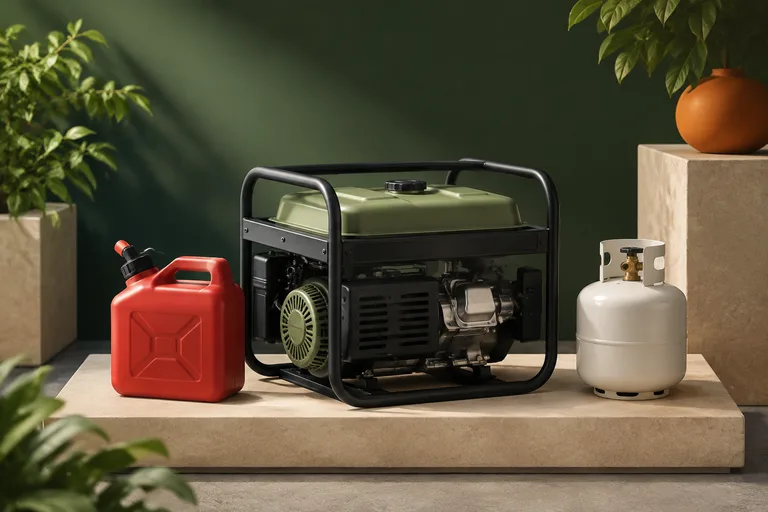
A dual-fuel generator is one of the strongest portable-generator configurations for home backup when you want gasoline performance but do not want gasoline to be your only fuel option.
Most dual-fuel portable generators run on:
- gasoline
- propane
That gives you two different resilience strategies in one machine.
Gasoline usually provides the higher rated output.
Propane usually gives you easier long-term fuel storage.
For a homeowner without natural gas service, that combination can make far more sense than a gasoline-only generator.
But if your property already has natural gas, I would compare a dual-fuel generator directly against tri-fuel before buying.
Natural gas can add a third fuel source that may be much more convenient during a long outage.
Dual-Fuel Generator: Quick Verdict
| Factor | Dual-Fuel Generator |
|---|---|
| Fuels | Usually gasoline + propane |
| Highest output | Usually gasoline |
| Easier stored backup fuel | Propane |
| Good for home backup | Yes |
| Good for RV/camping | Yes |
| Available as inverter generator | Yes |
| Fuel redundancy | Strong |
| Better than gasoline-only? | Usually, if price premium is sensible |
| Better than tri-fuel? | When NG isn't useful or available |
| Main disadvantage | Lower LP output on many models |
Our default call: if natural gas is not available and you are buying a portable generator for emergency home backup, I would generally prefer dual-fuel over gasoline-only unless the price or output penalty is substantial.
What Is a Dual-Fuel Generator?
A dual-fuel generator is designed to operate on two fuel sources.
In the portable-generator market, that usually means:
gasoline + liquid propane (LPG)
The generator uses the same engine and alternator but incorporates fuel-delivery hardware that allows operation on either fuel.
Current examples include:
Generac GP7500E Dual Fuel
- gasoline
- propane
with a fuel-selector dial allowing the operator to change fuel source. Generac currently rates it at:
Gasoline
- 9,400 starting watts
- 7,500 running watts
Propane
- 8,500 starting watts
- 6,800 running watts.
Champion 201493
Champion's current 8,500W dual-fuel model is rated at:
Gasoline
- 10,000 starting watts
- 8,500 running watts
Propane
- 9,000 starting watts
- 7,650 running watts.
Those examples show the central rule of this category:
same generator, different fuel, different usable output.
Are Dual-Fuel Generators Worth It?
Usually, yes - particularly for emergency backup.
The extra fuel option buys you flexibility when one supply becomes difficult.
Imagine a long outage.
You might:
- begin on propane already stored at home
- preserve gasoline for later
- switch to gasoline when maximum output is required
- use whichever fuel can actually be obtained locally
That is materially stronger than depending on one fuel.
The dual-fuel premium therefore buys fuel optionality, not merely a marketing feature.
Dual-Fuel vs Gasoline-Only Generator
If two generators are otherwise similar, I would usually take dual-fuel.
Dual-Fuel Advantages
- second fuel source
- propane storage
- less dependence on fresh gasoline
- flexibility during regional shortages
- ability to choose higher gasoline output when needed
Gasoline-Only Advantages
- potentially lower price
- simpler fuel system
- sometimes greater model selection
- no need to manage propane equipment
If the dual-fuel version only costs slightly more, the optionality is normally worth having.
Gasoline vs Propane: Which Fuel Produces More Power?
On many current dual-fuel generators:
gasoline wins.
For example:
Generac GP7500E Dual Fuel
- gasoline: 7,500 running watts
- propane: 6,800 running watts
That is a 700W reduction on LP.
Champion 201493
- gasoline: 8,500 running watts
- propane: 7,650 running watts
That is an 850W reduction.
Champion 201281
- gasoline: 7,500 running watts
- propane: 6,750 running watts.
Champion 201284
- gasoline: 8,000 running watts
- propane: 7,200 running watts.
So do not size your home-backup system from the gasoline number if propane is the fuel you expect to use.
Why Does a Dual-Fuel Generator Make Less Power on Propane?
Gasoline and propane have different fuel properties, and the engine/fuel-delivery system does not necessarily produce identical maximum output on both.
For the homeowner, the engineering explanation matters less than the practical result:
read the separate fuel ratings.
A generator marketed as:
8,500 watts
may only provide:
7,650 running watts on propane.
That could change whether it starts:
- central AC
- well pump
- another heavy load
alongside the rest of the house.
What Size Dual-Fuel Generator Do I Need for a House?
Use actual electrical load.
The process is:
- identify outage loads
- calculate realistic running demand
- add the largest likely motor-starting event
- define manual load management
- compare with the generator's running rating on your intended fuel
Use our generator size calculator before choosing a model.
For dual-fuel specifically, run the calculation against the lower propane output if propane is intended to be your primary emergency fuel.
That avoids buying a generator that only fits the load on gasoline.
Is a 7,500-Watt Dual-Fuel Generator Enough for Home Backup?
Often, yes.
Current 7,500W-class machines can provide strong essential-load backup.
For example, Champion's current 201281 provides:
- 7,500 running watts gasoline
- 6,750 running watts propane
- 120/240V output
- L14-30R connection
- 10 hours gasoline runtime at 50% load
- 5.5 hours propane runtime at 50% load.
That can support combinations of:
- refrigerator
- freezer
- furnace
- well pump
- lights
- outlets
- sump pump
- selected larger loads
depending on actual demand.
Is an 8,500-Watt Dual-Fuel Generator Enough?
For many homes, this enters serious manual-backup territory.
Champion's current 201493 gives you:
- 8,500 running watts gasoline
- 7,650 propane
- 120/240V
- 30A locking connection
- 35A 120/240V outlet
- electric start.
At around 7.5-8.5 kW of continuous capacity, the question becomes less:
"Can it power my house?"
and more:
"Which large loads am I willing to manage?"
Can a Dual-Fuel Generator Run a Whole House?
Potentially, but not without limits.
A large dual-fuel portable connected through proper transfer equipment can energise many household circuits.
That does not mean it recreates full utility service.
A 200A house can theoretically support much more power than an 8 kW generator produces.
The operator still needs to manage:
- AC
- water heater
- electric cooking
- dryer
- pumps
- other large loads
The generator only has its rated continuous output available.
Dual-Fuel Generator + Interlock
This is one of my favourite budget home-backup combinations:
dual-fuel portable → 30A/50A inlet → approved interlock → existing electrical panel
You gain:
- hard-wired furnace
- well pump
- refrigeration
- lighting
- selected HVAC
- flexible circuit selection
without permanent standby-generator economics.
See our generator interlock guide.
Dual-Fuel Generator + Manual Transfer Switch
A manual transfer switch is another clean setup.
This can be preferable when:
- panel does not support an approved interlock
- only selected circuits need backup
- fixed load selection is desirable
See our main generator transfer switch guide.
Best Fuel to Start With During an Outage
There is no universal winner.
Start With Propane When:
- propane is already stored
- you want to preserve gasoline
- load fits comfortably on LP rating
- outage duration is uncertain
Start With Gasoline When:
- you need maximum generator output
- propane output is too low for required load
- fresh gasoline is readily available
The most useful thing about dual-fuel is that you do not need one rule forever.
You have options.
Propane as Long-Term Backup Fuel
Propane is extremely attractive for emergency preparedness because it stores cleanly in suitable cylinders or bulk tanks.
Compared with gasoline, you avoid much of the anxiety around:
- stale carburettor fuel
- fuel rotation
- draining tanks
- stabiliser
That makes propane a natural "waiting for the outage" fuel.
Gasoline as Maximum-Output Fuel
Gasoline often unlocks the generator's highest rated capacity.
That can be valuable when you temporarily need to run:
- central AC
- well pump
- multiple large loads
A sensible strategy can therefore be:
propane most of the time → gasoline when maximum power is actually required
if the model and fuel-switch procedure permit it.
Can You Switch Fuel While a Dual-Fuel Generator Is Running?
It depends on the generator.
Do not assume every dual-fuel system supports seamless hot switching.
Generac specifically says its current GP7500E Dual Fuel uses a selector that can switch between fuel sources to prevent unit shutdown.
Other manufacturers/models may specify their own procedure.
Follow the exact operating instructions.
Dual-Fuel Generator Runtime on Gasoline
Current examples:
Generac GP7500E
- 7.9-gallon gasoline tank
- up to 10 hours at 50% load.
Champion 201493
- 7.7-gallon gasoline tank
- 10 hours at 50% load.
Champion 201281
- 7.7-gallon gasoline tank
- 10 hours at 50% load.
That works out to roughly an overnight fuel cycle for many large portable systems at moderate load.
Dual-Fuel Generator Runtime on a 20 lb Propane Tank
Runtime is often much shorter on a single barbecue-size cylinder.
Examples:
Generac GP7500E
Approximately:
5 hours at 50% load on a 20 lb LP cylinder.
Champion 201493
Approximately:
5 hours at 50% load on a 20 lb tank.
Champion 201281
Approximately:
5.5 hours at 50% load.
For multi-day home backup, repeatedly swapping 20 lb cylinders can become annoying fast.
Is a 20 lb Propane Tank Enough for Home Backup?
For several hours?
Yes.
For serious prolonged outage resilience?
Not really.
A large 7-8 kW generator can consume a 20 lb cylinder in around five hours at half load in current manufacturer examples.
If propane is your primary long-outage strategy, consider:
- multiple cylinders
- larger cylinder
- bulk propane connection where generator/manufacturer/setup permits
The propane generator guide covers the storage side in more depth.
Can a Dual-Fuel Generator Connect to a Large Propane Tank?
Potentially, depending on the generator's approved fuel system and regulator requirements.
Do not simply remove the supplied hose/regulator and connect the generator directly to a bulk tank.
The generator needs:
- correct pressure
- correct regulator arrangement
- sufficient vaporisation
- manufacturer-compatible connection
For a permanent bulk setup, use a qualified propane professional.
Dual-Fuel Generator vs Tri-Fuel Generator
This is the main commercial decision.
Dual-Fuel
Usually:
- gasoline
- propane
Tri-Fuel
Usually:
- gasoline
- propane
- natural gas
If your home has usable natural gas, tri-fuel is usually the configuration I'd investigate first.
Why?
Natural gas can let you operate without:
- refilling gasoline
- swapping propane cylinders
while the utility supply remains available.
You still retain gasoline and propane as alternatives.
When Dual-Fuel Is Better Than Tri-Fuel
Dual-fuel is the smarter buy when:
- no natural gas service exists
- you do not intend to add NG
- tri-fuel model costs materially more
- dual-fuel version provides better output/value
- propane already solves your stored-fuel requirement
There is no value in paying for a natural-gas capability you can never use.
When Tri-Fuel Is Better
Tri-fuel wins when:
- property has NG
- suitable generator connection can be installed
- long outages are possible
- fuel flexibility is highly valued
You get:
pipeline fuel + stored propane + portable gasoline
That is a stronger fuel stack.
Compare the fuel choices and home-backup trade-offs in our tri-fuel generator guide.
Dual-Fuel vs Natural Gas-Only Generator
A permanent natural-gas standby system wins on:
- automation
- continuous utility fuel
- automatic transfer
- unattended operation
Dual-fuel portable wins on:
- price
- mobility
- stored propane
- gasoline fallback
Different buyer.
Different economics.
Dual-Fuel vs Propane-Only Generator
I would generally prefer dual-fuel unless:
- propane-only configuration is significantly cheaper
- system has a specific dedicated propane role
Gasoline gives you another fallback fuel and often higher output.
Optionality has value.
Dual-Fuel Inverter Generator
Dual-fuel is not limited to large open-frame machines.
Current inverter examples combine:
- gasoline
- propane
- inverter electronics
- low-THD output
- lower noise
That is a particularly attractive setup for:
- RV
- camping
- essential home loads
- electronics
For example, current Champion dual-fuel inverter models provide gasoline/propane flexibility in the roughly 3-4 kW running-output range.
See our inverter generator guide for that category.
Open-Frame vs Inverter Dual-Fuel
Open-Frame Dual-Fuel
Best for:
- large home backup
- maximum output
- 120/240V
- heavy loads
- lower cost per watt
Inverter Dual-Fuel
Best for:
- noise
- electronics
- RV
- portability
- modest home loads
Do not pay for inverter technology if the only thing you care about is getting 8 kW into your home electrical panel as cheaply as possible.
Can a Dual-Fuel Generator Run Central AC?
Some can.
You need to verify:
- 120/240V capability
- running watts
- starting watts
- compressor LRA/start requirement
- other household loads
The gasoline rating may handle the AC while the propane rating may become marginal.
That is why fuel-specific output matters.
Can a Dual-Fuel Generator Run a Well Pump?
Yes, with sufficient:
- voltage
- running power
- motor-starting capability
Most serious home-backup dual-fuel units include 120/240V output specifically useful for loads such as:
- well pumps
- transfer-panel systems
- larger appliances
Champion's current 7,500-8,500W examples include 120/240V locking outlets.
Can a Dual-Fuel Generator Run a Refrigerator and Furnace?
Usually, a 5 kW+ dual-fuel generator has plenty of theoretical capacity for those loads, but actual equipment demand still needs checking.
A refrigerator + gas-furnace blower + lighting + internet is one of the easier emergency-load combinations.
You may not need an 8.5 kW generator for that job.
30A vs 50A Dual-Fuel Generator
For home-panel backup, output connection matters.
30A / 240V
Approximately:
7.2 kW theoretical connection capacity
50A / 240V
Approximately:
12 kW
Current Champion 201493 includes both a 30A locking outlet and a larger 120/240V outlet.
Match:
- generator output
- receptacle
- inlet
- breaker
- conductor
as one electrical system.
Electric Start
For a large home-backup dual-fuel generator, I would choose electric start.
Current Generac GP7500E and Champion 201493 both include electric starting.
That matters more as engine size and generator weight increase.
Recoil backup is still useful.
Dual-Fuel Generator Weight
Large portable dual-fuel generators are not particularly light.
Current examples:
Generac GP7500E
Approximately 204 lb.
Champion 201281
Approximately 205 lb.
Champion 201284
Approximately 208 lb.
Wheels make them movable.
They do not make them small.
Plan the storage-to-operating route before the lights go out.
Are Dual-Fuel Generators Loud?
Large conventional dual-fuel generators are normally louder than enclosed inverter units.
Champion currently rates several of its large dual-fuel examples at approximately:
74 dB(A) from 23 feet.
That is manufacturer data, not a universal dual-fuel category rating.
Noise depends on:
- model
- load
- enclosure
- distance
If noise matters strongly, look at dual-fuel inverter models instead.
Dual-Fuel Generator Maintenance
A dual-fuel generator still has one combustion engine.
Maintenance commonly includes:
- oil
- air filter
- spark plug
- valve clearance where applicable
- starter battery on electric-start models
- storage/fuel system
The gasoline side introduces storage concerns.
The propane side introduces hose/regulator inspection.
Follow the exact model schedule.
Does Propane Keep the Carburettor Cleaner?
Using propane avoids sending gasoline through the carburettor while operating on propane.
That can reduce the gasoline-storage problems associated with leaving fuel sitting inside the system.
But do not turn that into:
"Propane means you never maintain the carburettor."
The generator still needs proper storage procedures, particularly if gasoline has been used.
Should I Store the Generator With Gasoline in It?
Follow the manufacturer's storage procedure.
Gasoline sitting for long periods can degrade and create fuel-system problems.
This is one reason dual-fuel ownership is attractive:
you may choose propane for periodic operation/emergency readiness and reduce reliance on stored gasoline.
But if gasoline enters the fuel system, storage still needs managing.
Dual-Fuel Generator Safety
Dual-fuel does not change portable-generator carbon-monoxide rules.
Whether burning:
- gasoline
- propane
the generator still produces dangerous combustion exhaust.
Operate outdoors according to current manufacturer/CPSC guidance.
Do not use it:
- inside home
- garage
- basement
- shed
- enclosed porch
A CO shutdown system is a backup safety feature.
It does not make indoor use acceptable.
Is Propane Safer to Store Than Gasoline?
Propane and gasoline have different hazards.
Propane's practical emergency-preparedness advantage is that approved cylinders/tanks can provide long-term stored fuel without the same degradation problems as gasoline.
That does not make propane harmless.
Store and handle both fuels according to their applicable requirements.
Dual-Fuel Generator for Hurricanes
Strong use case.
A hurricane can disrupt:
- electricity
- gasoline stations
- fuel deliveries
Having both gasoline and stored propane gives you more options.
If your home also has natural gas, tri-fuel becomes even stronger.
But for an off-gas rural home, dual-fuel is exactly the sort of redundancy I would want.
Dual-Fuel Generator for Winter Storms
Also strong.
Propane can be stored before winter.
Gasoline provides higher output on many models when heavy loads demand it.
But cold weather also affects:
- battery starting
- oil
- propane vaporisation
Make sure the generator and fuel system are designed for expected conditions.
Dual-Fuel Generator for RV Use
Excellent category.
A smaller dual-fuel inverter gives RV users:
- quieter operation
- gasoline
- propane
- easy integration with propane already carried for other RV loads
That is arguably a cleaner dual-fuel use case than buying a 200 lb open-frame machine.
Best Dual-Fuel Generator Size by Use Case
| Use Case | Capacity to Investigate |
|---|---|
| RV / camping | 2-4 kW inverter |
| Refrigerator + electronics | 2-4 kW |
| Essential home backup | 4-7 kW |
| Furnace + well + refrigeration | 6-8 kW |
| Serious panel-connected home backup | 7.5-10+ kW |
| Major central AC + broad whole-house load | Compare large portable vs standby |
These are starting bands.
Actual loads decide.
How Much More Should You Pay for Dual-Fuel?
There is no universal dollar premium that makes sense.
I would compare the dual-fuel model against the closest gasoline-only equivalent and ask:
"What am I paying for propane capability?"
If the answer is modest, buy the flexibility.
If dual-fuel costs several hundred dollars more while you have no realistic propane storage plan, the optionality may not justify it.
Same principle as every other upgrade:
capacity/features need a job.
Current Dual-Fuel Generator Examples
Generac GP7500E DF
- 7,500 running watts gasoline
- 6,800 propane
- 120/240V
- electric start
- 10 hours gasoline at 50% load
- 5 hours on 20 lb propane at 50%
- current starting MSRP around $1,049.
Champion 201281
- 7,500W gasoline
- 6,750W propane
- 120/240V
- electric + recoil start
- 10 hours gasoline
- 5.5 hours propane at half load
- 74 dB(A).
Champion 201493
- 8,500W gasoline
- 7,650W propane
- 120/240V
- electric start
- 10 hours gasoline
- 5 hours propane at 50%
- 74 dB(A).
These are examples for comparing the category.
They are not a claim that we personally lab-tested all three.
Questions to Ask Before Buying a Dual-Fuel Generator
- What are the running watts on gasoline?
- What are the running watts on propane?
- What starting output does each fuel provide?
- Is it 120V or 120/240V?
- Does it have a 30A or 50A connection?
- Is electric start included?
- How long does it run at 50% load on gasoline?
- How long on a 20 lb propane cylinder?
- Can it use a larger approved propane supply?
- Can fuel be switched while running?
- Does it include CO shutdown?
- Is it suitable for panel connection?
- How much more does it cost than the gasoline-only version?
- Would tri-fuel make more sense at my property?
That last question should be asked before buying any dual-fuel generator for a house with natural gas.
Dual-Fuel Generator FAQ
What is a dual-fuel generator?
A portable generator designed to operate on two fuels, typically gasoline and propane.
Which is better in a dual-fuel generator, gasoline or propane?
Gasoline usually gives higher output. Propane generally gives easier long-term fuel storage. The better fuel depends on your load and outage strategy.
Do dual-fuel generators make less power on propane?
Many do. Current examples from Generac and Champion show roughly 9-10% lower running output on propane than gasoline.
Is a dual-fuel generator worth the extra money?
Usually yes for emergency backup if the price premium is sensible and you will actually keep/use propane.
Is dual-fuel better than tri-fuel?
Only when natural gas provides little or no value to you. If the property already has NG, tri-fuel deserves serious consideration.
Can a dual-fuel generator power a whole house?
A sufficiently large model can power many household circuits through proper transfer equipment, but it remains limited by its continuous wattage.
How long does a dual-fuel generator run on propane?
Current 7.5-8.5 kW-class Champion and Generac examples run roughly 5-5.5 hours at half load on a 20 lb cylinder.
How long will it run on gasoline?
Current examples with roughly 7.7-7.9 gallon tanks publish around 10 hours at 50% load.
Can you switch from propane to gasoline?
Some current models support fuel switching through a selector, but follow the exact manufacturer procedure.
Can a dual-fuel generator connect to a transfer switch?
Yes, many large 120/240V dual-fuel generators are specifically suitable for transfer-switch or interlock-based home backup.
Can dual-fuel generators run central AC?
Some can if their running/starting capacity matches the AC system and other simultaneous loads.
Are dual-fuel generators louder than inverter generators?
Large conventional dual-fuel models usually are. Current Champion examples in the 7.5-8.5 kW class publish around 74 dB(A), whereas smaller enclosed inverter models can be materially quieter.
Final Verdict
For a portable home-backup generator without natural gas available, dual-fuel is usually the configuration I would buy.
Gasoline gives you:
- maximum output
- widespread availability
Propane gives you:
- stored emergency fuel
- easier long-term readiness
- a second supply chain
That is a real resilience improvement over gasoline-only.
The most important catch is:
size from the propane rating if propane is what you expect to use.
A current dual-fuel generator producing:
8,500W gasoline
might only give you:
7,650W propane.
If your calculated load needs 8 kW continuously, that is not a small detail.
The buying sequence should be:
calculate load → pick likely primary fuel → size from that fuel's running watts → confirm voltage/outlet architecture → install safe panel connection → compare dual-fuel premium against tri-fuel.
My final call:
No Natural Gas at the Property
Dual-fuel is excellent.
Natural Gas Already Available
I'd usually investigate tri-fuel first.
Only Need a Small Quiet Generator
Look at a dual-fuel inverter.
Need Maximum Whole-House Watts per Dollar
Look at a large conventional dual-fuel unit.
Fuel flexibility is valuable.
Pay for the flexibility you'll actually use, not the number of fuel logos printed on the box.
Evidence Basis
Current specifications were checked against active manufacturer information from Generac and Champion.
Generac's current GP7500E Dual Fuel is rated at 7,500 running watts on gasoline and 6,800 on propane, with 10 hours gasoline runtime and 5 hours on a 20 lb propane cylinder at 50% load. Current MSRP starts around $1,049.
Champion's current 201493 provides 8,500 gasoline / 7,650 propane running watts and 10/5 hours of half-load runtime respectively.
Champion's current 201281 provides 7,500 gasoline / 6,750 propane running watts and 10/5.5 hours of half-load runtime.
The examples deliberately use fuel-specific output because dual-fuel generators commonly lose usable capacity when switching from gasoline to propane.