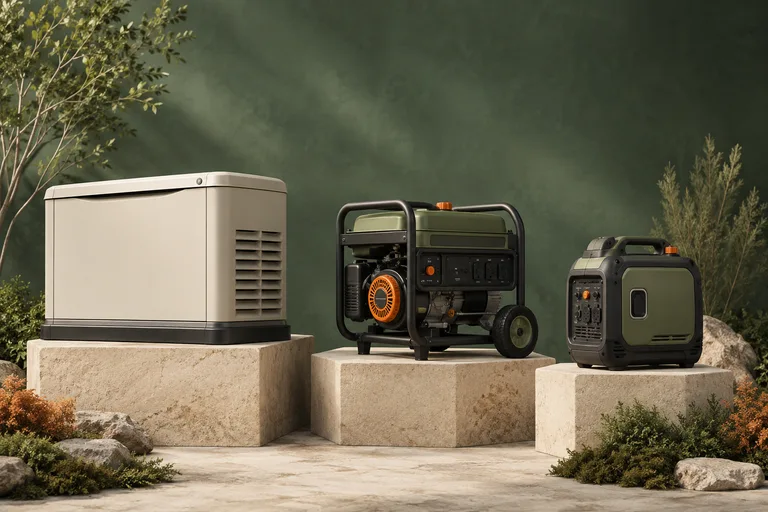
The best generator for home backup depends on what you actually expect it to do during an outage.
If you want automatic whole-house power for multi-day outages, we would choose a permanent standby generator.
If you want the best balance of cost, output and flexibility, a large portable generator connected through a proper transfer switch or interlock can deliver a huge amount of backup power for much less money.
If your priority is quiet operation, portability and sensitive electronics rather than running an entire house, an inverter generator is normally the better tool.
And if fuel flexibility matters, a tri-fuel portable generator that can run on gasoline, propane or natural gas is one of the strongest value propositions in home backup.
There is no single generator that wins all four jobs.
Best Home Generators: Quick Picks
| Use Case | Our Pick | Why |
|---|---|---|
| Best overall whole-house backup | Generac Next Generation 22 kW standby | Automatic operation, strong residential ecosystem, 21 kW NG / 22 kW LP |
| Best upgrade for higher whole-house load | Generac Next Generation 26 kW standby | 24 kW NG / 26 kW LP with modest price step over 22 kW |
| Best portable generator for serious home backup | Westinghouse WGen11500TFc | 11,500 running watts gasoline, tri-fuel, 120/240V, transfer-ready |
| Best tri-fuel alternative | Champion 201438 | 10,000 running watts gasoline, 9,000 LP, 8,000 NG |
| Best inverter generator for essential loads | Honda EU3200i | Quiet, compact, clean inverter power, strong runtime for its size |
| Best for automatic multi-day outages | Whole-house standby generator | Starts and transfers automatically |
| Best value for occasional outages | Portable + interlock/transfer switch | Much lower installed cost |
| Best for fuel flexibility | Tri-fuel portable | Gasoline, propane and NG from one machine |
| Best for quiet/sensitive loads | Inverter generator | Low noise and inverter output |
| Best for large estates/farms | Liquid-cooled standby / diesel | Better suited to larger sustained loads |
Our default call: for a homeowner who can justify the installed cost and wants proper automatic backup, buy the correctly sized standby system.
For everyone else, a large tri-fuel portable generator connected safely to the electrical panel can be absurdly good value.
Best Overall Whole-House Generator: Generac Next Generation 22 kW
For a mainstream residential standby installation, our default starting point remains the Generac Next Generation 22 kW.
Current Generac model G0072600 is rated at:
- 21 kW on natural gas
- 22 kW on propane
- 100A main-line circuit breaker
- approximately 451 lb
- current starting MSRP around $6,309 for the generator-only configuration
Generac also offers the current 22 kW package with a 200A transfer switch starting around $7,369 MSRP.
Why We Pick It
It sits in the sweet spot for a lot of American homes.
You get enough capacity to support substantial whole-home loads without automatically jumping into larger equipment.
More importantly, Generac has a massive residential standby ecosystem.
That matters for:
- installers
- maintenance
- replacement parts
- monitoring
- dealer familiarity
The biggest caveat is the natural-gas rating.
The unit is marketed as 22 kW, but you should size it as a 21 kW generator when running on natural gas.
Use our generator size calculator before assuming it fits.
Best For
Homeowners who want:
- automatic outage backup
- natural gas or propane
- whole-home coverage
- a mainstream residential system
- a broad service ecosystem
See our full Generac 22 kW generator guide for the generation-specific details.
Best Higher-Capacity Whole-House Pick: Generac Next Generation 26 kW
If the 22 kW model is genuinely too small, the Generac Next Generation 26 kW is the next model we would investigate.
Current Generac pricing starts around:
- $7,159 MSRP generator only
- $8,219 MSRP with 200A transfer switch
The important fuel-specific output is:
- 24 kW natural gas
- 26 kW propane
That means moving from the 22 kW to 26 kW buys approximately:
- 3 kW extra on natural gas
- 4 kW extra on propane
The current equipment MSRP difference between equivalent generator-only 22 and 26 kW models is approximately:
$850
That can be excellent value if the additional capacity has a real job to do.
It is wasted money if your calculated load already fits comfortably within the 22 kW model.
See our Generac 22 kW vs 26 kW comparison before automatically buying the larger machine.
Best Portable Generator for Home Backup: Westinghouse WGen11500TFc
If you want serious home-backup capability without paying for a permanent standby installation, the Westinghouse WGen11500TFc is one of the strongest current configurations.
Westinghouse currently specifies:
| Fuel | Running Watts | Peak Watts |
|---|---|---|
| Gasoline | 11,500 | 14,500 |
| Propane | 10,500 | 13,500 |
| Natural gas | 9,500 | 12,000 |
It is:
- tri-fuel
- 120/240V
- transfer-switch ready
- equipped with both L14-30R and 14-50R connections
- electric/remote start
- rated for up to 19 hours on its 9.5-gallon gasoline tank at 25% load
- equipped with carbon-monoxide shutdown
Westinghouse currently lists it around $1,699.
Why We Pick It
The output-to-price ratio is excellent.
On gasoline, 11.5 kW running capacity is enough to run a serious collection of household loads.
Connected through an approved generator interlock or manual transfer system, that can include combinations of:
- refrigerator/freezer
- lighting
- furnace
- well pump
- sump pump
- microwave
- selected HVAC
- outlets
depending on actual demand and load management.
And because it runs on three fuels, the owner can choose:
- gasoline when maximum portable output matters
- propane for stored-fuel convenience
- natural gas where an appropriate connection exists
The Trade-Off
It is still a portable generator.
That means somebody has to:
- set it up
- connect it
- start it
- switch the panel
- manage load
- refuel or connect fuel
If you want the house restored automatically at 2 AM while you are away, buy a standby generator.
Best Tri-Fuel Generator Alternative: Champion 201438
Champion's current 201438 10,000W Tri-Fuel Generator is another strong home-backup option.
Current manufacturer ratings are:
| Fuel | Running Watts | Starting Watts |
|---|---|---|
| Gasoline | 10,000 | 12,500 |
| Propane | 9,000 | 11,250 |
| Natural gas | 8,000 | 10,000 |
It provides:
- 120/240V output
- L14-30R
- 14-50R connection
- electric and recoil start
- CO Shield carbon-monoxide automatic shutdown
- included propane hose
- included natural-gas hose
- 8 hours gasoline runtime at 50% load
- 3 hours on a 20 lb propane cylinder at 50% load
Champion also provides a three-year limited warranty and lifetime technical support on the represented model.
Westinghouse vs Champion
The Westinghouse wins on raw output.
The Champion gives you:
- strong tri-fuel flexibility
- respectable 120/240V capacity
- a current manufacturer-supported platform
If pricing is close, we would generally favour the Westinghouse for a home where maximum portable backup capacity matters.
If the Champion is materially cheaper locally, it remains a very credible choice.
Best Quiet Generator for Essential Loads: Honda EU3200i
The Honda EU3200i solves a completely different problem.
It is not our pick for whole-house backup.
It is our pick when the homeowner wants:
- quiet operation
- portability
- inverter power
- refrigeration
- lights
- electronics
- camping/secondary use
- modest emergency loads
Honda currently rates the EU3200i at:
- 3,200W maximum
- 2,600W rated
- 120V output
- 1.2-gallon fuel tank
- approximately 8.6 hours runtime at quarter load
- approximately 54 dB(A) at quarter load
- approximately 58 dB(A) at rated load
- 59.1 lb dry weight
- current MSRP approximately $2,899
It also includes Honda's CO-MINDER system and Bluetooth/My Generator app capability.
Why Would You Pay That Much for 2.6 kW?
Because raw wattage is not the only buying criterion.
Compared with large open-frame generators, the EU3200i is built around:
- portability
- lower noise
- inverter output
- efficiency under light loads
If you need 10 kW of home backup, it is the wrong machine.
If you need clean, quiet power for essential loads and want a generator that is easy to move, it is a very different proposition.
Best Generator Type for Most Homes
Before choosing a model, choose the generator category.
Whole-House Standby Generator
Best when:
- outages can last days
- automatic backup matters
- homeowner may be away
- major HVAC loads need support
- permanent fuel supply is available
- budget supports professional installation
Large Portable Generator
Best when:
- outages are occasional
- budget matters
- homeowner can operate the system manually
- 7-12+ kW can cover realistic loads
- a transfer switch/interlock can be installed
Inverter Generator
Best when:
- noise matters
- portability matters
- loads are modest
- sensitive electronics dominate
- whole-home backup is not required
Tri-Fuel Generator
Best when:
- fuel flexibility matters
- natural gas may be available
- propane is stored
- gasoline provides maximum portable output
- the homeowner wants resilience across different fuel conditions
Whole-House Standby vs Portable Generator
This is the biggest buying fork.
Standby Wins On:
- automatic starting
- automatic transfer
- weather-ready permanent installation
- larger continuous backup
- convenience
- long-duration gaseous-fuel operation
Portable Wins On:
- purchase price
- installation cost
- mobility
- ability to use away from home
- fuel flexibility
- easier replacement
A portable generator can deliver a huge amount of power for the money.
What you are giving up is automation and permanent integration.
How Much Generator Power Does a Home Need?
Do not size from square footage.
Use actual load.
A smaller home can have enormous electrical demand if it contains:
- electric heat
- multiple heat pumps
- electric water heating
- well pump
- pool equipment
- EV charging
A larger home using gas heat and sensible load management can need less generator.
The correct process is:
running load + realistic motor-start requirement + sensible headroom
Use our generator size calculator rather than choosing a 22 kW generator because a salesperson says it is "good for houses up to X square feet."
Starting Watts vs Running Watts
Portable-generator specifications commonly show two numbers.
Running Watts
Power available continuously.
Starting / Peak Watts
Short-duration capacity available to start motor loads.
For example, the Westinghouse WGen11500TFc provides:
11,500 running watts gasoline
but:
14,500 peak watts gasoline.
Do not size continuous household demand against the larger peak number.
Fuel-Specific Output Matters on Portable Generators Too
The same mistake people make with standby generators happens with portable equipment.
A tri-fuel generator does not necessarily produce identical output on all three fuels.
The Westinghouse WGen11500TFc is rated:
- 11,500W gasoline
- 10,500W propane
- 9,500W natural gas
running output.
Champion's 201438 is rated:
- 10,000W gasoline
- 9,000W propane
- 8,000W natural gas.
So if your home needs 9 kW continuously, a generator that comfortably covers the requirement on gasoline may become marginal on natural gas.
Same machine.
Different fuel.
Different usable capacity.
Best Fuel for a Home Generator
Natural Gas
Best when:
- utility gas already exists
- convenience matters
- long-duration operation matters
- avoiding fuel storage matters
See our natural gas generator guide.
Propane
Best when:
- no NG service exists
- stored fuel matters
- rural property
- bulk tank installation is practical
See our propane generator guide.
Diesel
Best when:
- larger sustained loads
- farms/estates
- existing diesel infrastructure
- heavy-duty equipment is justified
See our diesel generator guide.
Gasoline
Best when:
- portable generator
- maximum rated output from many tri-fuel machines
- fuel can be obtained/stored safely
Its weakness is storage and refuelling during prolonged outages.
Best Generator for Hurricanes
For a hurricane-prone home where multi-day outages are realistic, our first choice is:
properly sized automatic standby generator
with either:
- resilient natural-gas supply
- or substantial propane storage
Why?
A hurricane creates exactly the situation where manual backup becomes more annoying:
- severe weather
- fuel queues
- long outages
- repeated refuelling
- potentially nobody home
A large portable can still work brilliantly.
But the homeowner needs a serious operating plan.
Best Generator for Winter Storms
For prolonged winter outages, we again favour a standby system where budget allows.
Critical loads can include:
- heating system
- well pump
- refrigeration
- sump pump
- lighting
If heat is electric resistance rather than gas-fired, generator demand can become extremely high.
Calculate it before buying.
A small portable inverter that comfortably handles summer refrigeration may be nowhere near adequate for all-electric winter heat.
Best Generator for a Well Pump
The important issue is motor starting demand.
A well pump can have a significantly higher starting load than running load.
So we would normally favour:
- 120/240V portable generator with adequate surge capability
- or a properly sized standby generator
rather than a small 120V inverter.
The generator interlock route can be particularly useful because the well pump is already hard-wired to the home's panel.
Best Generator for Central Air Conditioning
For substantial central AC:
whole-house standby is the easiest solution.
Large portable generators can run some central systems, especially with:
- adequate 240V output
- motor-start capacity
- soft-start equipment
- load management
But calculate the compressor's actual requirements.
Do not assume:
"50 amp generator = runs any air conditioner."
Best Generator for Refrigerator and Freezer
If your objective is primarily:
- refrigerator
- freezer
- lights
- internet
- phone charging
you probably do not need a 22 kW standby generator.
A smaller inverter generator can be the more rational buy.
That is where the Honda EU3200i-style category makes sense.
Best Generator for an Apartment
Usually:
none, unless you have a safe, compliant outdoor location that satisfies manufacturer and property rules.
Combustion generators produce carbon monoxide.
They must not be operated:
- inside an apartment
- in a hallway
- inside a garage
- on an enclosed balcony
- near openings where exhaust can enter occupied space
For apartment backup, battery systems are generally a much more realistic category to investigate.
Best Generator for Sensitive Electronics
Inverter generators are normally the stronger portable category when:
- laptops
- networking equipment
- electronics
- audio/video equipment
are the primary loads.
The Honda EU3200i uses inverter voltage regulation and is designed specifically around this type of clean portable output.
For a permanently installed whole-house generator, sensitive electronics should be considered within the complete electrical and surge-protection design rather than assuming you need a tiny inverter generator for the entire home.
Best Generator for Long Outages
For prolonged high-energy outages:
standby generator wins.
Why?
Because a permanent generator can continue producing electricity while fuel remains available.
A portable gasoline generator is constrained by:
- onboard tank
- refuelling
- storage
A battery is constrained by:
- stored kWh
- recharge availability
A utility-fed natural-gas generator or large propane/diesel system can supply enormously more total energy over a week-long event.
Best Generator if You Don't Have Natural Gas
Our order would normally be:
- propane standby if permanent automatic backup is the goal
- tri-fuel/dual-fuel portable if value and flexibility matter
- diesel for larger/heavier-duty applications
Do not install expensive natural-gas infrastructure simply because you assume NG is automatically the "best" generator fuel.
Best Generator if You Already Have Propane
Propane standby becomes very compelling.
But have the existing:
- tank
- regulators
- fuel lines
checked against the generator's maximum demand.
Owning a propane tank does not automatically mean it is large enough to support a 22 or 26 kW generator in all conditions.
Best Generator if You Already Have Natural Gas
For automatic backup:
natural-gas standby is normally the first thing we'd quote.
For lower-budget manual backup:
tri-fuel portable connected to an appropriate NG outlet/inlet architecture can be extremely attractive.
The Westinghouse and Champion examples above are strong precisely because natural gas is available without giving up propane/gasoline capability.
Is a Portable Generator Enough for a House?
Often, yes.
But not if your definition of "enough" means:
every electrical load operating exactly as though the grid never failed.
A 10 kW portable can cover a lot of real household needs.
You simply have to manage the loads.
That can be an excellent trade:
manual operation + lower capacity + intelligent prioritisation
in exchange for saving many thousands of dollars.
Portable Generator + Interlock: The Value Play
For a competent homeowner willing to operate backup manually, this may be the best value architecture on the entire site:
large 120/240V portable generator → proper inlet → approved panel interlock → manual load management
You gain:
- hard-wired circuits
- flexible breaker selection
- significant generator output
- much lower capital cost than standby
You lose:
- automatic starting
- automatic transfer
- permanent weather protection
- seamless operation
That trade is commercially excellent for a lot of homes.
Standby Generator + ATS: The Convenience Play
At the other end:
standby generator → permanent fuel → automatic transfer switch
You are paying for:
- automation
- convenience
- higher resilience
- permanent installation
Current Generac residential packages pair 22-26 kW-class generators with 200A ATS systems, illustrating how this architecture is designed around whole-home service rather than portable connection.
See our generator transfer switch guide for the ATS side.
Inverter Generator vs Conventional Portable Generator
Inverter Wins On:
- noise
- portability
- light-load fuel efficiency
- sensitive electronics
- compact size
Conventional Portable Wins On:
- raw watts per dollar
- larger home-backup capacities
- 120/240V availability at lower price
- heavy appliance capability
If you're trying to power a refrigerator and laptop:
inverter is attractive.
If you're trying to power a well pump, furnace, fridge, lights and AC:
large conventional portable is usually the stronger buy.
Tri-Fuel vs Dual-Fuel Generator
Tri-fuel gives you:
- gasoline
- propane
- natural gas
Dual-fuel usually gives you:
- gasoline
- propane
If the house already has natural gas, tri-fuel is a substantial upgrade in resilience.
You can use pipeline gas for convenience and retain liquid/stored fuel alternatives.
If NG does not exist at the property, tri-fuel may add little practical value over dual-fuel.
Generator Safety: Carbon Monoxide Is Not Optional Reading
Every combustion generator produces dangerous exhaust.
Westinghouse and Champion both explicitly warn that portable generators must not be used inside homes or garages, and both current models referenced here include automatic CO-shutdown technology.
Portable generators belong:
outside and away from windows, doors and vents
according to manufacturer requirements.
A CO sensor is another safety layer.
It is not permission to run the generator in a garage.
Generator Transfer Equipment
If you want a portable generator to power household wiring, use properly installed transfer equipment.
Depending on the installation:
- manual transfer switch
- approved interlock
may be appropriate.
Do not backfeed the home through:
- dryer outlet
- improvised cord
- unprotected breaker connection
Our generator interlock kit guide covers the lower-cost panel connection, while the main transfer-switch guide covers both manual and automatic architecture.
How Much Should You Spend on a Home Generator?
Think in systems.
Small Inverter Generator
Expect to pay primarily for:
- generator
- cords/accessories
- fuel
The current Honda EU3200i MSRP is around $2,899, although inverter generators exist at much lower price points from other manufacturers.
Large Portable Generator
Current examples such as the Westinghouse WGen11500TFc list around $1,699, before electrical interlock/inlet installation.
Whole-House Standby
Current Generac equipment alone can run roughly:
- $6,309 for a current 22 kW generator
- $7,369 for a 22 kW package with ATS
- $7,159 for a current 26 kW generator
- $8,219 with ATS
before complete installation.
See our whole-house generator cost guide for the actual installed-cost decision.
How We Choose the Best Generator
We care more about whether the generator solves the outage than whether it wins a specification table.
Our decision factors are:
- backup objective
- required running load
- motor starting demand
- expected outage duration
- automatic vs manual operation
- available fuels
- fuel-specific output
- transfer architecture
- maintenance/service support
- complete installed cost
We do not manufacture a reliability score from owner anecdotes.
And Backup Generator Guide does not claim to have personally lab-tested every generator on this page.
Manufacturer specifications, current product data and the intended use case drive the shortlist.
Best Home Generator FAQ
What is the best generator for a whole house?
For most homeowners wanting automatic backup, we start with a correctly sized Generac standby system because of the broad residential ecosystem. The exact model should follow the load calculation rather than brand popularity.
What size generator is best for a house?
There is no universal size. Calculate actual running loads, starting demand and load management, then compare that result with the generator's fuel-specific output.
Is 10,000 watts enough to run a house?
It can run a substantial set of household loads if managed intelligently. It may not support every large electric appliance simultaneously.
Is 22 kW enough for a whole house?
Often, yes, but not universally. A current Generac 22 kW provides 21 kW on natural gas and 22 kW on propane, so size against the actual fuel rating.
Is a portable generator worth it for home backup?
Absolutely. A large portable generator connected through proper transfer equipment can provide serious home backup for far less upfront cost than a permanent standby system.
What is the best tri-fuel generator for home backup?
The Westinghouse WGen11500TFc is our current lead pick because it combines up to 11,500 running watts on gasoline, 10,500 on propane and 9,500 on natural gas with 120/240V transfer-ready connections.
Is Honda the best inverter generator?
Honda's EU3200i is a premium current example with 2,600 rated watts, inverter output, 54 dB(A) quarter-load operation and 8.6-hour quarter-load runtime. Whether it is the best value depends on how heavily you weight price against noise, portability and the Honda platform.
Should I buy a standby or portable generator?
Buy standby if automatic operation and prolonged whole-home resilience justify the cost. Buy portable if you can manage operation manually and want much better watts-per-dollar.
Should I buy dual-fuel or tri-fuel?
If the property has natural gas, tri-fuel is especially attractive. Without NG service, dual-fuel may provide nearly all the practical value.
What is the quietest type of generator?
Inverter generators are generally the quietest combustion-generator category. Current Honda EU3200i specifications list 54 dB(A) at quarter load and 58 dB(A) at rated load.
What generator is best for a refrigerator and freezer?
A modest inverter generator can be enough if those are the main loads. Check both running and starting requirements before buying.
What generator is best for central AC?
A properly sized whole-house standby generator is the easiest answer. Large 120/240V portable generators can work with some systems when starting load and load management are properly addressed.
Final Verdict
There are really three winners, depending on what you mean by "best home generator."
Best for Proper Automatic Home Backup
Generac Next Generation 22 kW standby
It is the default whole-house starting point because the capacity is useful for a huge number of homes and the residential ecosystem is difficult to beat.
If the load calculation proves you need more, move to the 26 kW model.
Not before.
Best Value for Serious Manual Home Backup
Westinghouse WGen11500TFc
You get:
- 11.5 kW gasoline running output
- propane
- natural gas
- 120/240V
- transfer-ready connections
for a fraction of the capital required for a permanent standby installation.
Pair it with a properly installed interlock or manual transfer system and manage loads intelligently.
Best for Quiet Essential-Load Backup
Honda EU3200i
It sacrifices raw capacity for:
- inverter output
- low noise
- portability
- efficiency
That makes it excellent for essential loads and completely wrong for somebody trying to run a large all-electric home.
So don't start by asking:
"What's the best generator?"
Start with:
What loads must survive → how long must they survive → does backup need to be automatic → what fuels are available → what am I willing to spend?
Then choose the generator category.
The best generator is not the machine with the biggest wattage number.
It is the one that keeps the loads you actually care about running, for the outage you are actually planning for, without buying capacity or complexity that has no job.
Evidence Basis
Current product specifications and pricing were checked against manufacturer sources in August 2026.
Generac's current Next Generation 22 kW model G0072600 is rated at 21 kW on natural gas and 22 kW on propane and starts at approximately $6,309 MSRP; the 22 kW package with a 200A transfer switch starts around $7,369.
The Westinghouse WGen11500TFc is currently rated at 11,500/10,500/9,500 running watts on gasoline/propane/natural gas respectively, with a current listed price around $1,699.
Champion's current 201438 produces 10,000 running watts on gasoline, 9,000 on propane and 8,000 on natural gas.
Honda's current EU3200i provides 2,600 rated watts, 3,200 maximum watts, 54 dB(A) quarter-load noise, 8.6-hour quarter-load runtime and a current MSRP of approximately $2,899.