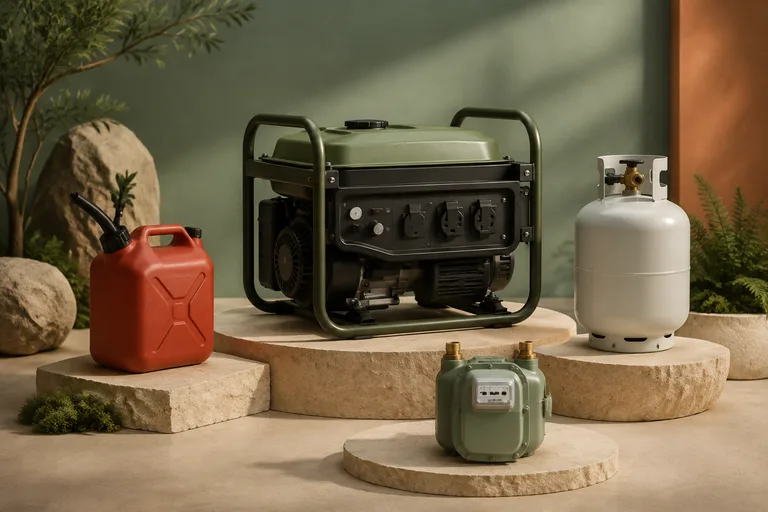
A tri-fuel generator is usually the best portable-generator configuration for a home that already has natural gas and still wants propane and gasoline as backup fuels.
That is the real appeal.
One machine can run on:
- gasoline
- propane
- natural gas
So instead of betting your entire outage plan on one fuel supply, you have three.
But tri-fuel is not automatically better than dual-fuel.
The biggest catch is fuel-specific output.
Current tri-fuel generators can lose a substantial amount of capacity as you move from gasoline to propane and then natural gas.
For example, Champion's current 201438 produces:
- 10,000 running watts on gasoline
- 9,000 running watts on propane
- 8,000 running watts on natural gas
Same generator.
A 20% difference between the highest and lowest continuous rating.
So the buying rule is:
choose the generator from the output of the fuel you actually expect to use most - not the biggest number on the product page.
Tri-Fuel Generator: Quick Verdict
| Factor | Tri-Fuel Generator |
|---|---|
| Fuels | Gasoline + propane + natural gas |
| Highest output | Usually gasoline |
| Lowest output | Usually natural gas |
| Best for homes with NG service | Excellent |
| Stored backup fuel | Propane/gasoline |
| Long-outage convenience | Strong on NG |
| Fuel redundancy | Best portable category |
| Whole-house manual backup | Strong on larger 120/240V models |
| Automatic backup | No |
| Better than dual-fuel? | Usually if NG is genuinely usable |
| Worth paying extra? | When the third fuel solves a real problem |
Our call: if your property already has adequate natural gas and you are buying a large portable generator for home backup, I would usually buy tri-fuel over dual-fuel unless the price premium or natural-gas derating is ugly.
What Is a Tri-Fuel Generator?
A tri-fuel generator is designed to run on three fuels:
- gasoline
- propane/LPG
- natural gas
Current portable examples use a fuel selector and appropriate hoses/regulators to switch between supported fuels.
Champion's current 201438 includes both:
- propane hose
- 25-foot natural-gas hose
and supports all three fuels from the factory.
FIRMAN similarly sells current tri-fuel models ranging from smaller 4,000W-class units through larger 9,200W gasoline-running-output equipment.
Why Tri-Fuel Is So Useful for Home Backup
The key advantage is not merely convenience.
It is supply redundancy.
During an extended outage:
Natural Gas
Use utility-fed gas while service remains available.
No:
- gasoline cans
- propane cylinder swapping
- repeated refuelling
Propane
Use fuel stored before the event.
Useful when:
- gas utility is unavailable
- you want a known reserve
- gasoline availability is poor
Gasoline
Use the fuel that often provides the generator's highest electrical output.
That gives you three distinct failure modes instead of one.
For an emergency-backup machine, that has real value.
Gasoline vs Propane vs Natural Gas Output
This is the most important table on the page.
Current examples:
| Generator | Gasoline Running | Propane Running | Natural Gas Running |
|---|---|---|---|
| Champion 201438 | 10,000W | 9,000W | 8,000W |
| Westinghouse WGen11500TFc | 11,500W | 10,500W | 9,500W |
| FIRMAN T04073 | 4,000W | 3,600W | 3,200W |
| FIRMAN T07573/T07571 family | 7,500W | 6,750W | 5,500W |
| FIRMAN T09275 | 9,200W | 8,300W | 6,900W |
Champion's current ratings are manufacturer-published at 10,000/9,000/8,000 running watts.
Westinghouse's WGen11500TFc manual lists 11,500W gasoline, 10,500W propane and 9,500W natural-gas continuous output.
FIRMAN's current T09275 drops from 9,200W gasoline to 6,900W natural gas - a 2,300W reduction.
That is why "tri-fuel" alone tells you almost nothing about usable home-backup capacity.
Why Does Natural Gas Usually Produce Less Power?
Gasoline, propane and natural gas have different energy and fuel-delivery characteristics.
The engine therefore may not produce identical maximum output across all three fuels.
For the buyer, the practical conclusion is simple:
natural gas is usually the convenience fuel, not the maximum-output fuel.
Gasoline often wins raw output.
Propane usually sits between the two.
How Much Power Do You Lose on Natural Gas?
It varies materially by generator.
Champion 201438
Gasoline:
10,000W
Natural gas:
8,000W
Reduction:
2,000W / 20%
Westinghouse WGen11500TFc
Gasoline:
11,500W
Natural gas:
9,500W
Reduction:
2,000W / about 17%.
FIRMAN T07573
Gasoline:
7,500W
Natural gas:
5,500W
Reduction:
2,000W / about 27%.
FIRMAN T09275
Gasoline:
9,200W
Natural gas:
6,900W
Reduction:
2,300W / 25%.
That is enough to completely change which household loads fit.
Size the Generator From Natural-Gas Output if NG Is Your Main Fuel
Suppose your calculated backup load is:
8.5 kW
You buy a generator marketed around:
10,000 watts
Sounds fine.
But your intended fuel is natural gas.
Champion 201438:
8,000W NG
Now it is too small for an 8.5 kW continuous requirement.
On gasoline:
10,000W
it fits.
This is why you should use our generator size calculator and compare the result against each fuel rating separately.
What Size Tri-Fuel Generator Do I Need?
For home backup, I would broadly investigate:
| Required Backup Role | Tri-Fuel Running Output |
|---|---|
| Refrigerator/electronics | 3-4 kW |
| Essential circuits | 4-6 kW |
| Furnace + refrigeration + pumps | 6-8 kW |
| Serious whole-panel manual backup | 8-10+ kW |
| Large central AC + broader loads | 10 kW+ or compare standby |
But again:
use the NG number if NG is the primary fuel.
A "9,200W" tri-fuel generator could become a 6,900W machine when connected to natural gas.
Best Tri-Fuel Size for Home Backup
For serious panel-connected manual backup, the sweet spot is generally:
roughly 8-10+ kW continuous output on the fuel you actually intend to use.
That means you may need a machine advertised above 10 kW if natural gas is the plan.
The Westinghouse WGen11500TFc is strong here because even after NG derating it still provides:
9,500W continuous on natural gas.
That is substantially more useful than a machine whose NG rating falls into the 5-7 kW range.
Tri-Fuel Generator + Generator Interlock
For a house, this is probably the strongest tri-fuel architecture:
tri-fuel generator → 30A/50A inlet → approved panel interlock → manual load management
You get:
- utility natural gas when available
- propane backup
- gasoline backup
- hard-wired household circuits
- existing electrical panel
- far lower cost than permanent standby
See our generator interlock kit guide.
Tri-Fuel Generator + Manual Transfer Switch
A manual transfer switch works too.
It can be preferable where:
- interlock is unavailable for the panel
- fixed critical loads are preferred
- electrical architecture favours separate transfer equipment
See our generator transfer switch guide.
Is Tri-Fuel Good for Whole-House Backup?
Yes - with realistic expectations.
A large 120/240V tri-fuel generator can supply many household circuits.
But "whole house" does not mean:
everything on simultaneously.
You still have a limited generator.
For example, Champion's 201438 provides on natural gas:
8,000W continuous
or about:
33.1 amps at 240V.
That can power a lot.
It does not reproduce a 200A utility service.
Can a Tri-Fuel Generator Run Central AC?
Some can.
The important inputs are:
- 240V capability
- compressor starting load
- running load
- other simultaneous household demand
- fuel-specific generator output
A large Westinghouse-class tri-fuel unit may support some central AC systems, particularly with sensible load management or an appropriate soft-start device.
But test the actual AC requirements.
Do not buy from tonnage alone.
Can a Tri-Fuel Generator Run a Well Pump?
Yes, with adequate:
- 240V output where required
- running wattage
- motor starting capability
This is one reason I favour large 120/240V tri-fuel machines for rural or well-served properties.
Can a Tri-Fuel Generator Run a Furnace?
Usually, if it is a gas furnace whose electrical demand is primarily:
- blower
- ignition
- controls
That is a relatively modest load compared with electric resistance heating.
A tri-fuel machine using the home's natural gas can therefore power the electrical side of a gas heating system while both systems use the same utility fuel infrastructure.
Natural Gas Is the Convenience Fuel
This is where tri-fuel earns its money.
A suitable NG connection can remove:
- carrying gasoline
- repeated fuel-can refills
- swapping propane cylinders
during an outage.
If the generator is outside, connected safely, and the home's gas supply remains available, you can potentially operate for prolonged periods without touching liquid fuel.
That is a massive quality-of-life improvement versus gasoline-only portable backup.
But Natural Gas Is Still a Utility
Do not confuse convenience with independence.
If the gas utility is interrupted:
your NG option disappears.
That is exactly why propane and gasoline remain useful.
Tri-fuel is compelling because each fuel covers weaknesses in the others.
Propane Is the Stored-Fuel Middle Ground
Propane gives you:
- onsite stored fuel
- easier long-term storage than gasoline
- less fuel-system degradation concern than stale gasoline
- higher output than NG on many models
It usually produces less output than gasoline, but often more than natural gas.
Example:
Champion 201438:
- gasoline: 10,000W
- propane: 9,000W
- NG: 8,000W.
Propane literally sits in the middle.
Gasoline Is the Maximum-Power Option
When you need every available watt:
gasoline usually wins.
That can matter temporarily when starting:
- AC
- well pump
- large appliance
or carrying heavier household loads.
You can therefore use natural gas for routine outage operation and retain gasoline as a higher-output fallback.
That is far more useful than treating fuel selection as a permanent brand identity.
Tri-Fuel vs Dual-Fuel
This is the key buying decision.
Buy Dual-Fuel When:
- property has no NG
- natural gas will never be used
- dual-fuel unit is materially cheaper
- propane already gives you the redundancy you need
Buy Tri-Fuel When:
- property already has NG
- suitable NG connection is practical
- multi-day outages are a real concern
- you want maximum fuel redundancy
For a home already connected to natural gas:
tri-fuel usually wins.
For an off-gas home:
dual-fuel may be all you need.
See our dual-fuel generator guide.
How Much More Is Tri-Fuel Worth?
I would not pay an unlimited premium for the third fuel.
Compare the closest dual-fuel and tri-fuel models on:
- gasoline output
- propane output
- NG output
- outlet configuration
- electric start
- warranty
- price
Then ask:
"What am I actually paying for natural-gas capability?"
If the answer is $100-$200 and you have NG at the property, that can be excellent value.
If the tri-fuel machine costs $800 more while delivering worse output and you barely lose power, the economics are weaker.
Tri-Fuel vs Gasoline-Only
Tri-fuel is generally a much stronger emergency-preparedness product.
Gasoline-only means your outage plan depends on:
- stored gasoline
- fuel rotation
- petrol stations
- manual refuelling
Tri-fuel gives you two additional supply routes.
Unless price/output makes the gasoline-only machine materially better, I would take the redundancy.
Tri-Fuel vs Natural-Gas Standby Generator
This is manual vs automatic backup.
Tri-Fuel Portable
Wins on:
- upfront cost
- fuel flexibility
- mobility
- easy replacement
NG Standby
Wins on:
- automatic start
- automatic transfer
- permanent installation
- unattended operation
- larger residential ecosystem
If you're frequently away from home, tri-fuel's manual nature matters.
The generator cannot roll itself outside and connect the inlet.
Tri-Fuel vs Propane Standby Generator
Same principle.
Propane standby gives:
- automatic operation
- permanent storage
- seamless transfer
Tri-fuel portable gives:
- much lower capital cost
- three fuel choices
- mobility
Your willingness to operate the system manually decides much of the comparison.
Tri-Fuel Inverter Generators
Tri-fuel is no longer limited to conventional open-frame equipment.
FIRMAN's current WT06073 is a tri-fuel inverter generator rated at:
- 6,000W running gasoline
- 5,400W propane
- 4,500W natural gas
with:
- 120/240V output
- less than 3% THD
- electric start
- parallel capability
- 50A outlet
- 67 dB at quarter load
and a current listed price around $1,999.99.
That creates an interesting premium category:
quiet-ish inverter architecture + home-panel voltage + three fuels.
Is a Tri-Fuel Inverter Worth It?
Yes when you want:
- lower noise
- sensitive-electronics output
- 120/240V
- multiple fuels
- moderate home backup
But look at the NG derating.
The FIRMAN WT06073 falls from:
6,000W gasoline
to:
4,500W natural gas.
If you need 5.5 kW continuously on NG, the expensive tri-fuel inverter still does not solve your problem.
Best Tri-Fuel Generator for High-Capacity Home Backup
From the current examples we've researched, the Westinghouse WGen11500TFc remains the strongest high-output configuration for broad home backup.
Current manufacturer manual data gives:
- 11,500W gasoline
- 10,500W propane
- 9,500W natural gas
- 14,500/13,500/12,000W peak respectively
- 120/240V output
- 9.5-gallon gasoline tank.
That 9.5 kW NG rating is the important number.
It keeps the generator in serious home-backup territory even on its weakest fuel.
Champion 201438 Tri-Fuel
Champion's current 201438 is another strong option:
- 10,000W gasoline
- 9,000W propane
- 8,000W natural gas
- electric + recoil start
- 120/240V
- L14-30R
- 14-50R
- 25-foot NG hose
- propane hose
- CO Shield
- 3-year limited warranty
- lifetime technical support.
It runs:
- 8 hours gasoline at 50% load
- 3 hours on a 20 lb propane cylinder at 50% load.
That is a solid home-backup package.
FIRMAN Tri-Fuel Generators
FIRMAN currently offers several relevant configurations.
T04073
- 4,000W gas
- 3,600W propane
- 3,200W NG
- 120/240V
- electric start
- $1,099.99 current listed price.
T07573
- 7,500W gas
- 6,750W propane
- 5,500W NG
- 120/240V
- L14-30R
- 14-50R
- current listed price around $1,349.99.
T09275
- 9,200W gas
- 8,300W propane
- 6,900W NG
- 120/240V
- 30A and 50A outputs.
FIRMAN's range illustrates why you need to compare NG output carefully rather than assuming the largest gasoline model automatically remains the strongest NG value.
Tri-Fuel Generator Runtime on Gasoline
Champion 201438:
- 7.7-gallon tank
- 8 hours at 50% load.
FIRMAN runtime varies by model and tank size.
The T07571/T07573 family uses an 8-gallon tank and advertises up to 12 hours at 25% load.
Remember:
25% and 50% runtime numbers cannot be compared directly.
Tri-Fuel Runtime on Propane
Champion 201438:
- about 3 hours at 50% load
- using a standard 20 lb propane cylinder.
That is not much long-outage autonomy.
If propane is intended to carry a house for days, a larger approved propane supply deserves investigation.
Tri-Fuel Runtime on Natural Gas
Natural gas does not have a tank-style runtime when connected to a utility gas supply.
The practical runtime is limited by:
- continued gas service
- adequate pressure
- generator maintenance
- mechanical operation
That is exactly why NG is attractive for long outages.
It also means you need to confirm the fuel connection is actually capable of delivering full generator demand.
Does a Portable Tri-Fuel Generator Need a Dedicated Natural-Gas Line?
Potentially.
Do not assume an existing barbecue outlet can supply a 500cc generator at full demand.
Fuel delivery depends on:
- pipe size
- length
- pressure
- meter/regulator capacity
- other gas appliances
- generator requirement
A machine can run under light load and still be fuel-starved when household electrical demand rises.
Have the fuel system sized properly.
Natural-Gas Hose Length Matters
Champion supplies a 25-foot NG hose with the 201438.
Do not simply extend that hose indefinitely with random additional fittings because you want the generator farther away.
Fuel pressure/drop and manufacturer requirements matter.
Generator placement also needs to satisfy carbon-monoxide safety.
Solve both constraints properly.
Can You Connect a Tri-Fuel Generator to the House Gas Meter?
Through a correctly designed and approved connection, potentially yes.
But the generator is not simply connected "to the meter."
A suitable system needs:
- correct pressure
- shutoff
- approved connection
- correct piping/hose
- sufficient gas capacity
Use a qualified gas professional where required.
What If Natural Gas Goes Out?
Switch to one of the other fuels according to the generator's approved procedure.
That is the entire tri-fuel thesis.
If:
NG fails
you retain:
propane + gasoline
If:
gasoline stations are shut
you retain:
NG + propane
If:
propane delivery becomes difficult
you retain:
NG + gasoline
No individual fuel is invulnerable.
The diversity is the value.
Can You Switch Fuels While the Generator Is Running?
This is model-specific.
Some fuel-selector systems are designed to support switching under defined conditions.
Others may require shutdown or a specific procedure.
Do not assume the word "tri-fuel" means:
turn the dial whenever you fancy.
Read the actual operating manual.
Tri-Fuel Generator Noise
Large conventional tri-fuel generators are not quiet.
Champion publishes approximately:
74 dB(A)
for its 201438.
FIRMAN's T07571 similarly lists:
74 dB at quarter load.
If noise matters, tri-fuel inverter models such as the FIRMAN WT06073 become more interesting at around 67 dB quarter load, but you give up substantial capacity on NG.
Tri-Fuel Generator Weight
High-output tri-fuel units are heavy.
Champion 201438:
231 lb.
FIRMAN T07571:
213 lb.
So "portable" means:
wheeled and movable
not:
easy to carry.
Plan the storage and deployment route in advance.
Electric Start Matters
For a 200+ lb high-output backup generator, electric start is worth having.
Champion's 201438 includes:
- battery
- electric start
- recoil backup.
That is the setup I prefer.
Battery starting for convenience.
Recoil for redundancy.
Tri-Fuel Generator Maintenance
Three fuels do not mean three engines.
Normal engine maintenance still includes:
- oil
- air filter
- spark plug
- valve checks where applicable
- starter battery
- fuel-system inspection
You additionally need to keep:
- propane hose/regulator
- NG hose/fittings
- gasoline system
in usable condition.
More fuel options create more flexibility.
They also create more equipment to inspect.
Gasoline Storage Still Needs Managing
Buying tri-fuel does not fix stale gasoline if you leave petrol sitting in the carburettor/tank for years.
The advantage is that you can reduce how often gasoline is needed.
Natural gas or propane can become the normal exercise/outage fuel where the manufacturer permits that operation.
Follow the model's storage procedure.
Carbon Monoxide Safety
Tri-fuel does not change combustion safety.
Natural gas and propane still create carbon monoxide when burned.
Operate portable generators outside according to current manufacturer/CPSC guidance.
Never run one in:
- home
- garage
- basement
- shed
- enclosed porch
CO shutdown is a useful safety layer.
It is not an indoor-use licence.
Can You Run a Tri-Fuel Generator Under a Carport?
Do not assume it is safe simply because it is technically outdoors.
Portable-generator placement needs sufficient distance from:
- doors
- windows
- vents
- occupied structures
and must follow current manufacturer and safety guidance.
The generator needs weather protection without trapping exhaust.
Tri-Fuel Generator for Hurricanes
Excellent category.
A hurricane can disrupt:
- grid electricity
- petrol stations
- roads
- delivery systems
- sometimes natural-gas infrastructure
Tri-fuel gives you three supply paths.
For a home already served by NG, it is arguably the strongest portable hurricane-generator configuration.
Tri-Fuel Generator for Winter Storms
Also excellent.
You can:
- use NG for routine operation
- keep propane stored
- retain gasoline for maximum output/fallback
Cold-weather factors still include:
- starter battery
- oil
- propane vaporisation
- natural-gas pressure
Fuel diversity does not remove weather engineering.
Tri-Fuel Generator for Rural Homes
If there is no NG service:
tri-fuel loses part of its value.
You effectively own a dual-fuel generator with an unused third capability.
For a rural off-gas property, I would generally compare:
- dual-fuel generator
- propane standby
- diesel
before automatically paying extra for tri-fuel.
Tri-Fuel Generator for Natural-Gas Homes
This is the killer use case.
You get:
NG convenience
plus:
propane storage
plus:
gasoline maximum output
For manual home backup, that is a very strong fuel architecture.
Tri-Fuel Portable vs Whole-House Standby
If the homeowner can afford the standby system and wants:
- automatic power
- no manual setup
- unattended operation
standby still wins.
If they want:
- lower capital cost
- fuel diversity
- occasional backup
tri-fuel portable wins the economics.
This is not really a generator-quality comparison.
It is a labour vs capital comparison.
Is Tri-Fuel Worth It for RV Use?
Potentially, but natural-gas availability is usually less useful on the road.
For RV owners, gasoline + propane may already cover most practical situations.
Tri-fuel makes more sense when the generator also serves as home emergency backup.
What Is the Best Tri-Fuel Generator?
There is no universal winner.
Our current use-case calls are:
Best for Maximum Home-Backup Output
Westinghouse WGen11500TFc
because the current NG rating remains a strong 9,500W while gasoline reaches 11,500W.
Strong All-Round Alternative
Champion 201438
at 10,000 / 9,000 / 8,000 running watts with both hoses included and 120/240V home-backup outputs.
Best if You Want Inverter Architecture
FIRMAN WT06073
with 6,000 / 5,400 / 4,500W fuel-specific ratings, less than 3% THD and 120/240V output.
Smaller Home/Jobsite Option
FIRMAN T04073
at 4,000 / 3,600 / 3,200W.
Questions to Ask Before Buying a Tri-Fuel Generator
- What are the running watts on gasoline?
- What are the running watts on propane?
- What are the running watts on natural gas?
- What is the starting output on each fuel?
- Is it 120/240V?
- Does it have L14-30R?
- Does it have 14-50R?
- Is electric start included?
- Are NG and propane hoses included?
- What NG pressure/supply does it require?
- How long is the supplied NG hose?
- What is gasoline runtime at a stated load?
- What is propane runtime on the supplied/reference cylinder?
- Can it connect to larger propane storage?
- Can fuel be switched while running?
- How much more does it cost than the closest dual-fuel model?
The answer to #16 tells you whether the third fuel is good economics.
Tri-Fuel Generator FAQ
What fuels does a tri-fuel generator use?
Typically gasoline, propane and natural gas.
Which fuel gives a tri-fuel generator the most power?
Usually gasoline. Current Champion, Westinghouse and FIRMAN examples all produce their highest running output on gasoline.
Does a tri-fuel generator lose power on natural gas?
Usually, yes. Current examples show meaningful NG derating, from roughly 17% on the Westinghouse WGen11500TFc to around 25% on FIRMAN's T09275 compared with gasoline output.
Is tri-fuel better than dual-fuel?
Usually if your home already has usable natural gas. If NG is unavailable, dual-fuel may provide nearly all the practical value.
Can a tri-fuel generator power a house?
A large 120/240V tri-fuel unit can power a substantial selection of household circuits through proper transfer equipment, but load still needs to remain within generator capacity.
Can a tri-fuel generator run central AC?
Some large models can if voltage, starting capacity and continuous output meet the AC system's requirements.
Can you connect a tri-fuel generator to natural gas?
Yes on models designed for it, using the manufacturer-approved connection and an adequately sized gas supply.
How long can a tri-fuel generator run on natural gas?
There is no tank-style runtime while utility gas remains available. Generator maintenance and gas-supply continuity become the main limits.
How long does a tri-fuel generator run on propane?
It depends on generator load and storage. Champion's current 201438 publishes about three hours at half load on a 20 lb propane cylinder.
Is a tri-fuel inverter generator better?
It is better when low THD, reduced noise and partial-load efficiency matter. It may provide substantially less raw output for the money.
Do tri-fuel generators automatically switch fuels?
Do not assume so. Fuel-selection and switching procedures are model-specific.
Are tri-fuel generators safe indoors on natural gas?
No. Natural gas combustion still produces carbon monoxide. Portable combustion generators belong outside.
Final Verdict
If your home already has natural gas, tri-fuel is usually the portable-generator category I would buy.
It gives you:
natural gas for convenience
propane for stored-fuel resilience
gasoline for maximum output
That is a genuine backup strategy rather than a gimmick.
But there is one number you cannot ignore:
natural-gas running watts.
A generator marketed as:
10,000W
may only provide:
8,000W on NG.
A generator advertised at:
9,200W
may fall to:
6,900W NG.
If natural gas is the fuel you intend to use through most outages, the lower number is your generator size.
So the buying sequence is:
calculate required home load → decide primary fuel → compare all three running ratings → verify 120/240V and 30A/50A output → engineer NG connection → install proper transfer/interlock → keep propane/gasoline as fallbacks.
My final call:
Home Already Has Natural Gas
Tri-fuel is worth it.
No Natural Gas
Dual-fuel is usually enough.
Need 9-10 kW While Running on NG
Buy a machine whose NG rating actually provides 9-10 kW - not one whose gasoline sticker says 10 kW.
Need Automatic Backup
Stop looking at portable tri-fuel machines and buy a standby generator.
The third fuel only has value if you can actually use it.
When you can, it is one of the best bits of cheap redundancy available in home backup.
Evidence Basis
Current manufacturer specifications were checked against Champion, Westinghouse and FIRMAN.
Champion's current 201438 is rated at 10,000W gasoline, 9,000W propane and 8,000W natural-gas running output, with 120/240V 30A and 50A-class outlets, included NG/LPG hoses, eight hours gasoline runtime and three hours LP runtime at half load.
Westinghouse's WGen11500TFc manual specifies 11,500W gasoline, 10,500W propane and 9,500W natural-gas running output.
FIRMAN's current range includes the T04073 at 4,000/3,600/3,200W, T07573 family at 7,500/6,750/5,500W and T09275 at 9,200/8,300/6,900W for gasoline/propane/natural gas respectively.
FIRMAN also currently offers the WT06073 tri-fuel inverter at 6,000/5,400/4,500W with 120/240V output and less than 3% THD.