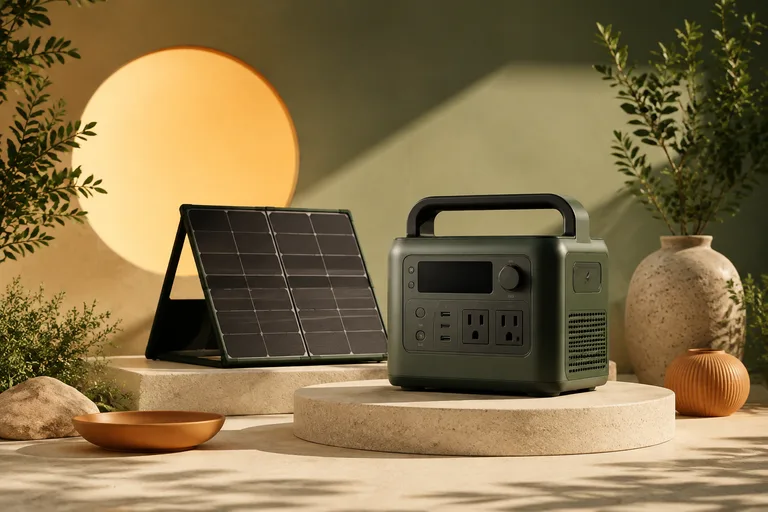
A “solar generator” is not a generator in the same sense as a gasoline, propane or natural-gas generator.
In most consumer products, it is really:
battery + inverter + charger + solar input
The battery stores electricity.
The inverter converts that stored DC energy into AC power for household devices.
Solar panels can then recharge the battery when sunlight is available.
That makes solar generators excellent for:
- silent backup
- electronics
- refrigeration
- short outages
- camping/RV use
- solar-supported off-grid use
- homes where combustion generators are undesirable
But they have one hard constraint that marketing often hides:
stored energy is finite.
A fuel generator can keep creating electricity while fuel remains available.
A solar generator can only deliver what is stored in the battery plus whatever energy can realistically be harvested during the outage.
That distinction is the whole buying decision.
Solar Generator: Quick Verdict
| Factor | Solar Generator / Power Station |
|---|---|
| Fuel | Stored electricity + optional solar |
| Noise | Very low / effectively silent in normal operation |
| Indoor use | Designed for indoor electrical operation where manufacturer permits |
| Carbon monoxide | None from the power station itself |
| Automatic backup | Available on some home systems |
| Small-load backup | Excellent |
| Short outages | Excellent |
| Long high-load outages | Weak unless battery/solar system is large |
| Solar recharge | Weather-dependent |
| Fuel storage | None |
| Routine engine maintenance | None |
| Whole-home capability | Available on larger modular systems |
| Main weakness | Finite kWh |
Our call: if your outage profile is mostly short and you value silence, automatic operation and solar integration, battery-based backup can be excellent.
If you expect multi-day outages while running large HVAC and other heavy loads, a fuel generator usually gives you much more total energy for the money.
What Is a Solar Generator?
The phrase usually describes a portable or modular battery power station that includes:
- rechargeable battery
- inverter
- AC outlets
- DC/USB outputs
- AC charger
- solar charge controller
It may be recharged using:
- wall power
- solar panels
- vehicle charging
- in some systems, a fuel generator
The important part is:
the battery is the energy store.
Solar is only one way of putting energy back into it.
Does a Solar Generator Actually Generate Power?
The solar panels do.
The battery power station stores and converts it.
That is why “solar generator” is convenient marketing language but technically imprecise.
If the battery is empty at midnight:
there is no sunlight available to magically create more electricity.
You need:
- stored battery energy
- another charging source
- or enough daylight later to recharge it
kW vs kWh: The Most Important Solar Generator Distinction
Two numbers control what a battery system can do.
kW = Power
How much electrical load the inverter can supply at one time.
Examples:
- 2 kW
- 5 kW
- 7.2 kW
kWh = Energy
How much electricity the battery can store.
Examples:
- 2 kWh
- 5 kWh
- 15 kWh
A system can have plenty of kW but still have poor runtime because the battery is small.
Example: 7.2 kW Output Does Not Mean Long Runtime
Jackery's current Explorer 5000 Plus has approximately:
- 5.04 kWh battery capacity
- 7.2 kW maximum AC output
- 14.4 kW surge output
- 120/240V capability.
That means it can potentially power fairly heavy loads.
But if the battery only contains about 5 kWh, sustained high loads will empty it quickly.
For example, ignoring conversion losses:
500W Average Load
5.04 ÷ 0.5 =
about 10 hours
1,000W Average Load
5.04 ÷ 1 =
about 5 hours
2,000W Average Load
5.04 ÷ 2 =
about 2.5 hours
5,000W Average Load
5.04 ÷ 5 =
about 1 hour
Real runtime will be somewhat lower because of:
- inverter losses
- reserve limits
- battery-management behaviour
- temperature
- load variation
That is why inverter output and battery capacity must be evaluated separately.
How Long Will a Solar Generator Run a Refrigerator?
This depends on:
- refrigerator duty cycle
- ambient temperature
- battery capacity
- other loads
- inverter efficiency
Suppose a refrigerator averages:
100 watts over time
A 2 kWh usable battery would theoretically provide:
2,000 Wh ÷ 100W = 20 hours
before losses.
But a refrigerator does not draw one fixed amount continuously.
Its compressor cycles.
Startup demand also matters.
So runtime claims based only on the appliance's nameplate are rough planning numbers.
How Long Will a 5 kWh Solar Generator Last?
Approximate theoretical runtime:
| Average Load | 5 kWh Battery |
|---|---|
| 100W | 50 hours |
| 250W | 20 hours |
| 500W | 10 hours |
| 1,000W | 5 hours |
| 2,000W | 2.5 hours |
| 5,000W | 1 hour |
Again, actual runtime will be lower after system losses.
But this table exposes the real issue:
runtime is controlled by average watts, not by how many appliance names the product page lists.
Can a Solar Generator Power a Whole House?
Yes, some current systems can.
But “power a whole house” has two separate meanings:
- enough instantaneous output to run household loads
- enough stored energy to run those loads for the required time
Current large systems can solve #1 surprisingly well.
#2 is much harder.
Jackery Explorer 5000 Plus
Current Jackery specifications include:
- 5,040 Wh battery capacity
- LiFePO4 chemistry
- 7,200W AC output
- 14,400W surge
- 120/240V output
- optional smart transfer equipment
- 12 supported branch circuits through the current smart transfer switch.
That is legitimate home-backup hardware.
But one 5.04 kWh battery is still only 5.04 kWh of nominal stored energy.
The machine can deliver large power.
The duration still depends on how aggressively you use it.
BLUETTI AC500 + B300S
BLUETTI's current AC500/B300S platform provides:
- 5,000W inverter output
- up to 10,000W surge
- 3,072 Wh per B300S battery
- expandable to 18,432 Wh on one AC500
- up to 3,000W solar input
- up to 5,000W AC charging
- up to 8,000W combined AC + solar input.
BLUETTI itself models its larger configurations using a 3 kWh/day emergency household consumption assumption.
That is an important qualifier.
A household limited to 3 kWh/day is operating in a very different mode from a typical all-electric house running central AC normally.
Anker SOLIX F3800 Whole-Home Architecture
Current Anker whole-home equipment around the F3800 platform supports 120/240V architecture.
Its Home Power Panel documentation specifies:
- 6 kW continuous grid-side output
- up to 12 kW continuous backup output in supported paired-system architecture
- 120/240V operation.
Again, this shows that modern battery backup can supply serious power.
The remaining question is:
for how long?
Solar Generator vs Home Battery
The line between these categories is increasingly blurry.
Portable Solar Generator / Power Station
Usually:
- movable
- plug-in
- self-contained
- modular
- can be charged from portable solar panels
Installed Home Battery
Usually:
- permanently wired
- integrated transfer equipment
- automatic
- tied into home solar/grid systems
- designed as part of household electrical architecture
Large products from Jackery, BLUETTI, EcoFlow and Anker increasingly sit between those two categories.
The important comparison is not the label.
It is:
- usable kWh
- continuous kW
- surge capability
- 120/240V support
- transfer architecture
- solar input
- expansion cost
Solar Generator vs Gas Generator
Solar Generator Wins On:
- silence
- no local exhaust
- automatic operation on some systems
- electronics
- minimal engine maintenance
- solar recharge
- indoor electrical use where designed
Gas Generator Wins On:
- continuous energy production
- long outage duration
- very high total kWh through refuelling
- lower cost per unit of prolonged backup energy
If you have:
5 kWh battery
and the house consumes:
20 kWh/day
you have roughly six hours of nominal energy before considering recharge/losses.
A gasoline generator can keep operating as you add fuel.
That is the fundamental difference.
Solar Generator vs Whole-House Standby Generator
For long-duration home resilience:
standby generally wins on energy availability.
For short outages:
battery can be dramatically nicer to own.
A battery system can restore power:
- silently
- quickly
- without engine warmup
- without fuel handling
A standby generator makes noise and needs maintenance, but it can create enormous amounts of energy over multiple days.
Solar Generator vs Portable Generator
This is probably the most interesting comparison.
Battery Power Station
Best when:
- loads are small/moderate
- silence matters
- outage is short
- indoor electronics matter
- solar recharge is available
Portable Fuel Generator
Best when:
- budget matters
- high output matters
- outage could last days
- refuelling is possible
A hybrid approach can be stronger than either alone.
Battery + Fuel Generator: The Underrated Setup
This is arguably one of the best resilience architectures.
Use the battery for:
- overnight
- light loads
- electronics
- short outages
Use the fuel generator to:
- run heavy loads
- recharge battery quickly
- operate when solar is poor
That means the combustion generator does not need to run continuously.
You gain:
- quieter nights
- lower fuel consumption
- less generator runtime
- stored electrical buffer
BLUETTI's current AC500 platform explicitly supports generator charging alongside AC and solar inputs.
Solar Generator + Solar Panels
Solar panels can extend battery runtime.
But never describe solar charging as:
unlimited power.
Actual solar generation changes with:
- panel wattage
- sun angle
- clouds
- season
- shading
- temperature
- charge-controller limits
A 2,000W solar array does not produce 2,000W continuously from sunrise to sunset.
How Much Solar Do You Need?
Start with daily energy consumption.
Suppose emergency loads consume:
5 kWh/day
If your solar system can realistically harvest:
5+ kWh/day
under expected outage conditions, you may be able to maintain the battery over time.
If your emergency loads consume:
20 kWh/day
and portable solar only harvests:
3 kWh/day
the system is still losing:
17 kWh/day
No marketing claim fixes that maths.
Solar Input Rating vs Real Solar Production
A system might advertise:
3,000W solar input
That is the maximum electrical input the system can accept under suitable conditions.
BLUETTI's AC500 supports up to 3,000W of solar charging.
That does not mean:
3 kW × 8 hours = guaranteed 24 kWh/day.
Weather and panel conditions determine real harvest.
Can Solar Recharge a Battery During a Power Outage?
Yes.
That is one of the biggest advantages over a simple standalone battery.
But the solar array must produce enough energy to keep pace with your consumption.
If it does:
the system can potentially sustain critical loads for a very long time.
If it doesn't:
solar merely slows the rate at which the battery empties.
Both outcomes are useful.
They are not the same.
Solar Generator for Hurricanes
Potentially excellent for:
- refrigeration
- communications
- lighting
- electronics
- fans
- modest appliance loads
But hurricanes create a problem:
weather.
Cloud cover and storm conditions can severely reduce solar production exactly when the outage begins.
That means you should size the system around:
stored battery energy first
and treat solar recharge as additional resilience.
Do not build a hurricane plan assuming perfect sunshine the morning after landfall.
Solar Generator for Winter Storms
Same issue.
Winter can mean:
- shorter daylight hours
- poor panel angle
- snow cover
- clouds
If the outage also requires electric heating, energy consumption can be enormous.
Battery + solar is much stronger when the house uses:
- gas heating
- propane heating
- wood heat
and electricity is mainly needed for:
- blower
- pumps
- controls
- refrigeration
- lights
Can a Solar Generator Run Central AC?
Some large battery systems can supply enough power to start and run some air-conditioning systems.
For example, Jackery's current 5000 Plus supplies:
7.2 kW continuous / 14.4 kW surge.
That is meaningful output.
But the energy problem remains.
A central AC averaging 3 kW would theoretically drain a 5.04 kWh battery in well under two hours before accounting for losses.
So the question becomes:
not only:
“Can it start my AC?”
but:
“How many kWh will the AC consume during the outage?”
Can a Solar Generator Run a Refrigerator?
Yes.
This is one of the best use cases.
Refrigeration has relatively modest average energy consumption compared with:
- HVAC
- electric water heating
- cooking
- EV charging
A battery can also power the refrigerator overnight without engine noise.
Can It Run a Furnace?
Often, where the furnace burns:
- natural gas
- propane
- heating oil
and electricity is only required for the blower and controls.
That can make battery backup extremely effective during winter.
Electric resistance heating is a much harder load.
Can It Run a Well Pump?
Potentially, if the system provides:
- correct 120/240V
- sufficient running output
- sufficient surge output
Current Jackery 5000 Plus supports 120/240V and substantial surge capacity, for example.
But calculate the pump's starting load.
Can It Run an Electric Water Heater?
Technically possible with sufficiently powerful systems.
But electric water heating burns through battery energy quickly.
A 4.5 kW water heater running for one hour consumes:
4.5 kWh
That is nearly the entire nominal capacity of a 5.04 kWh Jackery Explorer 5000 Plus.
This is why backup-energy management matters.
Can It Charge an EV?
Some large power stations can supply 240V power suitable for certain charging scenarios.
Commercially, though, EV charging is an enormous backup-energy load.
Adding:
20 kWh
to an EV can consume several times the entire capacity of many large portable power stations.
Unless vehicle charging is essential, protect:
- refrigeration
- water
- heating controls
- communications
first.
How Big a Solar Generator Do I Need?
Use two calculations.
Calculation 1: Maximum Power
What loads might need to run simultaneously?
This determines required:
kW
Calculation 2: Daily Energy
How much electricity will those loads consume per day?
This determines required:
kWh
Do not buy until you have both.
Example Home Emergency Energy Budget
Suppose an outage plan uses:
- refrigerator: 1.5 kWh/day
- freezer: 1.0 kWh/day
- lights: 0.5 kWh/day
- internet/electronics: 0.5 kWh/day
- furnace blower: 2.0 kWh/day
- miscellaneous: 0.5 kWh/day
Total:
6 kWh/day
A 5 kWh-class battery alone does not provide a full day after losses.
But:
10-15 kWh battery + meaningful solar recharge
starts becoming very useful.
That is the level at which battery sizing becomes rational.
How Many kWh Do You Need for One Day of Backup?
There is no universal number.
A highly managed emergency household might consume:
3-6 kWh/day
A normal modern home can easily use:
20-30+ kWh/day
An all-electric home running:
- central AC
- electric water heat
- cooking
- EV charging
can consume far more.
Battery backup gets expensive when you try to preserve normal grid behaviour instead of emergency loads.
Information Gain: Think in kWh per Day
This is the calculation that makes most “best solar generator” lists useless.
Do not start with:
“Which EcoFlow/Jackery/BLUETTI should I buy?”
Start with:
How many kWh per day must survive?
Then solve:
required output kW + required storage kWh + realistic daily solar harvest
The brand comes afterwards.
Expandable Solar Generators
Modern power stations increasingly support expansion batteries.
That changes the category substantially.
BLUETTI AC500 supports up to:
18.432 kWh
with six B300S batteries on one system.
Two AC500 systems can reach:
36.864 kWh
in the represented architecture.
At that point you are no longer discussing a glorified camping battery.
You are building a real home energy-storage system.
Is 10 kWh Enough?
For emergency loads:
potentially.
If emergency consumption is:
5 kWh/day
then 10 kWh nominal storage represents approximately:
two days before losses/recharge.
If the house consumes:
25 kWh/day
then it represents less than half a day.
Same battery.
Completely different outcome.
Is 20 kWh Enough?
For a well-managed home, 20 kWh can be substantial.
For an all-electric home trying to live normally, it may disappear surprisingly quickly.
Again:
kWh/day decides.
LiFePO4 Batteries
Many current power stations use lithium iron phosphate battery chemistry.
Jackery's Explorer 5000 Plus currently uses LiFePO4 and publishes:
4,000 cycles to 70%+ capacity.
BLUETTI's B300S platform also uses a long-cycle-life battery architecture and currently advertises 3,500+ life cycles.
Cycle-life claims should always be read with:
- remaining-capacity threshold
- test conditions
- temperature
- charge/discharge behaviour
in mind.
Do not convert cycle count directly into an exact number of years.
Solar Generator Charging From the Grid
Fast AC charging matters more than people realise.
If the grid returns for a few hours during a rolling outage, a system that charges quickly can rebuild its reserve.
BLUETTI's AC500 currently supports:
- up to 5,000W AC charging
- up to 8,000W combined AC + solar charging in supported configurations.
That can be operationally more useful than adding another 200W folding panel.
UPS / Automatic Backup
Some modern power stations can act as UPS or integrated home-backup systems.
Jackery's current 5000 Plus can work with its smart transfer switch for selected household circuits, with current switch specifications listing UPS transfer at ≤20 ms.
BLUETTI's AC500 likewise advertises 24/7 UPS functionality.
This is a major battery advantage over a manually deployed portable fuel generator.
Can a Solar Generator Be Used Indoors?
The battery power station itself does not produce combustion exhaust during normal battery operation.
That makes indoor use possible where the manufacturer permits.
Solar panels obviously need access to sunlight.
If you charge the battery using a fuel generator, that generator still belongs outdoors.
Do not bring a combustion generator inside because the battery charging cable reaches it.
Solar Generator Maintenance
Battery power stations eliminate most combustion-engine maintenance.
No:
- engine oil
- spark plug
- carburettor
- fuel filter
- exhaust
But they still require:
- battery care
- firmware/software where applicable
- connector inspection
- suitable storage temperature
- periodic state-of-charge management according to manufacturer guidance
Less maintenance does not mean zero ownership considerations.
Solar Generator Lifespan
Do not define lifespan from years alone.
Battery systems age through:
- charge cycles
- calendar ageing
- temperature
- high/low state of charge
- power demand
Manufacturers increasingly publish cycle-life specifications.
Use those instead of fake universal statements such as:
“Every solar generator lasts ten years.”
Solar Generator Cost
The category ranges from:
- several hundred dollars for small power stations
- into thousands for 5 kWh-class products
- into five figures for heavily expanded whole-home systems
That means battery backup can beat a generator economically at small scale and become dramatically more expensive as you chase multi-day whole-house energy.
The cost curve is fundamentally different.
Why Batteries Get Expensive Fast
Adding generator runtime can be as simple as adding:
more fuel.
Adding battery runtime means buying:
more battery cells.
Suppose you need an extra:
20 kWh
of outage energy.
A fuel generator can produce it by burning additional fuel.
A battery system needs approximately another 20 kWh of stored/recharged electrical energy.
That is why generators dominate long-duration high-energy backup economics.
Solar Generator Federal Tax Credit in 2026
Do not assume the old federal 30% Residential Clean Energy Credit still applies to a new 2026 purchase.
For expenditures made after December 31, 2025, the federal Residential Clean Energy Credit under §25D is no longer available following the 2025 legislative change.
That matters because a lot of older solar/battery content still tells shoppers to subtract 30% from the purchase price.
For a 2026 buying decision, that is stale guidance.
State, utility or other local incentives may still exist.
Best Solar Generator for Small Emergency Loads
I would look around:
1-3 kWh storage
with adequate inverter capacity for:
- refrigerator
- lights
- internet
- electronics
This is where power stations are incredibly strong.
You get silent backup without having to run a combustion engine all night.
Best Solar Generator for Broader Home Backup
I'd move toward:
- 5+ kWh base capacity
- expansion capability
- 120/240V
- meaningful surge output
- integrated transfer equipment
- 2-3+ kW potential solar input
Current Jackery 5000 Plus, BLUETTI AC500 architecture and Anker F3800-class systems live in this broader home-backup conversation.
Best Solar Generator for Multi-Day Backup
Do not choose from battery size alone.
You need:
battery capacity + realistic solar harvest + daily emergency consumption
For example:
If you consume:
5 kWh/day
and reliably harvest:
5 kWh/day
a large enough battery can potentially maintain critical loads for a prolonged period.
If you consume:
15 kWh/day
but harvest:
4 kWh/day
you have an:
11 kWh/day deficit.
Eventually the battery empties.
Solar Generator for Off-Grid Use
This is one of the strongest use cases.
Battery + solar works particularly well when daily consumption is designed around available energy.
That means:
- efficient appliances
- controlled HVAC
- low standby loads
- energy-aware behaviour
Off-grid living is much easier when load is engineered to the energy system rather than assuming unlimited grid-style consumption.
Solar Generator for Camping
Excellent.
Small solar generators are nearly ideal for:
- phones
- laptops
- lighting
- portable fridges
- CPAP machines
- cameras
- small appliances
No combustion generator needs to run beside the campsite for low loads.
Solar Generator for RV
Also strong.
Especially when paired with:
- rooftop solar
- alternator charging
- shore-power charging
The battery becomes the central energy buffer.
Fuel generator can remain a backup rather than the primary electrical source.
Solar Generator for CPAP
Strong use case, but calculate actual overnight consumption.
A small battery can often cover a CPAP far more comfortably than running a fuel generator overnight.
Check:
- humidifier/heated hose consumption
- DC vs AC operation
- battery reserve
rather than relying on generic “X nights” marketing.
Solar Generator Safety
Battery systems avoid carbon-monoxide risk from combustion during normal operation.
But battery products still need to be used according to manufacturer requirements involving:
- ventilation
- moisture
- temperature
- charging
- damaged battery packs
- electrical connections
Do not use physically damaged or swollen battery equipment.
For integrated home systems, electrical transfer equipment should be installed appropriately.
Questions to Ask Before Buying a Solar Generator
- What is the usable battery capacity in kWh?
- What is continuous AC output?
- What is surge output?
- Is it 120V only or 120/240V?
- Can batteries be expanded?
- What is maximum solar input?
- What solar voltage/current range is supported?
- What is maximum AC charging rate?
- Can it charge from a fuel generator?
- Can it integrate with a home transfer switch?
- What circuits can the transfer system support?
- What battery chemistry does it use?
- What cycle-life claim does the manufacturer publish?
- What is my calculated emergency consumption in kWh/day?
- What is realistic solar harvest during the outage season?
Number 14 is more important than the logo on the box.
Solar Generator FAQ
What is a solar generator?
Usually a battery power station with an inverter and solar-charging input rather than an engine-driven electrical generator.
Does a solar generator work at night?
Yes, using electricity stored in its battery. Solar panels cannot recharge it from sunlight at night.
Can a solar generator power a whole house?
Large systems can supply whole-home or selected-home loads, but runtime depends on battery kWh and electrical consumption.
How long will a 5 kWh solar generator last?
At a theoretical 500W average load, about 10 hours before losses. At 1 kW, roughly five hours. At 2 kW, roughly 2.5 hours.
Can a solar generator run a refrigerator?
Yes. Refrigeration is one of the strongest battery-backup use cases.
Can a solar generator run central AC?
Some high-output systems can start and run some AC equipment, but air conditioning can consume battery energy very quickly.
Can a solar generator run a well pump?
Potentially, if the system supplies the required voltage, continuous output and startup surge.
Is a solar generator better than a gas generator?
For silence, short outages, electronics and solar integration, yes. For prolonged high-energy outages, fuel generators usually provide substantially more energy for the money.
Do solar generators need fuel?
No combustion fuel during battery operation. They require stored electrical energy and a charging source such as grid power or solar.
Can solar panels keep a solar generator running forever?
Only if real solar production keeps pace with consumption over time. Weather, season, shading and panel size determine whether that happens.
Is 5 kWh enough for home backup?
It can be excellent for managed essential loads. It is small relative to normal daily consumption in many modern homes.
Is a solar generator safe indoors?
Battery power stations do not create combustion exhaust in normal operation and can be used according to manufacturer indoor-use instructions. Combustion generators used to recharge them still belong outside.
Is there still a 30% federal battery tax credit in 2026?
Do not assume so. The federal Residential Clean Energy Credit no longer applies to expenditures after December 31, 2025. Check current state/local incentives separately.
Final Verdict
“Solar generator” is useful shorthand, but buy it as what it really is:
a battery energy system that can be recharged by solar.
That means you need to solve two different problems.
Power
How many:
kW
must the system provide at once?
Energy
How many:
kWh
do you need to survive the outage?
The second number is usually where people screw this up.
A 7.2 kW inverter sounds enormous.
But paired with 5 kWh of battery, a sustained 5 kW load can theoretically empty that battery in about an hour.
So my buying call is:
Short Outages + Essential Loads
Solar generator/battery is excellent.
Quiet Overnight Backup
Excellent.
Refrigeration + Internet + Lights + Gas-Furnace Blower
Very strong use case.
Long Multi-Day Outage + Central AC + Heavy Electrical Loads
Fuel generator usually wins the economics.
Premium Resilience
Battery + solar + fuel generator is arguably better than choosing either technology alone.
The battery handles:
- silence
- instant power
- light loads
The generator handles:
- prolonged energy production
- bad solar weather
- heavy loads
- rapid recharge
And solar stretches the battery/fuel reserve whenever conditions cooperate.
The buying sequence should be:
calculate maximum kW → calculate kWh/day → decide outage duration → estimate realistic solar harvest → size battery → size inverter → compare against fuel-generator/hybrid economics.
Do that before comparing brands.
Otherwise you're shopping for a battery based on how many pictures of refrigerators appear on the product page.
Evidence Basis
Current large-system specifications were checked against active manufacturer sources.
Jackery's current Explorer 5000 Plus provides approximately 5.04 kWh battery capacity, 7.2 kW continuous AC output, 14.4 kW surge and 120/240V capability, with an optional smart transfer architecture.
BLUETTI's current AC500/B300S platform provides 5 kW inverter output, 10 kW surge, starts from 3.072 kWh battery capacity and can expand to 18.432 kWh on one AC500, with up to 3 kW solar input and 8 kW combined AC/solar charging in supported configurations.
Current Anker F3800 home-panel architecture supports 120/240V operation and larger paired backup configurations, demonstrating how far portable/modular battery systems have moved into genuine household backup territory.